

Many families install an AAC app with real hope. A few weeks later, the tablet is on a shelf. Nobody decided to give up. Life just got busy.
This is common, and it is rarely the app's fault. Research points to other reasons: a lack of support, adults who are not on board, and the feeling that AAC is one more job on a long list.
The good news is that research also shows what helps. This article sums up what studies say about using AAC at home, and how we built those findings into RomaTalk. Every claim has a source at the end.
How often do families stop?
Exact numbers for AAC apps are hard to find. But the picture for assistive technology in general is clear.
| What was measured | Result | Source |
|---|---|---|
| Assistive devices that adults stopped using completely | 29.3% | Phillips & Zhao, 1993 |
| AAC abandonment, as summarised by ASHA | about one third of cases | ASHA Practice Portal |
| The main factors behind abandonment, according to 275 AAC specialists | lack of training, lack of support, poor fit, a system that was not kept up to date | Johnson et al., 2006 |
The American Speech-Language-Hearing Association (ASHA) puts it plainly: "Lack of family involvement in the AAC process is cited as a significant factor in device abandonment."
Why families stop: their own words
The most useful research here comes from Australia. Moorcroft, Scarinci and Meyer interviewed parents who had stopped using AAC, and specialists who had seen it happen.
The title of one paper is a quote from a parent: "We were just kind of handed it and then it was smoke bombed by everyone."
| Theme | What it looks like at home |
|---|---|
| Parents felt unsupported | The system arrived, but nobody showed how to use it in real life. |
| Professionals' attitudes shaped decisions | Doubt from one expert was enough to make a parent doubt the whole idea. |
| Poor communication between the adults around the child | School, home and specialists used AAC differently, or not at all. |
| No supportive community | Grandparents and other relatives were not involved. |
| The capacity of and demands on parents | Tiredness, stress and too many other tasks. |
None of these are about the app. They are about support, people and time. So an app that wants to be used at home has to help the parent, not just the child.
What actually helps with AAC at home: the adult shows
Children learn spoken language by hearing it for years before they speak. Picture cards work the same way. A child needs to see someone else use the cards many times before starting on their own.
Researchers call this aided language modeling, aided language input, or partner augmented input. In plain words: you talk as usual, and you tap the key word on the device as you say it. "Want more?" and you tap "More".
This is the best studied thing a parent can do at home:
- O'Neill, Light and Pope (2018) pooled 28 studies. Approaches that included aided AAC input were "highly effective" for both understanding and expression.
- Biggs, Carter and Gilson (2018) reviewed 48 studies with 267 children and young people. Modeling approaches were "generally effective" at improving expressive communication.
- Kent-Walsh and colleagues (2015) looked at training the adults around the child. Partner training was "highly effective". The three skills taught most often were aided modeling, expectant delay (waiting), and open-ended questions.
An honest note: these studies show what helps on average. They do not promise that every child will start tapping, or that it will happen quickly. But of everything a parent can do at home, modeling has the strongest evidence.
So the habit worth building is not "my child uses the app". It is "I show the cards for a minute, at the same moment every day".
How long does a habit take? Not 21 days
You have probably heard that a habit takes 21 days. That number comes from a 1960 self-help book by a plastic surgeon, Maxwell Maltz. He wrote that it takes "a minimum of about 21 days to effect any perceptible change in a mental image." He was talking about patients getting used to their new faces. Over the years, the "minimum" disappeared from the retelling.
Real studies say something different:
| Study | What it found |
|---|---|
| Lally et al., 2010: 96 adults, one daily behaviour tied to a daily cue such as "after breakfast", 12 weeks | On average 66 days to form the habit. Individual times ranged from 18 to 254 days. |
| Same study | "Missing one opportunity to perform the behaviour did not materially affect the habit formation process." |
| Singh et al., 2024: systematic review, 20 studies, 2,601 people | Median times of 59 to 66 days, with individual times from 4 to 335 days. |
Two things follow for parents:
- Expect about two months, not three weeks. If it feels slow after a month, nothing is wrong.
- A missed day does not break anything. Illness, a trip or a bad night are part of family life.
Why a moment of the day beats an alarm
"I'll use the cards more" is a good intention. It also gets lost by Tuesday.
A plan with a trigger works much better. Psychologists call it an implementation intention: "When X happens, I will do Y." For example: "When we sit down for breakfast, I'll show one card while I talk."
- Gollwitzer and Sheeran (2006) analysed 94 independent tests of this kind of plan. The effect on reaching goals was "of medium-to-large magnitude (d = .65)".
- Wood and Neal (2007) describe habits as links between a situation and an action. After enough repetition, the situation itself starts the action.
What about phone alarms? Stawarz, Cox and Blandford (2015) compared types of cues in a four-week study. Relying on reminders "supported repetition but hindered habit development, while the use of event-based cues led to increased automaticity."
In other words, a reminder at 8:00 gets you to do it today. Tying it to breakfast gets you to do it without thinking, a few weeks from now.
That is why we ask parents to choose a moment of the day, not a time on the clock. Breakfast, bath time, getting dressed, the drive to nursery. These moments happen anyway. And the child already wants something in them, so the card makes sense. "More" at a meal is clearer than "More" on command.
How many reminders? Fewer than you think
Parents get a lot of notifications. So we looked at research on texting parents of young children.
| Study | What it found |
|---|---|
| York, Loeb & Doss, 2019: READY4K, an 8 month text programme for parents of preschoolers | Parent involvement at home and school rose by 0.15 to 0.29 standard deviations. Children's early literacy rose by about 0.11. |
| Cortes et al., 2021: 1, 3 or 5 texts a week | "A single text per week is not as effective at improving parenting practices as a set of three texts". Five texts a week were not better than three either. |
| Mayer et al., 2019: text reminders plus goal setting plus small social rewards | Parents' use of a reading app rose by one standard deviation in six weeks. |
These studies are about reading, not AAC. But the pattern is useful: a few short, concrete messages a week beat both one and many. The three text set that worked best combined a fact, a tip, and encouragement.
Track progress, but never with a streak
Seeing your own progress helps. Harkin and colleagues (2016) pooled 138 experiments with almost 20,000 people. Monitoring progress improved goal attainment (d = 0.40). The effect was larger "when the information was physically recorded".
Streaks are a different story. Silverman and Barasch (2023) ran seven studies on streaks. An intact streak keeps people going. A broken one makes them pull back, especially when they blame themselves.
That matters a lot for this audience. Hayes and Watson (2013) found that parents of autistic children report much higher parenting stress than other parents, with a large effect size. A red "You broke your 12 day streak!" is the last thing a tired parent needs.
So the rule is simple: count what happened, reset nothing, blame no one.
Bring the family in
Parents in the Moorcroft studies named the lack of a supportive community as a reason to stop. And Kent-Walsh's review showed that partner training works for parents, teachers and other adults alike.
If grandma, the nanny and the teacher all show the same word in the same way, the child sees it far more often. And the parent is not carrying it alone.
How RomaTalk builds this into everyday life
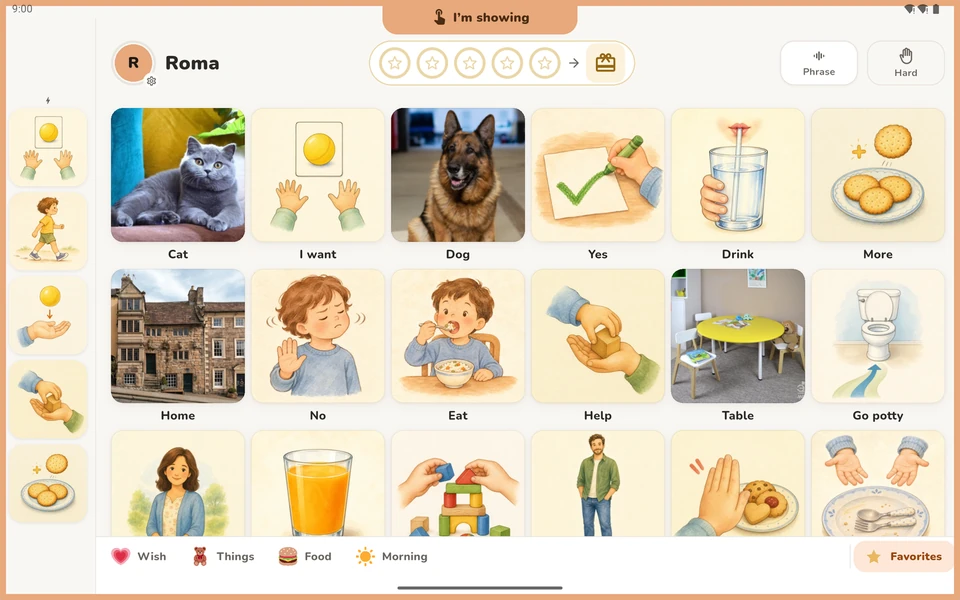
RomaTalk has a section in the parent area called "Every day". Every feature in it comes from the research above. Everything works on the device, without internet or an account.
| Feature | What it does | The research behind it |
|---|---|---|
| My moment | You pick one or two everyday moments and one small action for each | Gollwitzer & Sheeran 2006; Wood & Neal 2007; Lally 2010 |
| Reminders | A short tip at your moment, about 3 times a week, fewer after 8 weeks | Cortes 2021; York 2019; Stawarz 2015 |
| How the week went | A Monday summary: days with cards, new words, the word your child returns to | Harkin 2016; Silverman & Barasch 2023 |
| Word of the week | One word you show all week, with three steps: show, wait, respond | Kent-Walsh 2015; O'Neill 2018 |
| Sheet for family | A one-page PDF for grandparents, a nanny or a teacher | Moorcroft 2020; Kent-Walsh 2015 |
| The first 8 weeks | Eight short lessons, one a week | Lally 2010; Singh 2024; York 2019 |
| Why this works | Short articles that explain each feature, with links to the studies | ASHA; all of the above |
| I'm showing | A mode where your taps don't count in the child's statistics | O'Neill 2018; Biggs 2018 |
Here is how it looks in practice.
Step 1. Choose your moment
During setup, RomaTalk asks you to pick a moment for the cards. You can choose from everyday moments or add your own. Each one comes with a small suggested action, like "Say 'Want more?' and tap 'More'."
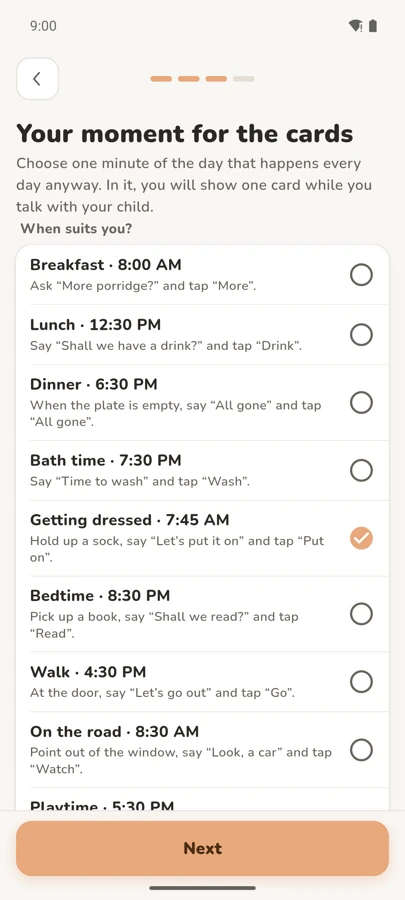
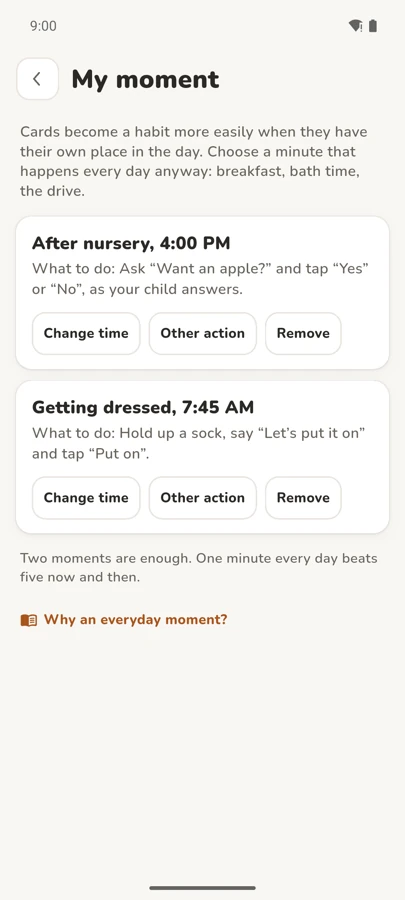
Your choice becomes a plan in the "when X, I will do Y" form: "After nursery, I'll show one card while I talk." Two moments is the maximum. As the app puts it: "One minute every day beats five now and then."
Step 2. Get a few gentle reminders
Reminders are off until you turn them on. When you do, the default is about 3 times a week, at your moment. You can choose once a week, once a day or twice a day instead.
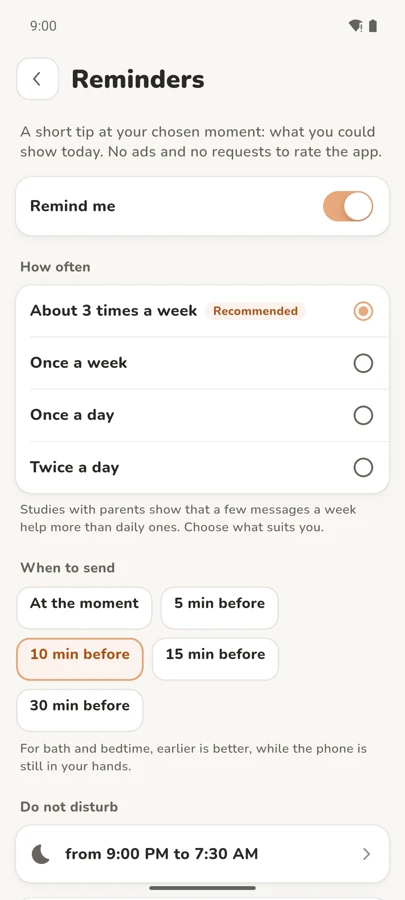
A few details matter here:
- Lead time. You can get the tip at the moment itself, or 5 to 30 minutes before. For bath and bedtime, earlier is better, while the phone is still in your hands.
- Do not disturb. Quiet hours, for example from 9:00 PM to 7:30 AM.
- Rotation. Tips, facts and encouragement take turns, so the same message does not keep coming back.
- Fewer after 8 weeks. Once the moment has become a habit, reminders thin out. The goal is a habit that works without them.
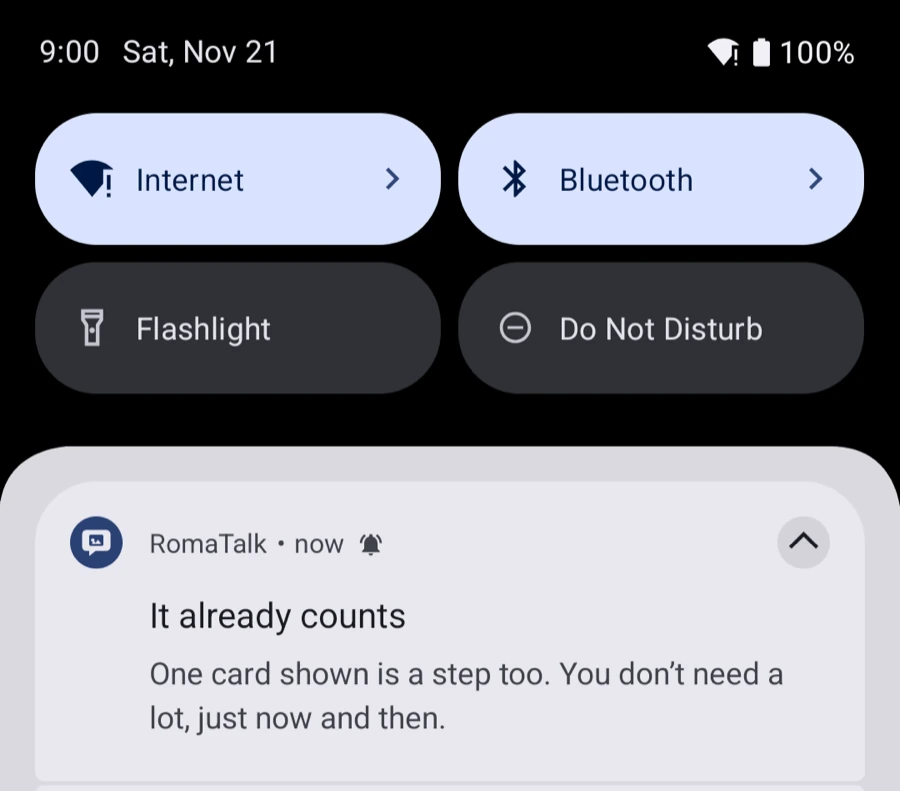
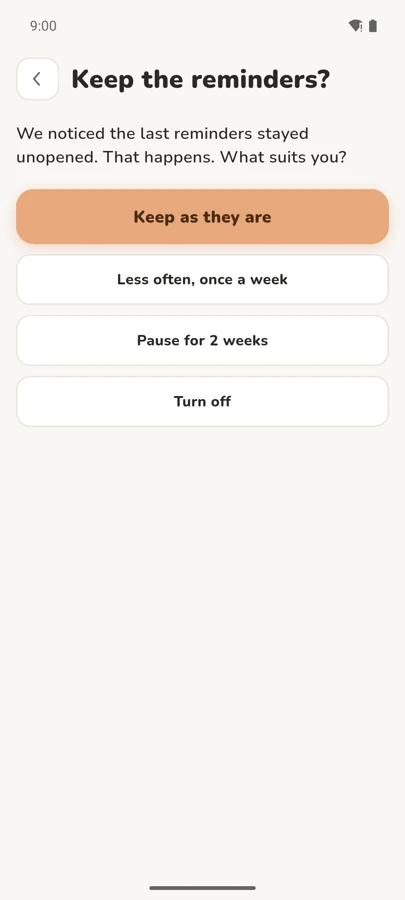
If the last few reminders stay unopened, RomaTalk does not send more. It asks once: keep them, get them less often, pause for two weeks, or turn them off.
Step 3. See how the week went
Every Monday, a short summary appears in the parent area. It shows how many days had cards, which cards your child tapped for the first time, and the word your child came back to most often.
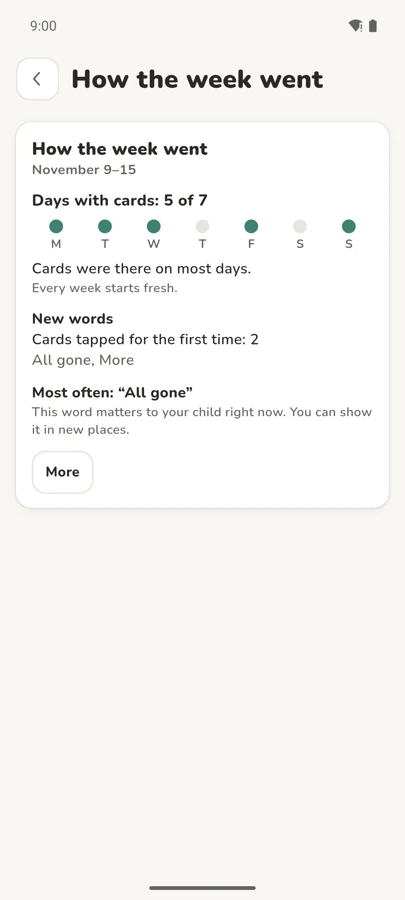
There are no red zeros and no "you missed". The line under the dots says "Every week starts fresh." A quiet week gets a kind note instead: illness, a trip and tiredness happen.
Step 4. Pick a word of the week
One word, shown all week, wherever it fits. "More", "Help", "All gone", "I want". The screen "How to show" turns the three partner skills from the research into three steps:
- Show. When a jar won't open, say "Help" and tap "Help".
- Wait. Hold out your hand and wait.
- Respond. Help right away: "I'm helping."
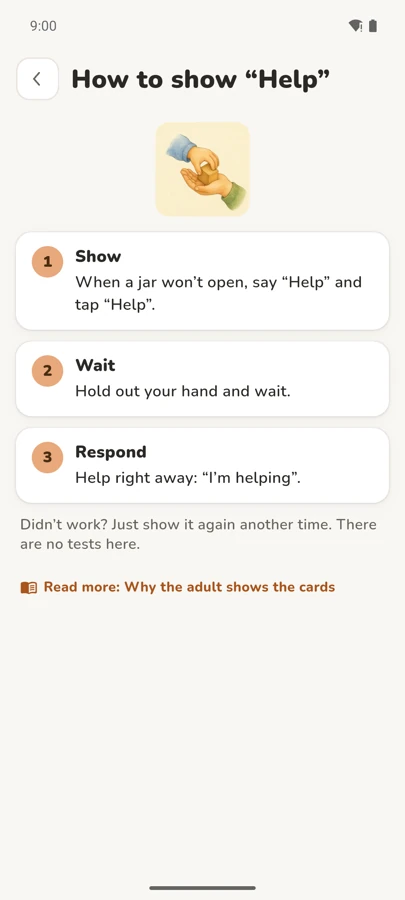
The word of the week also goes into the reminders and onto the family sheet.
Step 5. Share it with family
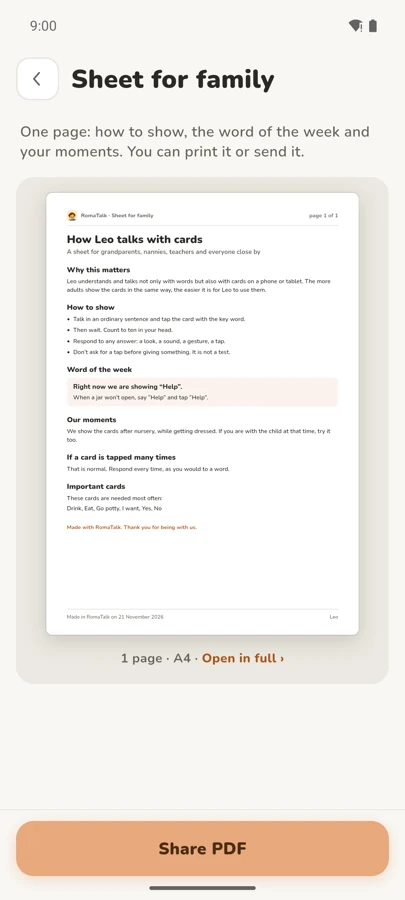
"Sheet for family" makes a one-page PDF: how to show the cards, this week's word, and your everyday moments. Print it for the fridge, or send it to a grandparent, a nanny or a teacher.
Step 6. Take the first 8 weeks one lesson at a time
"The first 8 weeks" is a short course: one lesson a week, a minute or two to read, and one small task. The lessons are:
- What showing means
- Don't make them tap
- Wait ten seconds
- Welcome every tap
- A new everyday moment
- Bring in family and friends
- Your own photo on a card
- What next
You tick a task when you've tried it. You can open the next lesson early. Nothing is locked and nothing is lost if a week doesn't work out.
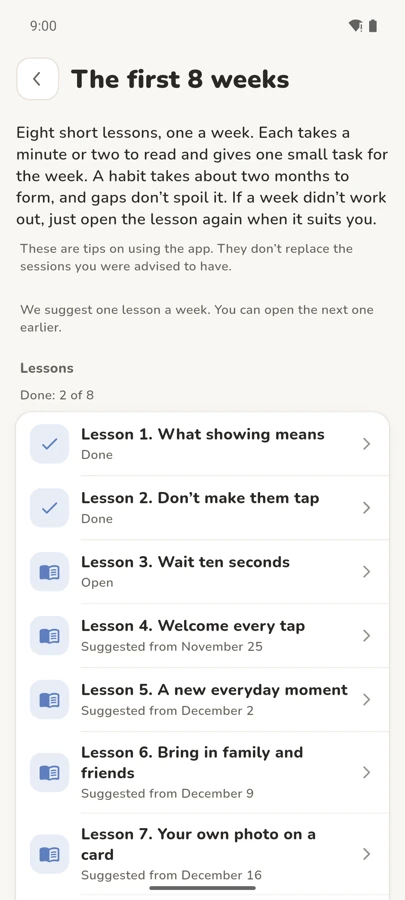
The course length is no accident. Eight weeks is close to the 59 to 66 days that habit studies report.
Step 7. Read why it works
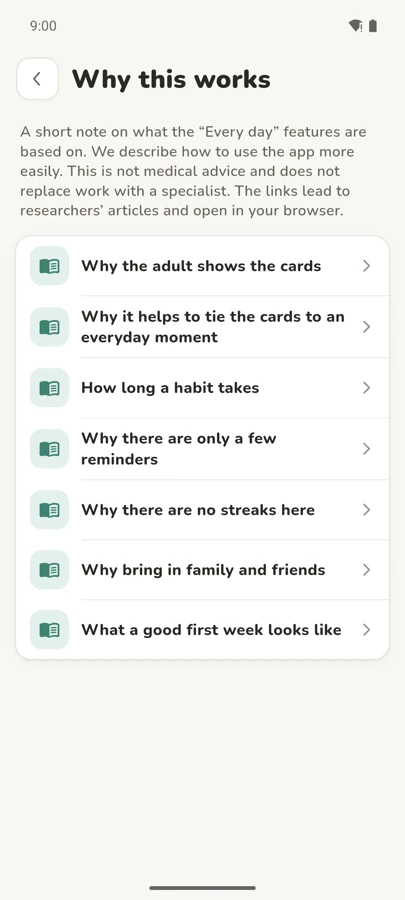
Parents deserve to know why an app asks them to do something. "Why this works" is a set of short articles in plain words. They cover why the adult shows the cards, why a moment of the day helps, how long a habit takes, why there are only a few reminders, and why there are no streaks. Each one links to the studies behind it.
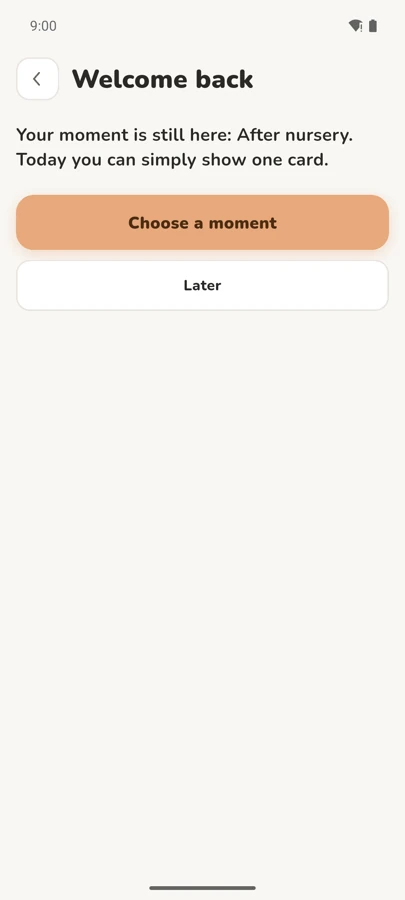
After a break: welcome back
Sooner or later, there will be a gap. After a week or more away, RomaTalk does not count what you missed. It says "Welcome back" and suggests starting again with one minute.
Your first week, in practice
| Day | What to do | Time |
|---|---|---|
| Monday | Choose one moment, for example breakfast. Pick a word of the week, for example "More". | 2 minutes |
| Tuesday to Sunday | At breakfast, say "More?" and tap "More" while you talk. Then wait. | 1 minute |
| Any day | Read lesson 1, "What showing means". | 2 minutes |
| Any day | If you can, send the family sheet to one other adult. | 1 minute |
| Next Monday | Look at "How the week went". Keep the word or choose a new one. | 1 minute |
That's it. No tests, no "show me where", no pressure on your child to tap. Your child's job is to watch. Yours is to show.
FAQ
How do I use AAC at home without it feeling like extra work?
Tie it to something you already do every day, like breakfast or bath time. Show one card while you talk, for about a minute. Research on habits shows that repeating one small action in the same situation works better than big plans.
How long until it becomes a habit?
Usually around two months, not 21 days. In the best known study, it took 66 days on average, with a wide range from 18 to 254 days. Missing a day did not break the habit.
Should my child be the one tapping?
Not at first. The most studied approach is aided language modeling: the adult taps the cards while talking. Children learn the cards by watching, just as they learn speech by listening.
How many reminders should I get?
In studies with parents of young children, three short messages a week worked better than one or five. RomaTalk uses about three a week by default, and you can change that.
Does RomaTalk need the internet for reminders?
No. Reminders are local notifications planned on your phone. RomaTalk works offline, with no account and no ads.
Sources
- Phillips, B., & Zhao, H. (1993). Predictors of assistive technology abandonment. Assistive Technology, 5(1), 36-45. https://doi.org/10.1080/10400435.1993.10132205
"Results showed that 29.3% of all devices were completely abandoned."
- American Speech-Language-Hearing Association. Augmentative and Alternative Communication (Practice Portal). https://www.asha.org/practice-portal/professional-issues/augmentative-and-alternative-communication/
"Lack of family involvement in the AAC process is cited as a significant factor in device abandonment."
- Johnson, J. M., Inglebret, E., Jones, C., & Ray, J. (2006). Perspectives of speech language pathologists regarding success versus abandonment of AAC. Augmentative and Alternative Communication, 22(2), 85-99. https://pubmed.ncbi.nlm.nih.gov/17114167/
Abandonment was most often linked to "Not Maintaining/Adjusting the System, Attitude, Lack of Training, Lack of Support, and Poor Fit."
- Moorcroft, A., Scarinci, N., & Meyer, C. (2020). "We were just kind of handed it and then it was smoke bombed by everyone": How do external stakeholders contribute to parent rejection and the abandonment of AAC systems? International Journal of Language & Communication Disorders, 55(1), 59-69. https://doi.org/10.1111/1460-6984.12502
Themes included that "parents did not feel supported by SLPs".
- Moorcroft, A., Scarinci, N., & Meyer, C. (2019). Speech pathologist perspectives on the acceptance versus rejection or abandonment of AAC systems for children with complex communication needs. Augmentative and Alternative Communication, 35(3), 193-204. https://doi.org/10.1080/07434618.2019.1609577
Themes included "Support Networks Around Parents" and "The Capacity of and Demands on Parents".
- O'Neill, T., Light, J., & Pope, L. (2018). Effects of interventions that include aided augmentative and alternative communication input on the communication of individuals with complex communication needs: A meta-analysis. Journal of Speech, Language, and Hearing Research, 61(7), 1743-1765. https://doi.org/10.1044/2018_JSLHR-L-17-0132
Such interventions "were found to be highly effective across participants of various ages, disabilities, and language skills."
- Biggs, E. E., Carter, E. W., & Gilson, C. B. (2018). Systematic review of interventions involving aided AAC modeling for children with complex communication needs. American Journal on Intellectual and Developmental Disabilities, 123(5), 443-473. https://pubmed.ncbi.nlm.nih.gov/30198767/
"Interventions were generally effective at improving diverse measures of expressive communication."
- Kent-Walsh, J., Murza, K. A., Malani, M. D., & Binger, C. (2015). Effects of communication partner instruction on the communication of individuals using AAC: A meta-analysis. Augmentative and Alternative Communication, 31(4), 271-284. https://doi.org/10.3109/07434618.2015.1052153
"Aided AAC modeling, expectant delay, and open-ended question asking were the most frequently targeted communication partner interaction skills."
- Gardner, B. (2012). Busting the 21 days habit formation myth. UCL Behavioural Science & Health blog. https://blogs.ucl.ac.uk/bsh/2012/06/29/busting-the-21-days-habit-formation-myth/
Quoting Maltz (1960): "It usually requires a minimum of about 21 days to effect any perceptible change in a mental image."
- Lally, P., van Jaarsveld, C. H. M., Potts, H. W. W., & Wardle, J. (2010). How are habits formed: Modelling habit formation in the real world. European Journal of Social Psychology, 40(6), 998-1009. https://doi.org/10.1002/ejsp.674
"Missing one opportunity to perform the behaviour did not materially affect the habit formation process."
- Singh, B., Murphy, A., Maher, C., & Smith, A. E. (2024). Time to form a habit: A systematic review and meta-analysis of health behaviour habit formation and its determinants. Healthcare, 12(23), 2488. https://pmc.ncbi.nlm.nih.gov/articles/PMC11641623/
Reported median times "ranging from 59-66 days", with "substantial individual variability (4-335 days)".
- Gollwitzer, P. M., & Sheeran, P. (2006). Implementation intentions and goal achievement: A meta-analysis of effects and processes. Advances in Experimental Social Psychology, 38, 69-119. https://doi.org/10.1016/S0065-2601(06)38002-1
"Implementation intentions had a positive effect of medium-to-large magnitude (d = .65) on goal attainment."
- Wood, W., & Neal, D. T. (2007). A new look at habits and the habit-goal interface. Psychological Review, 114(4), 843-863. https://doi.org/10.1037/0033-295X.114.4.843
- Stawarz, K., Cox, A. L., & Blandford, A. (2015). Beyond self-tracking and reminders: Designing smartphone apps that support habit formation. Proceedings of CHI 2015, 2653-2662. https://doi.org/10.1145/2702123.2702230
"Relying on reminders supported repetition but hindered habit development, while the use of event-based cues led to increased automaticity."
- York, B. N., Loeb, S., & Doss, C. (2019). One step at a time: The effects of an early literacy text-messaging program for parents of preschoolers. Journal of Human Resources, 54(3), 537-566. https://www.nber.org/papers/w20659
The programme "increased parental involvement at home and school by 0.15 to 0.29 standard deviations".
- Cortes, K. E., Fricke, H., Loeb, S., Song, D. S., & York, B. N. (2021). Too little or too much? Actionable advice in an early-childhood text messaging experiment. Education Finance and Policy, 16(2), 209-232. https://www.nber.org/papers/w24827
"A single text per week is not as effective at improving parenting practices as a set of three texts".
- Mayer, S. E., Kalil, A., Oreopoulos, P., & Gallegos, S. (2019). Using behavioral insights to increase parental engagement: The Parents and Children Together intervention. Journal of Human Resources, 54(4), 900-925. https://www.nber.org/papers/w21602
"The treatment increased usage of the reading application by one standard deviation after the six-week intervention."
- Harkin, B., Webb, T. L., Chang, B. P. I., et al. (2016). Does monitoring goal progress promote goal attainment? A meta-analysis of the experimental evidence. Psychological Bulletin, 142(2), 198-229. https://doi.org/10.1037/bul0000025
Progress monitoring had larger effects "when the information was physically recorded."
- Silverman, J., & Barasch, A. (2023). On or off track: How (broken) streaks affect consumer decisions. Journal of Consumer Research, 49(6), 1095-1117. https://doi.org/10.1093/jcr/ucac029
"Intact streaks highlighted via behavioral logs increase consumers' subsequent engagement in that behavior."
- Hayes, S. A., & Watson, S. L. (2013). The impact of parenting stress: A meta-analysis of studies comparing the experience of parenting stress in parents of children with and without autism spectrum disorder. Journal of Autism and Developmental Disorders, 43, 629-642. https://doi.org/10.1007/s10803-012-1604-y
The comparison with families of typically developing children "resulted in a large effect size."
RomaTalk is a communication and learning tool. Parents can also keep private notes and see simple counts of what they recorded, and read general information written for parents. It is not a medical device, and it does not diagnose, assess or treat anything.
 Vistadose
 TwoPillows
 Calmanota