

It's the question almost every parent asks before trying picture cards or a talking app: if my child can tap a picture, will they stop trying to talk? So, does AAC delay speech? The short answer from four decades of research is no. Studies keep finding the opposite worry is the one to drop.
Below is what the research actually shows, what it doesn't promise, and how to use an AAC app so that spoken words stay part of every exchange.
Why parents worry
The fear makes sense. If a child gets juice by tapping a card, why would they work on saying "juice"? It sounds like a shortcut that could become a habit.
The American Speech-Language-Hearing Association (ASHA) lists this exact belief among the common misconceptions about augmentative and alternative communication. Its AAC practice portal notes that families may believe "AAC reduces motivation to improve natural speech and delays language development", and answers that "AAC use may help improve natural speech when used in a multimodal approach." Multimodal simply means the child uses everything available: gestures, sounds, words, pictures.
Does AAC delay speech? What the studies found
Researchers have looked at this question many times, with children and adults, with signs, picture systems and speech devices. Here are the strongest summaries.
A research review of 23 studies (2006). Millar, Light and Schlosser pulled together studies from 1975 to 2003 that measured speech before, during and after AAC was introduced. In the six studies with the most rigorous design, covering 27 people aged 2 to 60, none showed a decrease in speech. 11% showed no change and 89% showed gains in speech. The authors add that the gains were mostly modest.
A systematic review focused on autism (2008). Schlosser and Wendt reviewed nine single-case studies and two group studies of children with autism. Their conclusion: AAC does not impede speech production, and most studies reported an increase. They also ask for realistic expectations, because the gains were modest.
A randomized study with toddlers (2010). Romski and colleagues worked with 68 toddlers with developmental delays who said fewer than 10 words. Families were coached in one of three approaches, two of them with augmented communication. Children in the augmented groups used both augmented and spoken words for the target vocabulary and had substantially larger vocabularies, while the speech-only group produced very few spoken words. The authors conclude that augmented communication "does not hinder, and actually aids" speech in young children.
An updated review (2021). White and colleagues repeated and extended the 2008 autism review with studies up to 2020. Overall, AAC resulted in improved speech production, though speech gains did not surpass AAC use.
What the research does not promise
It's worth being honest about the other half of these findings, because it shapes expectations.
- Gains are usually modest. No review describes AAC as a switch that turns speech on. Some children add many spoken words, some add a few, some stay the same.
- AAC isn't a waiting room for speech. Its first job is to let your child communicate today: ask, refuse, comment, join in. Spoken words, if they come, come alongside.
- There are no entry tests. ASHA states that "there are no prerequisites" for AAC and that it should be considered "as early as possible". You don't need to wait until your child is older, or "ready".
So the realistic message is this: picture cards don't take speech away, and for many children they open a door to more communication of every kind.
How to keep spoken words in the room
The studies that showed speech gains had one thing in common: adults kept talking. The cards were used together with voice, never instead of it. Here's how to do that with RomaTalk.
1. Let every tap make a sound
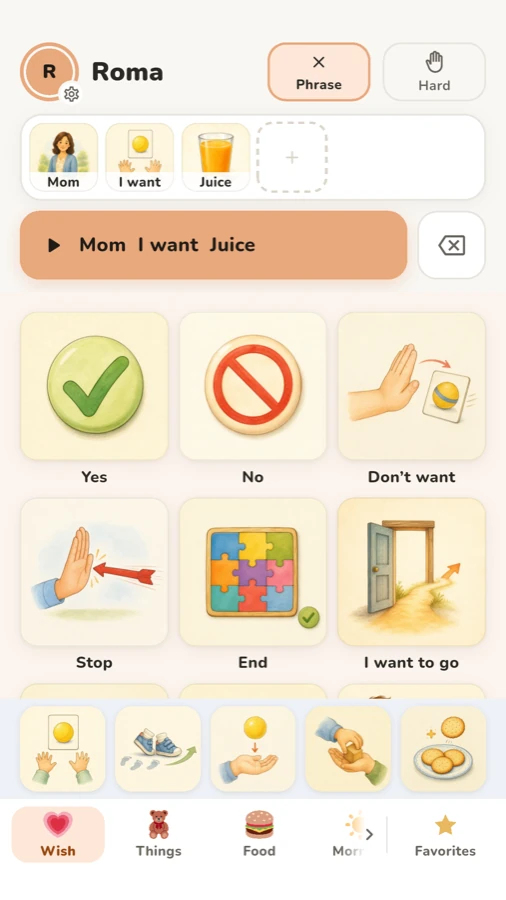
In RomaTalk, a tap on a picture speaks the word out loud. Your child hears the word every single time they use it. That's thousands of clear, consistent repetitions of the same word, said the same way.
2. Build short sentences together
Tap two or three cards and they line up in the phrase bar at the top of the screen. Tap play and RomaTalk says them as one sentence: "Mom, I want juice." Then say it yourself, warmly and a little slower: "You want juice! Here's your juice."
3. Record your own voice
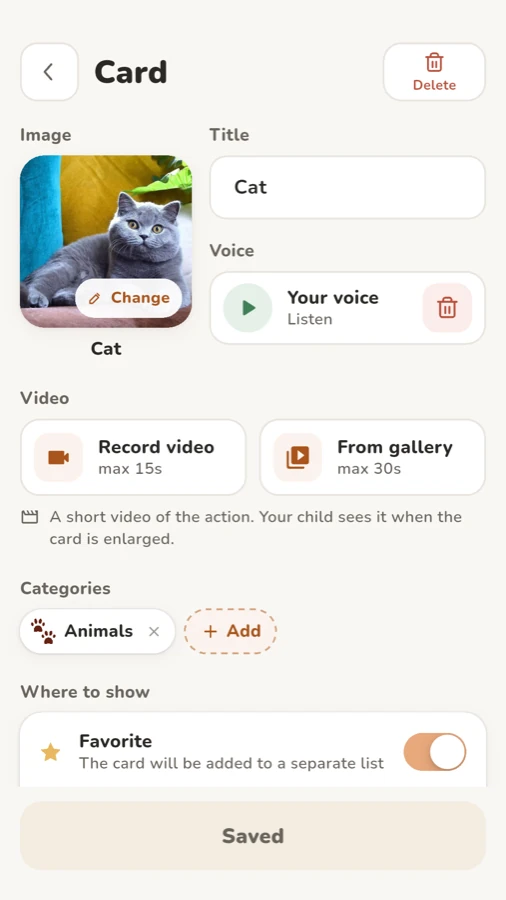
A familiar voice is easier to listen to. Open a card in the editor, find the "Voice" row, tap "Record a word" and say the word the way you say it at home. You can also add a short video of an action, which helps with verbs like "wash" or "jump". If you'd like to start with photos of your child's own things, our guide to AAC cards with your own photos walks through it.
4. Show, don't test
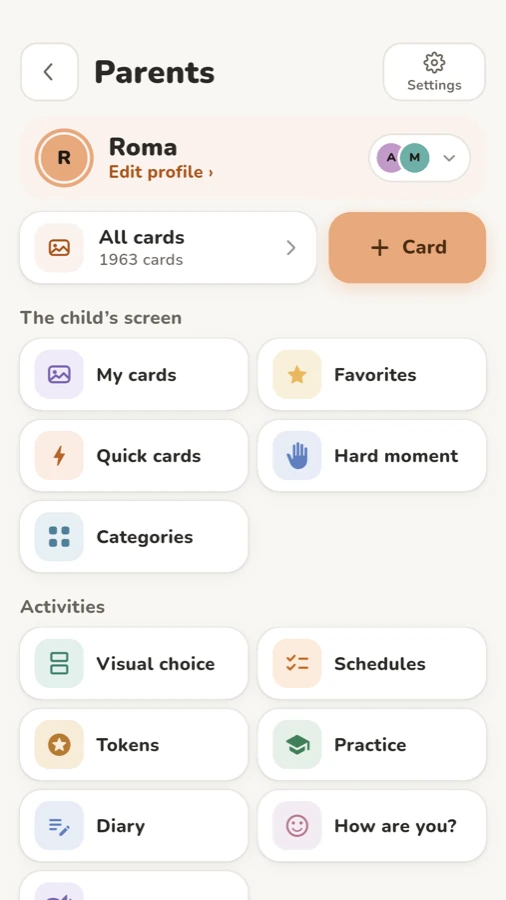
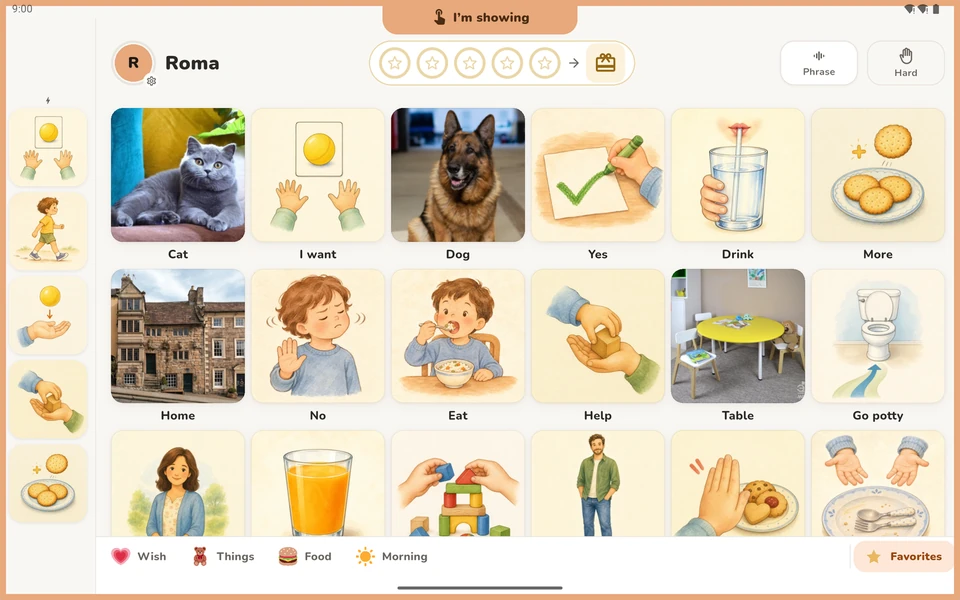
Children learn a language by seeing others use it, and picture cards are no different. In the Parents area there's an "I'm showing" mode: you tap cards yourself while you talk, and your taps don't count in your child's statistics. The app's own tips are worth keeping in mind:
- Tap a card and say the word out loud.
- One or two words, not whole sentences.
- Pause and wait for your child.
- Respond to every attempt as if it were a real word.
- Don't quiz your child with questions. Just talk.
5. Welcome every way of communicating
If your child says "ju" and taps the juice card, that's two ways of saying the same thing. Respond to both. A sound, a gesture, a look at the fridge and a tap are all communication. Treating them all as real keeps your child trying.
Practical tips for the first weeks
- Start with a few strong words. "More", "juice", "help", "stop" and one favourite toy are plenty at first.
- Keep the device close. A communication tool on a high shelf doesn't get used. Put it where the action is: the table at snack time, the floor at play time.
- Use it yourself, often. Many families find that the more adults tap and talk, the sooner the child joins in.
- Expect your child's own pace. Some children tap right away, others watch for weeks. Watching is learning too.
- Talk to your child's team. A speech and language specialist or teacher can help you choose first words and set goals that fit your child.
FAQ
Does AAC delay speech in children with autism?
Systematic reviews from 2008 and 2021 found that AAC does not impede speech in autistic children, and most studies reported some increase. The gains were usually modest, so it helps to keep expectations realistic.
Will my child stop trying to talk if they can tap a picture?
The research says this is unlikely. In a 2006 review, none of the 27 people in the strongest studies spoke less after AAC was introduced, and most spoke more. Keep saying the words out loud every time your child taps a card.
At what age can a child start using AAC?
There is no minimum age and no skills your child needs first. ASHA says AAC should be considered as early as possible. A randomized study with toddlers who said fewer than 10 words found more spoken words in the groups that used augmented communication.
Do I need to use the app all day?
No. Start in one or two daily routines where your child clearly wants something, such as snack time or play. Add more moments once those feel natural.
Try it at home
RomaTalk is a free AAC app for Android, iPhone and iPad. It works offline, with no ads and no account, and includes almost 2,000 ready-made cards in 48 languages. Download RomaTalk and try the phrase bar at your next snack time.
RomaTalk is a communication and learning tool. Parents can also keep private notes and see simple counts of what they recorded, and read general information written for parents. It is not a medical device, and it does not diagnose, assess or treat anything.
 Vistadose
 TwoPillows
 Calmanota