

You give your child the tablet. You point at the cards. "Show me what you want."
Nothing happens. Or your child taps random cards, then pushes the tablet away.
It's easy to think the app doesn't work. Or that your child isn't ready.
But think about how your child learned to understand speech. Nobody handed them a word and said "repeat". They heard you talk, every day, for years. Thousands of times before the first word.
Picture cards work the same way. Your child needs to see you use them. That's AAC modeling, and it's simpler than it sounds.
What AAC modeling actually is
AAC modeling means you use your child's cards while you talk to them. You say a normal sentence. On the key word, you tap the card.
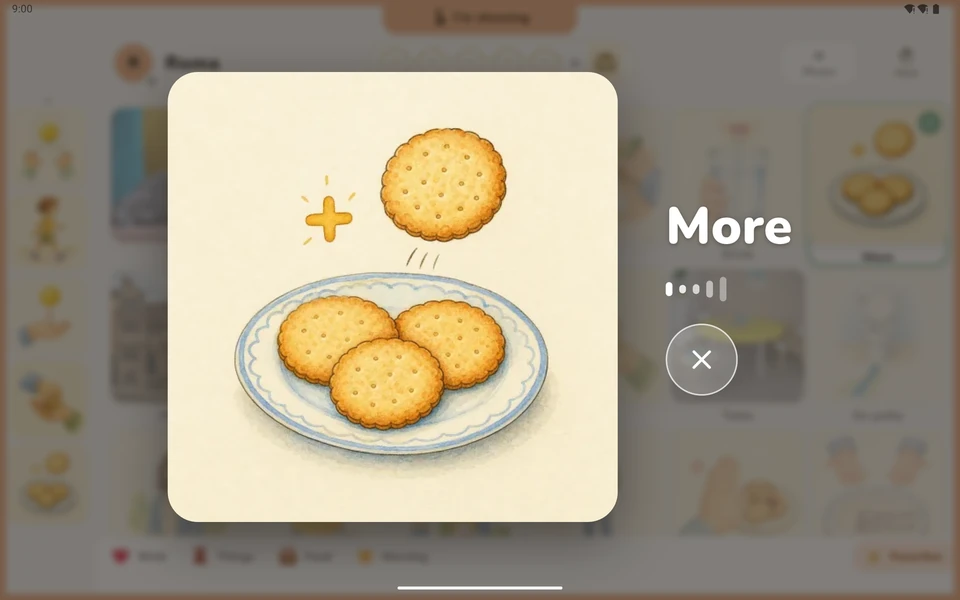
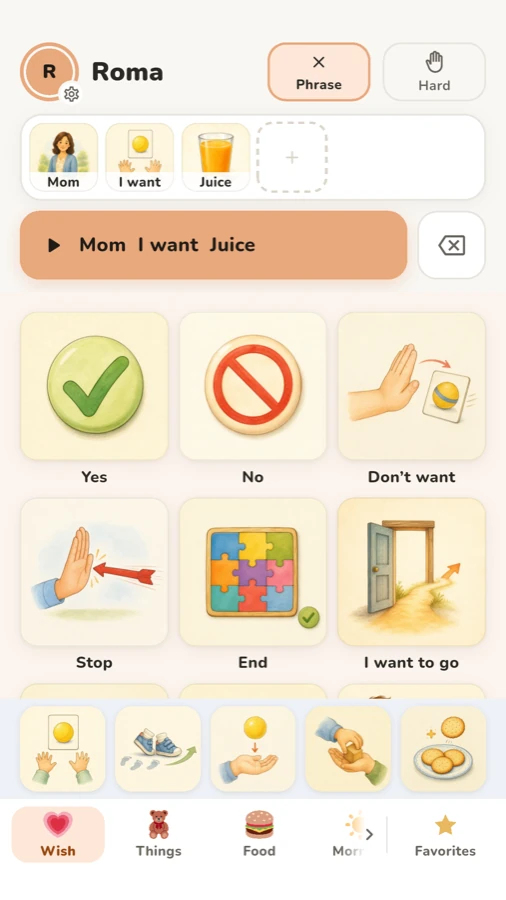
"Want more?" You tap More. The tablet says "More". Your child sees the picture and hears the word at the same moment.
That's it. No test. No "now you do it". You're not teaching a lesson. You're speaking your child's language, out loud, so they can learn it.
You'll also see it called aided language modeling or aided language input. It's the same idea.
What the research says
This isn't a trend. Researchers have studied it for years.
- Sennott, Light and McNaughton (2016) reviewed studies where adults modeled AAC during real conversations. They found "meaningful linguistic gains" in four areas: more turns in conversation, more words understood and used, longer messages, and better grammar (Sennott et al., 2016).
- O'Neill, Light and Pope (2018) pooled the results of many studies. Approaches that included aided AAC input were "highly effective across participants of various ages, disabilities, and language skills" (O'Neill et al., 2018).
- Biggs, Carter and Gilson (2018) looked at modeling studies with children. They were "generally effective at improving diverse measures of expressive communication" (Biggs et al., 2018).
- Kent-Walsh and colleagues (2015) studied what adults are taught. The three most common skills were modeling, waiting, and asking open questions (Kent-Walsh et al., 2015).
One honest note. These studies show what tends to help. They don't promise a result for any one child. Every child moves at their own pace.
| What you do | What your child gets |
|---|---|
| Tap the card as you say the word | The picture, the sound and the meaning, together |
| Use it in real moments | A reason to care about the word |
| Do it again and again | Many chances to notice and remember |
| Wait after you tap | Time to respond, if they want to |
Five simple rules for modeling AAC at home
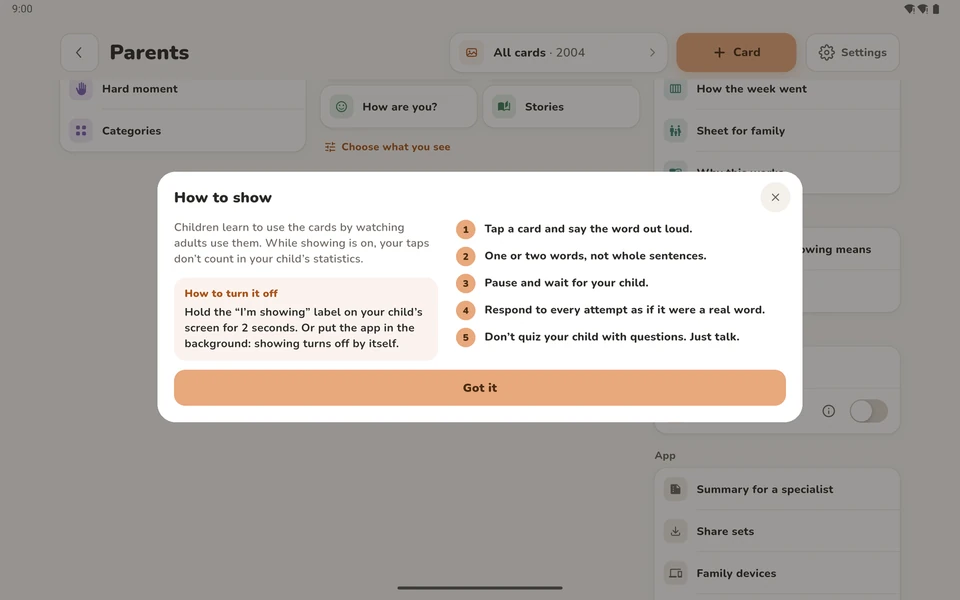
These five rules come straight from RomaTalk's “How to show” window. Keep them in your head. Forget the rest.
1. Tap a card and say the word out loud
Your voice and the tablet together. "Let's go outside," and you tap Go. Your child hears it twice: from you and from the card.
2. One or two words, not whole sentences
You don't need to tap every word. "Want juice?" One tap is plenty. If your child already taps single words, try two: want juice.
3. Pause and wait
After you tap, stop. Count to ten in your head. It feels long. That silence is space for your child to look, think, or reach for the tablet.
4. Respond to every attempt as if it were a real word
Your child taps Dog in the middle of lunch? Take it as a message. "Dog! Yes, where's the dog?" Every tap that gets a response teaches that the cards do something.
5. Don't quiz. Just talk
"What's this? Show me the cat. Where's red?" That's a test, and tests feel like pressure. Talk about what's happening instead. "The cat is sleeping." Tap Cat.
How to model AAC at home with RomaTalk
There's one small problem with modeling on your child's own tablet. Your taps look like your child's taps. The app can't tell the difference.
So if you tap More twenty times at dinner, your child's statistics say they used More twenty times. That's not true, and it hides what your child really does.
RomaTalk solves this with a mode called “I'm showing”. While it's on, your taps don't count in your child's statistics.
Here's how to use it:
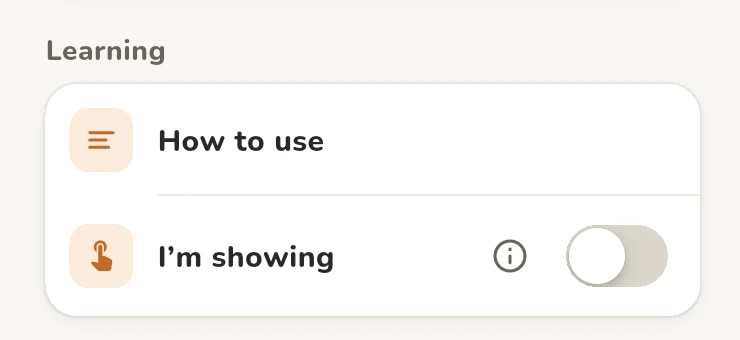
- Open Parents. Scroll to Learning.
- Turn on “I'm showing”.
- The “How to show” window opens with the five tips. Tap “Start showing”.
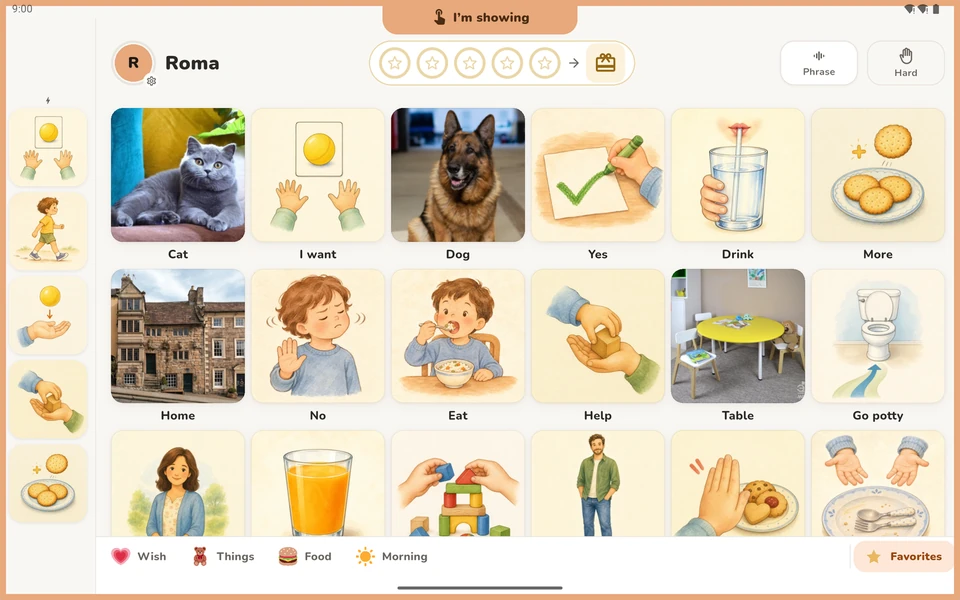
- Your child's screen opens with an “I'm showing” label at the top.
- Show the cards as you talk. Tap, say the word, wait.
- When you're done, hold the “I'm showing” label for 2 seconds. Or just put the app in the background. Showing turns off by itself.
Your child can tap too while showing is on. That's fine. Modeling works best as a back and forth, not a show.
Real moments to start with
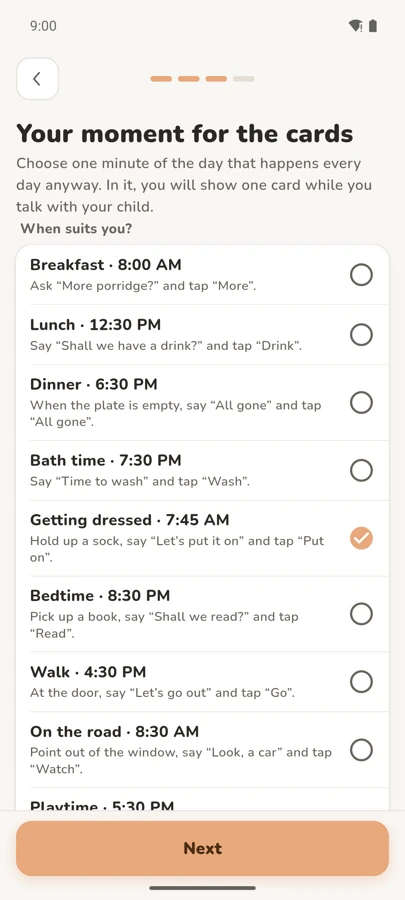
You don't need special time for this. You need moments that already happen. Here are a few:
| Moment | You say | You tap |
|---|---|---|
| Breakfast | "Want more?" | More |
| Getting dressed | "Let's put it on" | Put on |
| A toy gets stuck | "Need help?" | Help |
| The plate is empty | "All gone!" | All gone |
| At the door | "Let's go!" | Go |
| Playing with a car | "Stop! Go!" | Stop, Go |
Pick one. Do it for a week. Then add another. Doing a little every day beats doing a lot once a week.
Photo cards help here too. A photo of your own dog or your own front door is easier to connect than a drawing. You can make cards with your own photos in a minute.
Common worries
"My child doesn't even look." That's normal at first. Children often take in more than they show. Keep going without pressure.
"I feel silly." Most parents do, for about a week. Then it becomes just how you talk.
"Won't it stop my child from speaking?" Many parents worry about this. We looked at the research in Does AAC delay speech?.
"Everyone else in the family does it differently." Show them the five rules. The more people model, the more your child sees. The American Speech-Language-Hearing Association (ASHA) notes that "lack of family involvement in the AAC process is cited as a significant factor in device abandonment" (ASHA Practice Portal).
FAQ
What is AAC modeling?
AAC modeling means an adult uses the child's picture cards while talking to them. You say a normal sentence and tap the card for the key word. Your child sees and hears how the cards are used, without being asked to repeat.
How long before my child starts using the cards?
There's no fixed time. Many children need to see a word modeled many times before they use it themselves. Keep it short, daily and pressure-free.
Should I make my child copy me?
No. Modeling works without demands. Tap, say the word, then wait. If your child responds in any way, respond back.
Do my taps mess up my child's statistics?
Not if you turn on “I'm showing” in RomaTalk. While it's on, your taps don't count. To turn it off, hold the label for 2 seconds or put the app in the background.
Ready to try? Download RomaTalk and start with one word at breakfast tomorrow.
Sources
- Sennott, S. C., Light, J. C., & McNaughton, D. (2016). AAC modeling intervention research review. Research and Practice for Persons with Severe Disabilities, 41(2), 101-115. https://doi.org/10.1177/1540796916638822
"AAC modeling intervention packages led to meaningful linguistic gains across four areas including (a) pragmatics … (b) semantics … (c) syntax … and (d) morphology"
- O'Neill, T., Light, J., & Pope, L. (2018). Effects of interventions that include aided augmentative and alternative communication input on the communication of individuals with complex communication needs: A meta-analysis. Journal of Speech, Language, and Hearing Research, 61(7), 1743-1765. https://doi.org/10.1044/2018_JSLHR-L-17-0132
Such approaches "were found to be highly effective across participants of various ages, disabilities, and language skills."
- Biggs, E. E., Carter, E. W., & Gilson, C. B. (2018). Systematic review of interventions involving aided AAC modeling for children with complex communication needs. American Journal on Intellectual and Developmental Disabilities, 123(5), 443-473. https://pubmed.ncbi.nlm.nih.gov/30198767/
"Interventions were generally effective at improving diverse measures of expressive communication."
- Kent-Walsh, J., Murza, K. A., Malani, M. D., & Binger, C. (2015). Effects of communication partner instruction on the communication of individuals using AAC: A meta-analysis. Augmentative and Alternative Communication, 31(4), 271-284. https://doi.org/10.3109/07434618.2015.1052153
"Aided AAC modeling, expectant delay, and open-ended question asking were the most frequently targeted communication partner interaction skills."
- American Speech-Language-Hearing Association. Augmentative and Alternative Communication (Practice Portal). https://www.asha.org/practice-portal/professional-issues/augmentative-and-alternative-communication/
"Lack of family involvement in the AAC process is cited as a significant factor in device abandonment."
RomaTalk is a communication and learning tool. Parents can also keep private notes and see simple counts of what they recorded, and read general information written for parents. It is not a medical device, and it does not diagnose, assess or treat anything.
 Vistadose
 TwoPillows
 Calmanota