

"When did she last eat?" "Did you give him the medicine?" "Why is she crying, did something happen?"
Every time one parent hands the baby to the other, a little information gets lost. At 2 a.m. it means waking your partner to ask. At 8 a.m. it means a text in the middle of a meeting. In the evening it means the parent who's been home all day explaining everything while the parent who just walked in is still taking off their coat.
Nurses and doctors solve this with a structured handover: a short, fixed list of what the next person needs to know. Parents can do the same. A baby care handover checklist turns a vague "he's been fine" into two minutes of exactly the right information, so the next shift starts calm.
When handovers happen
Most couples hand over more often than they realise:
- The night shift change. If you split the night into two blocks, there's a handover in the middle of it, usually when one of you is half asleep.
- The morning. One parent leaves for work or goes back to sleep; the other takes over.
- The evening. One parent comes home after a day at work or a day alone with the baby.
- Other carers. A grandparent, a babysitter or nursery staff.
Each of these needs a slightly different handover, but the core list is the same.
The checklist: what to pass on
Feeding
- When the last feed was, and roughly how much or how long.
- Anything unusual: refused the bottle, fed very little, brought a lot back up.
- When the next feed is likely.
Nappies
- When the last nappy was changed.
- Anything worth watching, such as fewer wet nappies than usual or a sore bottom.
Sleep
- When the baby last slept and for how long.
- When the next sleep is likely, and what helped them settle last time.
Medicine
- What was given, the dose and the exact time.
This is the most important line on the list. When two people look after a baby, the easiest mistake is a double dose: both parents give paracetamol two hours apart, each assuming the other didn't. Write it down every time, somewhere you both see it.
Mood and anything unusual
- How the baby has been: settled, fussy, clingy.
- Anything that worried you, and whether it needs a call to the GP or health visitor.
What's next
- What's planned for the next few hours: a check-up, a visitor, a nap, the bath.
- Any task that's waiting, and who owns it.
And one line about you
- "I'm okay" or "I'm done, I need to sleep now." The handover isn't only about the baby. The parent coming on duty needs to know whether the parent going off duty needs anything.
How to keep handovers short and calm
Use the same order every time. Feed, nappy, sleep, medicine, mood, next, me. When the order is fixed, nothing gets skipped, even at 2 a.m.
Write the facts, say the feelings. Times and doses belong in writing, where they can't be misremembered. "It was a rough afternoon" is better said in person.
Hand over before you're desperate. A handover at the agreed time is calm. A handover after an hour of crying, when you just thrust the baby across, is not. If you're struggling before your shift ends, ask for help early.
Protect the evening handover. The first half hour after one of you gets home is often the hardest of the day for both. The parent coming home is switching from work; the parent at home has been counting the minutes. Agree on a routine: a quick handover, then ten minutes for the parent who was at home to step away. The Gottman Institute suggests a daily stress-reducing conversation for new parents, a few minutes where each of you talks about your day and the other just listens. It fits well after the evening handover, once the baby is settled.
Expect tears at handovers, and don't take them personally. From around the middle of the first year, many babies protest when one parent leaves. The American Academy of Pediatrics explains that this separation anxiety comes from a strong bond, not from anything either parent is doing wrong. A short, consistent goodbye works better than a long one. Once you've gone, don't come back in.
No big conversations at the night handover. Half asleep, both of you are at your least patient. Pass on the facts and go to bed. Researchers at UC Berkeley found that after poor sleep, couples are worse at resolving conflict. Anything that needs discussing can wait until daylight.
How TwoPillows helps with handovers
TwoPillows isn't a feeding tracker: if you log feeds and nappies, keep doing that in your tracker or a shared note. What TwoPillows does is take care of everything around the handover, so you both always know who's on, what's planned and who owns what.
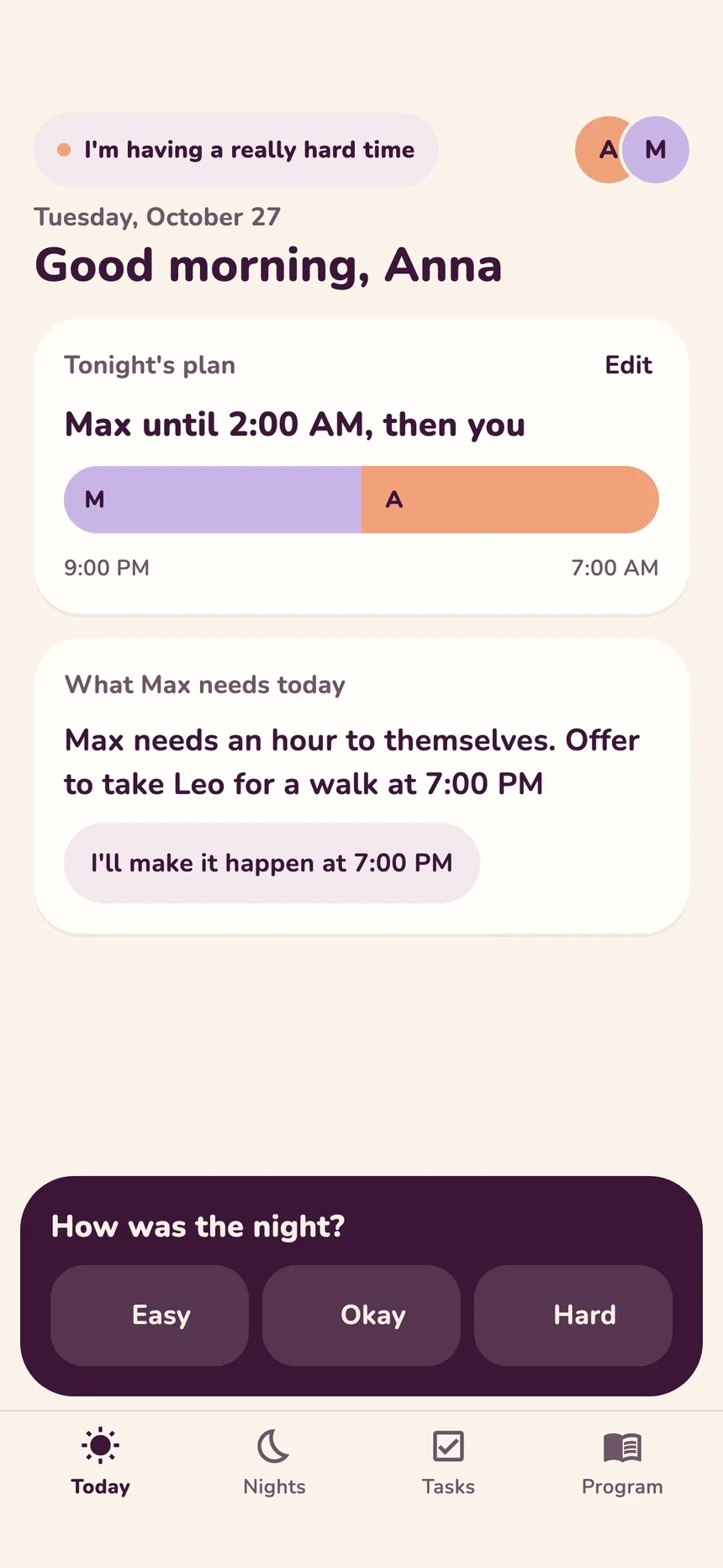
Everyone knows when the handover is. The night plan sets the shift change, for example "Max until 2:00 AM, then you". The Today screen shows it first thing, and during the night it shows whose shift it is and until when. No more "I thought you were on".
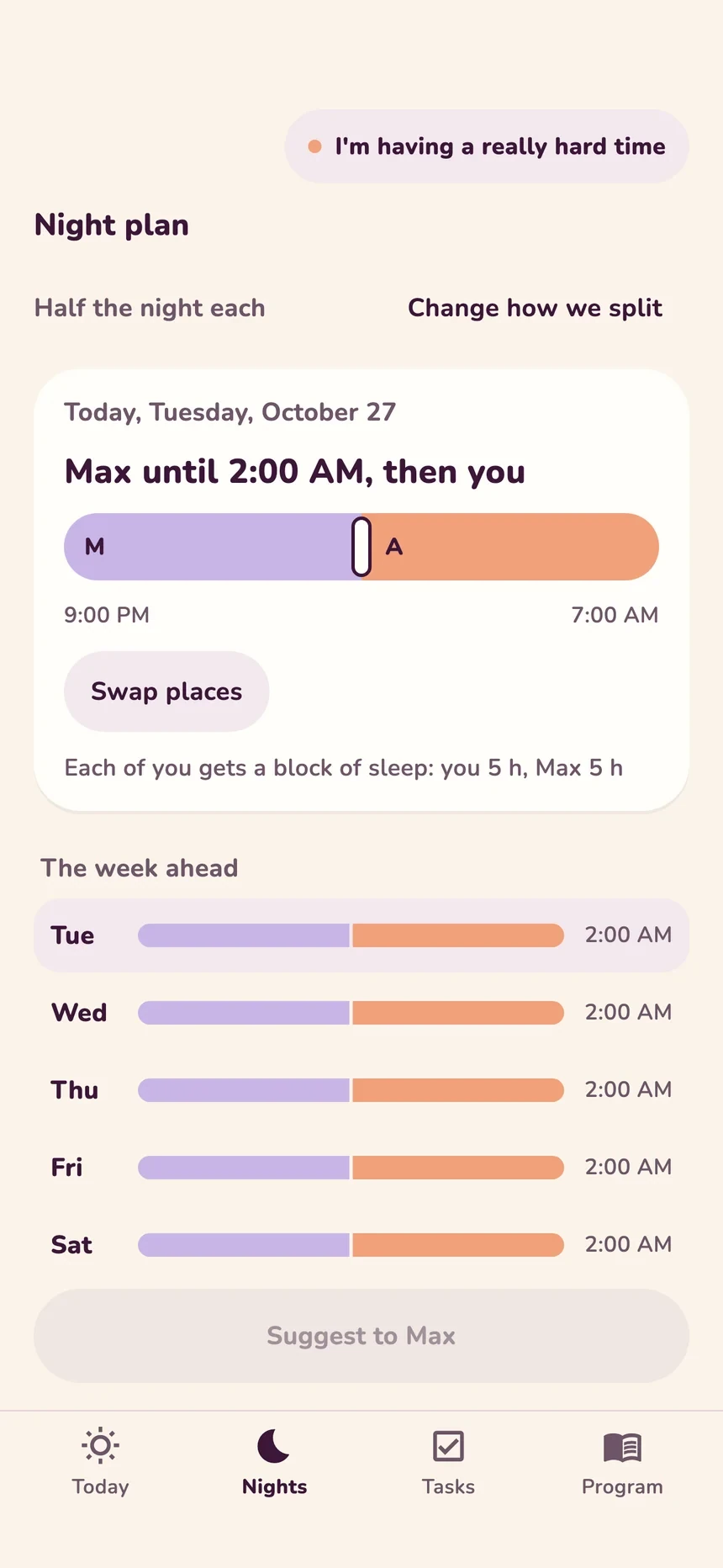
Changing the handover time is a suggestion, not a whisper. If one of you needs to move the shift change, say for an early start on Friday, you suggest the new time with a short reason, and your partner accepts it in one tap. If both of you change the same night at once, nothing is lost: the app shows both versions and lets you pick.
Tasks have one owner and a place for notes. Each task has an owner, a time and a note field for something worth remembering. That's a natural place for handover details that matter beyond today, such as "bath water: not too hot, she hates it" or "the new cream goes on after the bath". The Today screen shows the day's tasks with who owns each one and when.
Help without shouting across the house. If the on-duty parent needs a second pair of hands, the "Need help" button sends your partner a silent notification, so the baby doesn't wake. If they don't answer in three minutes, the app reminds them again, and you see when they reply "coming".
The handover of "how are you". The daily check-in covers the one line about you: how you feel, how much energy you have and what you need from your partner today. TwoPillows then suggests one thing your partner can do, like taking the baby for a walk so you get an hour to yourself, or taking your night shift.
The work stays visible. Every shift and finished task appears in your shared "What we did" feed, so the parent coming home sees what the day actually involved, and can say thank you.
A handover script you can use tonight
At your next handover, try this, in this order:
- "Last feed at , she had ."
- "Nappy at ___. All normal." (Or what you noticed.)
- "She slept from to . Next sleep is probably around ___."
- "Medicine: at ." (Or "none".)
- "Mood: ___."
- "Next up: ___."
- "And me: ___."
Two minutes. Then the parent going off duty goes, properly off duty.
If you want your night plan, tasks and check-ins in one place for both of you, get TwoPillows. It's free to start, and one subscription covers both partners if you want the full lesson program.
 RomaTalk
 Vistadose
 RomaTalk
 Vistadose
 TwoPillows