
Lypii Apps
Vistadose

What to Include in a Weekly GLP-1 Injection Log

What to record in a GLP-1 injection log each week: dose, time, injection site, missed doses, side effects and notes, plus a sample week you can copy.

You take your weekly shot on Sunday morning, and by Thursday you can't say whether you used your left thigh or your right one. A GLP-1 injection log fixes that. It doesn't need to be fancy. It needs the right few facts, written down at the time, so you and your doctor can see what actually happened.

Below: what to put in it, why each item matters, and a real week on paper. It works for semaglutide, tirzepatide, dulaglutide and other weekly medicines, and most of it applies to daily ones like liraglutide. At the end we show how Vistadose, the GLP-1 tracker we make, handles each part.

The core entries of a GLP-1 injection log

Every dose gets one line. Keep it short enough that you will actually fill it in.

Date and time

Write the time you injected, not the time you planned. Weekly medicines are usually taken on the same day each week, and the patient information has rules for changing that day. The MedlinePlus page on tirzepatide, for example, says doses need at least 3 days between them. You can only check a rule like that if you know when the last dose really happened.

Medicine and dose

Note the generic name and the dose, as prescribed. This matters most around a dose step, when the pen in your fridge may not match last month's. If your doctor changed the plan, write down the date.

Injection site

Upper arm, thigh or abdomen, plus left or right. The MedlinePlus semaglutide page says to use a different site for each injection. Without a record, most people drift back to the same one or two spots. We wrote a separate guide on keeping an injection site log if you want to go deeper on rotation.

Status: taken, skipped or late

People often leave this out, and doctors often ask about it. If you missed a dose, write "skipped" and why (travel, illness, an empty pen). If you took it late, record the real day.

Missed-dose rules differ by medicine and by what it was prescribed for. The NHS semaglutide guide and the MedlinePlus pages each give a time window, and they are not the same for every product. Don't guess from memory. Check the leaflet that came with your pen, or ask your pharmacist, and log what you did.

What to add once a week

The single dose line tells you what you did. A few extra notes each week tell you how it went.

Side effects, by day after the dose

Nausea, constipation, tiredness and redness where you inject are among the common side effects listed for these medicines. What helps is noting when they happen. If nausea always shows up the day after your shot, that is a pattern worth mentioning at your next visit. A plain "Day 1: mild nausea, gone by evening" is enough. For a fuller approach, see our post on keeping a GLP-1 side effect diary.

Appetite and how you feel

A 1 to 5 score once a day takes three seconds. Over a month it shows your own rhythm between doses far better than memory does.

Pen supply

Write how many doses are left in the pen, or when you opened a new one. For used needles, the FDA guidance on disposing of sharps at home explains what kind of container to use.

Questions for your doctor

Keep a running list at the bottom of the log. What you notice on a Tuesday is gone by the appointment.

A sample week

Here is what a simple weekly injection tracker can look like for someone on a Sunday schedule. Copy the layout into a notebook or a note on your phone.

Day Entry
Sun, Oct 11 Dose taken 8:05 AM, right thigh. Felt fine. 3 doses left in pen.
Mon Day 1. Mild nausea in the morning. Appetite low (2/5).
Tue Day 2. Felt good (4/5). No side effects.
Wed Day 3. Constipation. Drank more water.
Thu Day 4. Appetite back to normal.
Fri Day 5. Nothing to note.
Sat Day 6. Question for doctor: is the day 1 nausea expected at this dose?
Sun, Oct 18 Dose taken 8:05 AM, upper arm, left. 2 doses left in pen.

Short lines get written. Long ones get skipped after week two.

Using the log at your appointment

Log right after the injection, not from memory at the end of the week, and write the bad weeks too. A skipped dose or a rough few days is exactly what your doctor needs to see. Keep in mind the log is a record, not a tool for deciding on a dose: any change is a decision for you and your doctor.

A good dose log for your doctor answers three questions quickly: were the doses taken on schedule, what side effects came with them, and has anything changed since the last visit. Add up the taken and skipped doses before you go. Our GLP-1 appointment checklist covers what else to bring.

How Vistadose helps

Vistadose is built around the log described above, so most of it takes a tap or two.
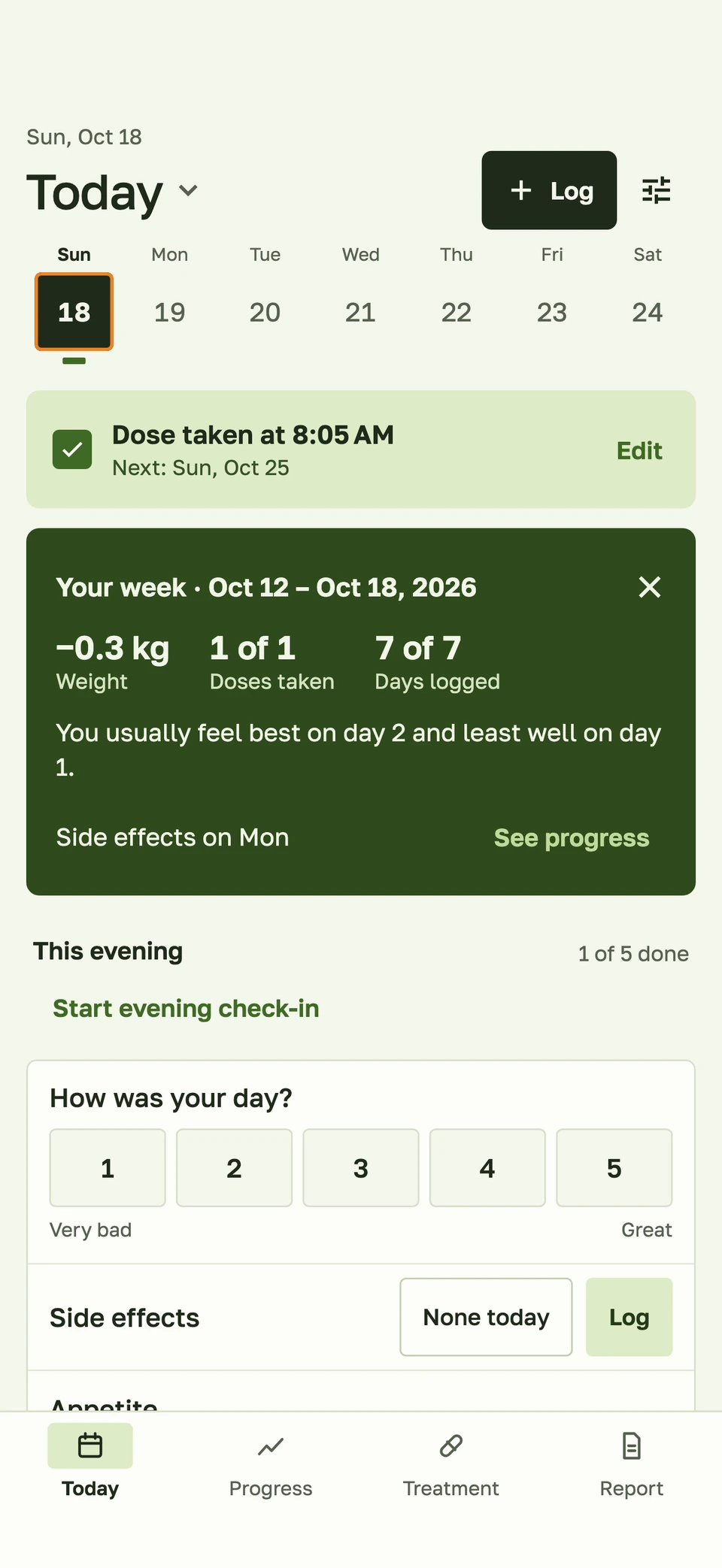
Vistadose Today screen: dose taken at 8:05 AM with the weekly summary
The Today screen after logging a dose, with the next dose date and a short summary of the week.

Logging a dose. On dose day, a card on the Today screen shows your dose. Tap "Mark as taken" and the time is saved; you can change it if you injected earlier. Doses are marked taken or skipped, and if a planned dose wasn't logged, the app asks the next day whether you took it.

Injection site rotation. Right after a dose you pick one of six sites: abdomen, thigh or upper arm, left or right. Each shows the date it was last used, and the most recent is marked "Last time".
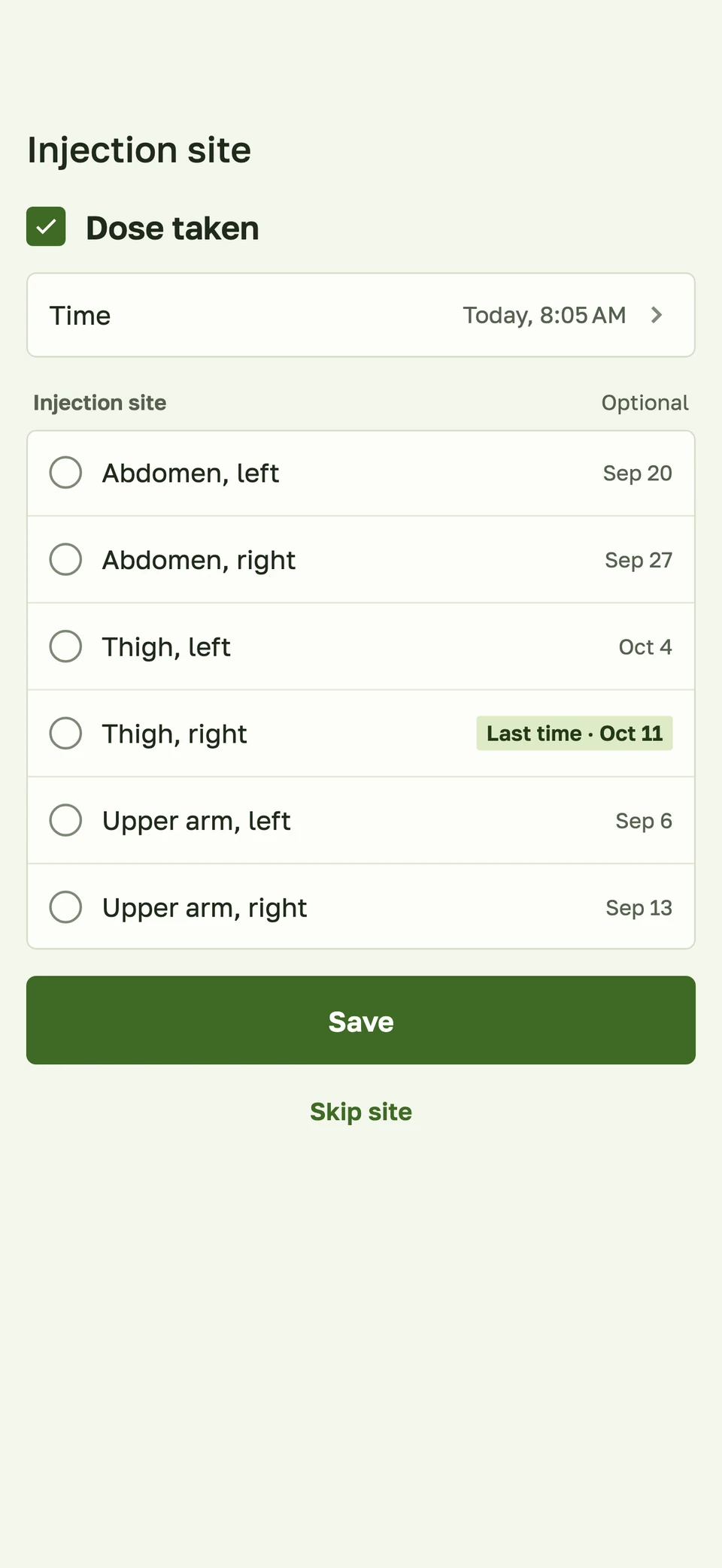
Injection site rotation in Vistadose showing the last date each site was used
Each site shows the date it was last used.

Side effects and how you feel. A short evening check-in asks how your day was (1 to 5) and which side effects you had. "None today" saves a quiet day in one tap. After a few cycles, the Progress screen shows your weekly rhythm, for example that nausea showed up mostly the day after your dose.

Schedule and pen. You enter the dose and schedule your doctor prescribed; Vistadose never suggests a dose. The dose card shows how many doses are left in your pen.

The doctor report. Pick a period and get a PDF with doses taken, skipped and not logged, the site of each dose, side effects by day after the dose, and notes you marked for the doctor.

The dose log, reminders, charts, the doctor report and encrypted backup to a file or folder are free. Plus adds deeper insights, more medications, the report in a second language and sync through your own Google Drive. There's no account and no ads, and your entries stay encrypted on your phone.

Learn more about Vistadose or get the app for iPhone or Android.

FAQ

What should a GLP-1 injection log include? At minimum: the date and time of each dose, the medicine and dose, the injection site, and whether the dose was taken or skipped. Adding side effects by day after the dose and a list of questions for your doctor makes it much more useful at appointments.

How do I record a missed GLP-1 dose? Write "skipped" or "late" with the date and the reason. Check the leaflet for your medicine or ask your pharmacist about what to do next, because the rules differ between medicines. Then log what you actually did.

Why track injection sites? The patient information for these medicines says to use a different site each time. A log shows which site you used last, so you don't keep returning to the same spot.

Is a paper log as good as an app? Yes, if you fill it in every week. An app mainly saves time: it adds the date and time for you, remembers the last site, and turns the log into a report.

Vistadose is not a medical device and does not replace advice from your doctor.
Lypii Apps
Vistadose

What to Include in a Weekly GLP-1 Injection Log

What to record in a GLP-1 injection log each week: dose, time, injection site, missed doses, side effects and notes, plus a sample week you can copy.

You take your weekly shot on Sunday morning, and by Thursday you can't say whether you used your left thigh or your right one. A GLP-1 injection log fixes that. It doesn't need to be fancy. It needs the right few facts, written down at the time, so you and your doctor can see what actually happened.

Below: what to put in it, why each item matters, and a real week on paper. It works for semaglutide, tirzepatide, dulaglutide and other weekly medicines, and most of it applies to daily ones like liraglutide. At the end we show how Vistadose, the GLP-1 tracker we make, handles each part.

The core entries of a GLP-1 injection log

Every dose gets one line. Keep it short enough that you will actually fill it in.

Date and time

Write the time you injected, not the time you planned. Weekly medicines are usually taken on the same day each week, and the patient information has rules for changing that day. The MedlinePlus page on tirzepatide, for example, says doses need at least 3 days between them. You can only check a rule like that if you know when the last dose really happened.

Medicine and dose

Note the generic name and the dose, as prescribed. This matters most around a dose step, when the pen in your fridge may not match last month's. If your doctor changed the plan, write down the date.

Injection site

Upper arm, thigh or abdomen, plus left or right. The MedlinePlus semaglutide page says to use a different site for each injection. Without a record, most people drift back to the same one or two spots. We wrote a separate guide on keeping an injection site log if you want to go deeper on rotation.

Status: taken, skipped or late

People often leave this out, and doctors often ask about it. If you missed a dose, write "skipped" and why (travel, illness, an empty pen). If you took it late, record the real day.

Missed-dose rules differ by medicine and by what it was prescribed for. The NHS semaglutide guide and the MedlinePlus pages each give a time window, and they are not the same for every product. Don't guess from memory. Check the leaflet that came with your pen, or ask your pharmacist, and log what you did.

What to add once a week

The single dose line tells you what you did. A few extra notes each week tell you how it went.

Side effects, by day after the dose

Nausea, constipation, tiredness and redness where you inject are among the common side effects listed for these medicines. What helps is noting when they happen. If nausea always shows up the day after your shot, that is a pattern worth mentioning at your next visit. A plain "Day 1: mild nausea, gone by evening" is enough. For a fuller approach, see our post on keeping a GLP-1 side effect diary.

Appetite and how you feel

A 1 to 5 score once a day takes three seconds. Over a month it shows your own rhythm between doses far better than memory does.

Pen supply

Write how many doses are left in the pen, or when you opened a new one. For used needles, the FDA guidance on disposing of sharps at home explains what kind of container to use.

Questions for your doctor

Keep a running list at the bottom of the log. What you notice on a Tuesday is gone by the appointment.

A sample week

Here is what a simple weekly injection tracker can look like for someone on a Sunday schedule. Copy the layout into a notebook or a note on your phone.

Day Entry
Sun, Oct 11 Dose taken 8:05 AM, right thigh. Felt fine. 3 doses left in pen.
Mon Day 1. Mild nausea in the morning. Appetite low (2/5).
Tue Day 2. Felt good (4/5). No side effects.
Wed Day 3. Constipation. Drank more water.
Thu Day 4. Appetite back to normal.
Fri Day 5. Nothing to note.
Sat Day 6. Question for doctor: is the day 1 nausea expected at this dose?
Sun, Oct 18 Dose taken 8:05 AM, upper arm, left. 2 doses left in pen.

Short lines get written. Long ones get skipped after week two.

Using the log at your appointment

Log right after the injection, not from memory at the end of the week, and write the bad weeks too. A skipped dose or a rough few days is exactly what your doctor needs to see. Keep in mind the log is a record, not a tool for deciding on a dose: any change is a decision for you and your doctor.

A good dose log for your doctor answers three questions quickly: were the doses taken on schedule, what side effects came with them, and has anything changed since the last visit. Add up the taken and skipped doses before you go. Our GLP-1 appointment checklist covers what else to bring.

How Vistadose helps

Vistadose is built around the log described above, so most of it takes a tap or two.

Vistadose Today screen: dose taken at 8:05 AM with the weekly summary
The Today screen after logging a dose, with the next dose date and a short summary of the week.

Logging a dose. On dose day, a card on the Today screen shows your dose. Tap "Mark as taken" and the time is saved; you can change it if you injected earlier. Doses are marked taken or skipped, and if a planned dose wasn't logged, the app asks the next day whether you took it.

Injection site rotation. Right after a dose you pick one of six sites: abdomen, thigh or upper arm, left or right. Each shows the date it was last used, and the most recent is marked "Last time".

Injection site rotation in Vistadose showing the last date each site was used
Each site shows the date it was last used.

Side effects and how you feel. A short evening check-in asks how your day was (1 to 5) and which side effects you had. "None today" saves a quiet day in one tap. After a few cycles, the Progress screen shows your weekly rhythm, for example that nausea showed up mostly the day after your dose.

Schedule and pen. You enter the dose and schedule your doctor prescribed; Vistadose never suggests a dose. The dose card shows how many doses are left in your pen.

The doctor report. Pick a period and get a PDF with doses taken, skipped and not logged, the site of each dose, side effects by day after the dose, and notes you marked for the doctor.

The dose log, reminders, charts, the doctor report and encrypted backup to a file or folder are free. Plus adds deeper insights, more medications, the report in a second language and sync through your own Google Drive. There's no account and no ads, and your entries stay encrypted on your phone.

Learn more about Vistadose or get the app for iPhone or Android.

FAQ

What should a GLP-1 injection log include? At minimum: the date and time of each dose, the medicine and dose, the injection site, and whether the dose was taken or skipped. Adding side effects by day after the dose and a list of questions for your doctor makes it much more useful at appointments.

How do I record a missed GLP-1 dose? Write "skipped" or "late" with the date and the reason. Check the leaflet for your medicine or ask your pharmacist about what to do next, because the rules differ between medicines. Then log what you actually did.

Why track injection sites? The patient information for these medicines says to use a different site each time. A log shows which site you used last, so you don't keep returning to the same spot.

Is a paper log as good as an app? Yes, if you fill it in every week. An app mainly saves time: it adds the date and time for you, remembers the last site, and turns the log into a report.

Vistadose is not a medical device and does not replace advice from your doctor.

ABOUT THIS APPVistadoseKeep a private record of your GLP-1 doses, injection sites and side effects. See how you feel between doses and bring a PDF report to your next appointment.
SHARE
Lypii AppsContact
Vistadose

What to Include in a Weekly GLP-1 Injection Log

What to record in a GLP-1 injection log each week: dose, time, injection site, missed doses, side effects and notes, plus a sample week you can copy.

You take your weekly shot on Sunday morning, and by Thursday you can't say whether you used your left thigh or your right one. A GLP-1 injection log fixes that. It doesn't need to be fancy. It needs the right few facts, written down at the time, so you and your doctor can see what actually happened.

Below: what to put in it, why each item matters, and a real week on paper. It works for semaglutide, tirzepatide, dulaglutide and other weekly medicines, and most of it applies to daily ones like liraglutide. At the end we show how Vistadose, the GLP-1 tracker we make, handles each part.

The core entries of a GLP-1 injection log

Every dose gets one line. Keep it short enough that you will actually fill it in.

Date and time

Write the time you injected, not the time you planned. Weekly medicines are usually taken on the same day each week, and the patient information has rules for changing that day. The MedlinePlus page on tirzepatide, for example, says doses need at least 3 days between them. You can only check a rule like that if you know when the last dose really happened.

Medicine and dose

Note the generic name and the dose, as prescribed. This matters most around a dose step, when the pen in your fridge may not match last month's. If your doctor changed the plan, write down the date.

Injection site

Upper arm, thigh or abdomen, plus left or right. The MedlinePlus semaglutide page says to use a different site for each injection. Without a record, most people drift back to the same one or two spots. We wrote a separate guide on keeping an injection site log if you want to go deeper on rotation.

Status: taken, skipped or late

People often leave this out, and doctors often ask about it. If you missed a dose, write "skipped" and why (travel, illness, an empty pen). If you took it late, record the real day.

Missed-dose rules differ by medicine and by what it was prescribed for. The NHS semaglutide guide and the MedlinePlus pages each give a time window, and they are not the same for every product. Don't guess from memory. Check the leaflet that came with your pen, or ask your pharmacist, and log what you did.

What to add once a week

The single dose line tells you what you did. A few extra notes each week tell you how it went.

Side effects, by day after the dose

Nausea, constipation, tiredness and redness where you inject are among the common side effects listed for these medicines. What helps is noting when they happen. If nausea always shows up the day after your shot, that is a pattern worth mentioning at your next visit. A plain "Day 1: mild nausea, gone by evening" is enough. For a fuller approach, see our post on keeping a GLP-1 side effect diary.

Appetite and how you feel

A 1 to 5 score once a day takes three seconds. Over a month it shows your own rhythm between doses far better than memory does.

Pen supply

Write how many doses are left in the pen, or when you opened a new one. For used needles, the FDA guidance on disposing of sharps at home explains what kind of container to use.

Questions for your doctor

Keep a running list at the bottom of the log. What you notice on a Tuesday is gone by the appointment.

A sample week

Here is what a simple weekly injection tracker can look like for someone on a Sunday schedule. Copy the layout into a notebook or a note on your phone.

Day Entry
Sun, Oct 11 Dose taken 8:05 AM, right thigh. Felt fine. 3 doses left in pen.
Mon Day 1. Mild nausea in the morning. Appetite low (2/5).
Tue Day 2. Felt good (4/5). No side effects.
Wed Day 3. Constipation. Drank more water.
Thu Day 4. Appetite back to normal.
Fri Day 5. Nothing to note.
Sat Day 6. Question for doctor: is the day 1 nausea expected at this dose?
Sun, Oct 18 Dose taken 8:05 AM, upper arm, left. 2 doses left in pen.

Short lines get written. Long ones get skipped after week two.

Using the log at your appointment

Log right after the injection, not from memory at the end of the week, and write the bad weeks too. A skipped dose or a rough few days is exactly what your doctor needs to see. Keep in mind the log is a record, not a tool for deciding on a dose: any change is a decision for you and your doctor.

A good dose log for your doctor answers three questions quickly: were the doses taken on schedule, what side effects came with them, and has anything changed since the last visit. Add up the taken and skipped doses before you go. Our GLP-1 appointment checklist covers what else to bring.

How Vistadose helps

Vistadose is built around the log described above, so most of it takes a tap or two.

Vistadose Today screen: dose taken at 8:05 AM with the weekly summary
The Today screen after logging a dose, with the next dose date and a short summary of the week.

Logging a dose. On dose day, a card on the Today screen shows your dose. Tap "Mark as taken" and the time is saved; you can change it if you injected earlier. Doses are marked taken or skipped, and if a planned dose wasn't logged, the app asks the next day whether you took it.

Injection site rotation. Right after a dose you pick one of six sites: abdomen, thigh or upper arm, left or right. Each shows the date it was last used, and the most recent is marked "Last time".

Injection site rotation in Vistadose showing the last date each site was used
Each site shows the date it was last used.

Side effects and how you feel. A short evening check-in asks how your day was (1 to 5) and which side effects you had. "None today" saves a quiet day in one tap. After a few cycles, the Progress screen shows your weekly rhythm, for example that nausea showed up mostly the day after your dose.

Schedule and pen. You enter the dose and schedule your doctor prescribed; Vistadose never suggests a dose. The dose card shows how many doses are left in your pen.

The doctor report. Pick a period and get a PDF with doses taken, skipped and not logged, the site of each dose, side effects by day after the dose, and notes you marked for the doctor.

The dose log, reminders, charts, the doctor report and encrypted backup to a file or folder are free. Plus adds deeper insights, more medications, the report in a second language and sync through your own Google Drive. There's no account and no ads, and your entries stay encrypted on your phone.

Learn more about Vistadose or get the app for iPhone or Android.

FAQ

What should a GLP-1 injection log include? At minimum: the date and time of each dose, the medicine and dose, the injection site, and whether the dose was taken or skipped. Adding side effects by day after the dose and a list of questions for your doctor makes it much more useful at appointments.

How do I record a missed GLP-1 dose? Write "skipped" or "late" with the date and the reason. Check the leaflet for your medicine or ask your pharmacist about what to do next, because the rules differ between medicines. Then log what you actually did.

Why track injection sites? The patient information for these medicines says to use a different site each time. A log shows which site you used last, so you don't keep returning to the same spot.

Is a paper log as good as an app? Yes, if you fill it in every week. An app mainly saves time: it adds the date and time for you, remembers the last site, and turns the log into a report.

Vistadose is not a medical device and does not replace advice from your doctor.

ABOUT THIS APPVistadoseKeep a private record of your GLP-1 doses, injection sites and side effects. See how you feel between doses and bring a PDF report to your next appointment.
SHARE