

It's 3:40 a.m. The baby stirs, and both of you wake up. One of you gets up. The other lies there listening: is it hunger, is it wind, should I go too? Twenty minutes later the baby is asleep again, and so is one of you. The other stares at the ceiling until five.
In the morning you have both been in bed for eight hours, and neither of you has really slept. It feels like teamwork. In fact it's the most tiring way to get through the night.
A newborn night shift schedule fixes this with one simple idea: instead of both parents half-waking all night, you split the night into two blocks. One of you is on duty, the other sleeps properly. Then you swap. This guide shows how to set it up, how it works if you breastfeed, and how to keep the plan fair when real life gets in the way.
Why one long block beats more hours in bed
Broken sleep costs more than it looks. In a 2014 study at Tel Aviv University, adults slept a normal night and then a night in which they were woken four times for a short task. After the broken night, their attention and mood were about as poor as after a night cut to four hours. The researchers noted that even wake-ups of five to ten minutes break the natural rhythm of sleep. One such night was enough to see the effect. New parents have months of them.
The good news runs the other way too. Sleep comes in cycles, and the deepest, most restoring sleep comes after you've been asleep for a while. Four or five hours in one piece gives your body that deep sleep back. Two parents who each get one protected block are in far better shape than two parents who both slept in scraps.
So the goal of a night shift schedule isn't to suffer equally. It's for each of you to get one block of sleep that nobody interrupts.
The two-block plan, step by step
1. Pick a split time that matches your baby's real nights
Many couples split at around 2 a.m. One covers from the evening until 2, the other from 2 until morning. If your baby tends to sleep a long stretch early in the night, give that stretch to whoever needs sleep most right now: the parent recovering from a caesarean, or the one driving to work in the morning.
A good test: each of you should get at least five hours in a row. If the line you've drawn leaves one person with three, move it.
2. Make the off-duty parent truly off duty
Being within earshot is half of being on duty. The person sleeping should be where they can't hear every sound: another room, the sofa bed, earplugs, a fan for background noise. It often takes a few nights to stop listening. That's normal.
3. The on-duty parent handles it alone
If you can handle it, you handle it. Waking your partner "just to ask" breaks their block, and a broken block is worth much less than you'd think. Write your questions down and ask them in the morning. The exception is a real emergency or a moment when you need a second pair of hands. More on that below.
4. Review it every week or two
The plan that suits week two may not suit week eight. Babies change, feeds change, one of you goes back to work. Put a short review in the diary and adjust without drama.
If one of you breastfeeds
Breastfeeding seems to make a split night impossible, but most of a night feed isn't the feed. Someone has to get up, change the nappy, bring the baby, take them back, burp them, rock them and lay them down. All of that can be the partner's job.
Then the parent who feeds wakes for the feed itself, feeds lying down or sitting up in bed, and goes straight back to sleep. On a good night that roughly halves the time they're awake. Some couples later add one bottle of expressed milk during the partner's half of the night, so the feeding parent gets one full block. If you want to try that, ask your midwife or health visitor when it makes sense for you, so it doesn't get in the way of feeding.
Choosing a pattern that fits your week
The half-and-half split isn't the only option. Four patterns cover most families:
- Half the night each. The classic two-block plan. Each of you gets around five hours in a row.
- Every other night. One whole night on, the next one off. Works well once nights are a bit calmer, or when the on-duty parent can nap the next day.
- Weeknights and weekends. Whoever works sleeps on weeknights; the other takes the weekends.
- Evening and early morning. One parent covers the evening and the early morning, the other the middle of the night. Useful when one of you is a night owl and the other an early bird.
How TwoPillows turns this into a plan you'll actually keep
Agreeing on a schedule at midnight is easy. Remembering who's on at 3 a.m. on the eleventh night in a row is harder. That's what the night plan in TwoPillows is for.
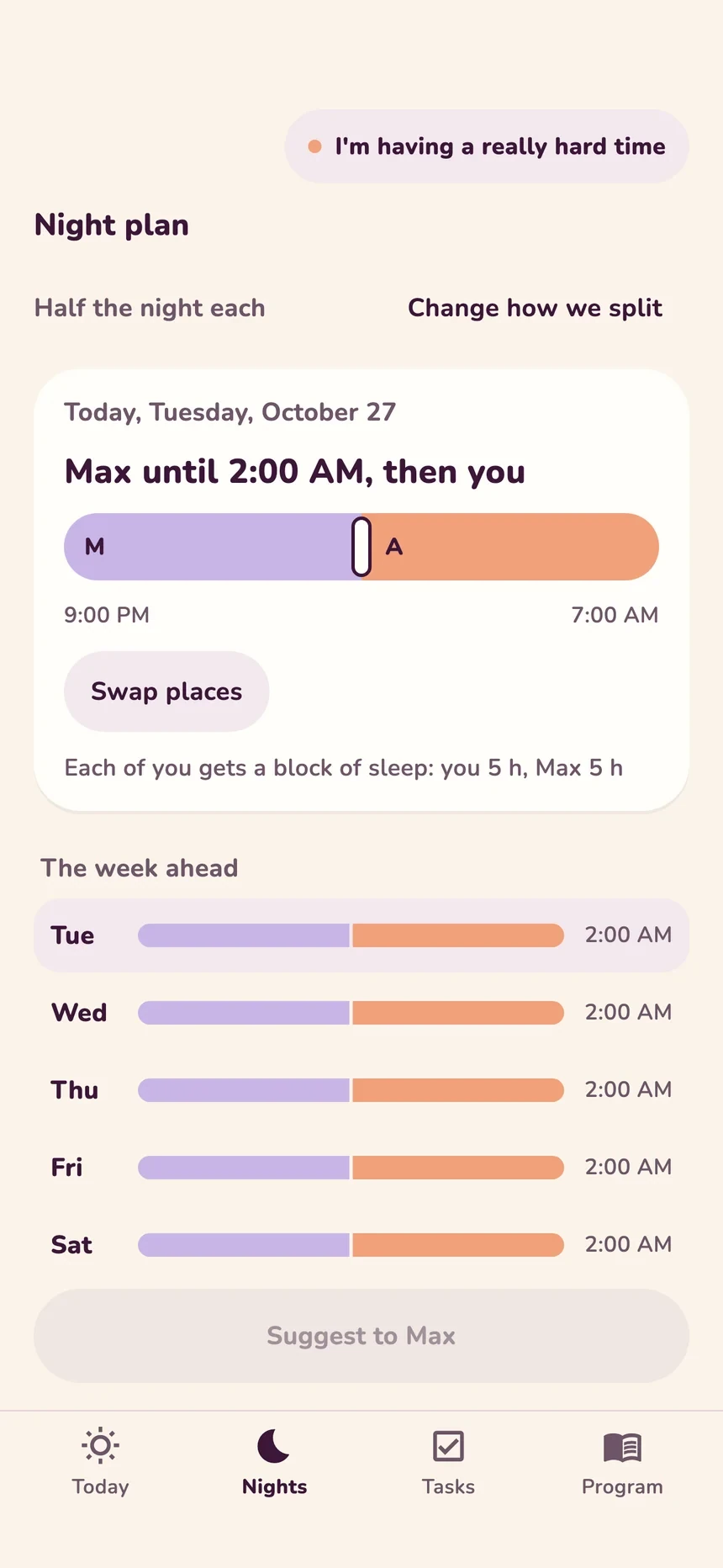
When you set it up, the app asks how you split the nights and offers the four patterns above. It also asks how you feed. If you breastfeed, the plan keeps feeds with the parent who gave birth and gives everything around the feed to the partner during their shift, exactly as described above.
Then you set the times. The plan shows each of you how long your block of sleep will be, and if either of you would get less than five hours in a row, it tells you and offers to move the line. You can see the whole week ahead at a glance, swap places on a night when one of you has an early start, or suggest a change to your partner with a short reason ("I have an early meeting on Friday"). They accept it with one tap, so nothing gets decided in a whisper at 2 a.m.
A few details make the night itself easier:
- Quiet hours follow the plan. While you sleep on schedule, the app keeps its notifications quiet. Only a "Need help" request from your partner comes through.
- "Need help" is silent. If the on-duty parent needs a second pair of hands, one tap sends your partner a notification with no sound, so the baby doesn't wake. If there's no answer in three minutes, the app reminds them again. When your partner answers "coming", you see it on screen.
- Each shift counts. The shift you covered appears in your shared feed of "What we did", so the night's work is visible in the morning, and your partner can say thank you.
The Today screen shows tonight's plan first thing ("Max until 2:00 AM, then you"), and in the morning it asks one quick question: how was the night? Easy, okay or hard. When it was hard for both of you, the app suggests keeping the day simple and deciding who naps when the baby does.
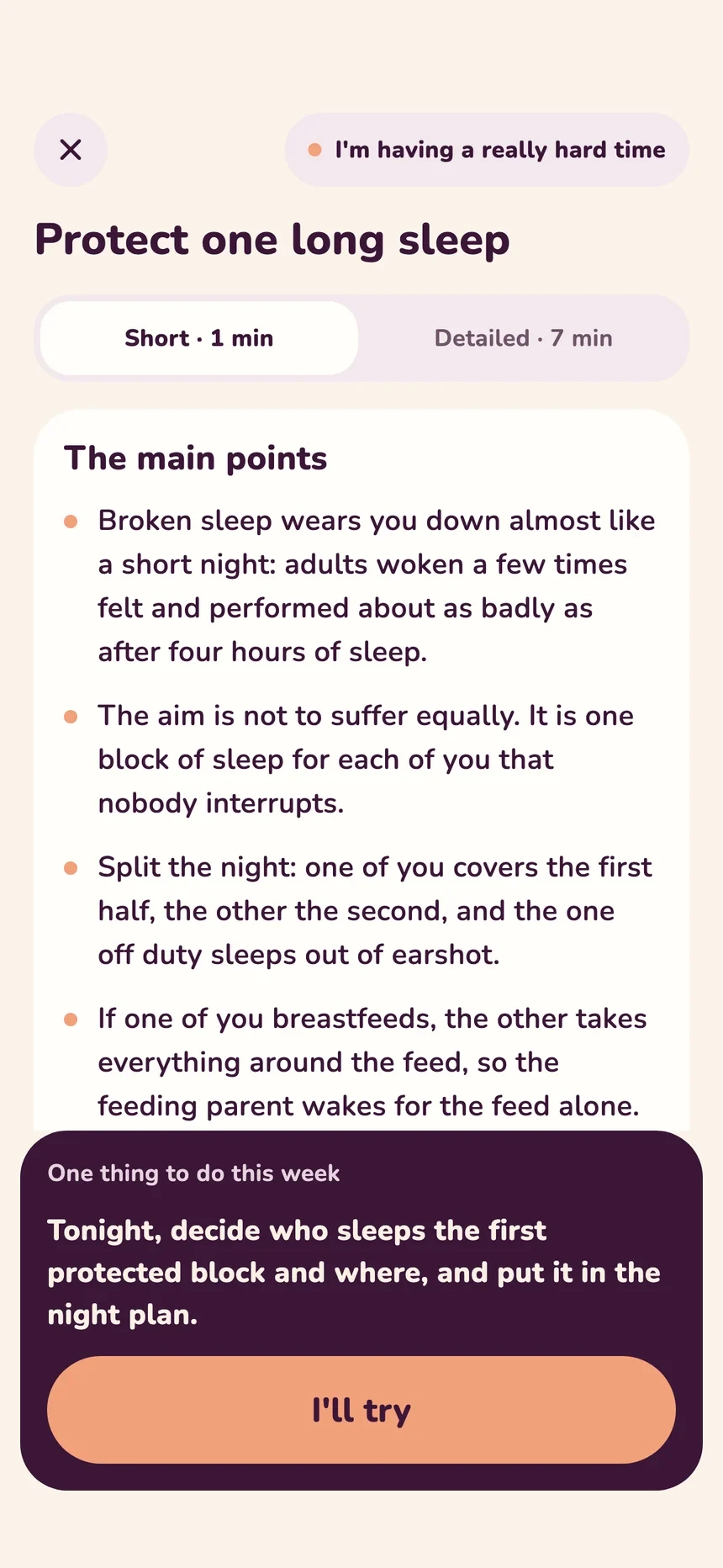
If you want the reasoning behind all this, the lesson program includes short lessons on sleep: protecting one long block, building a fair night plan, and why big conversations should wait until daylight. Each lesson has a one-minute version with the key points and a detailed version for when you have more time.
When the plan stops working
The off-duty parent still wakes up. Move further away, try earplugs, and agree that the on-duty parent closes the door.
The baby settles only with one of you. The other can still do the first ten minutes and hand over only if it isn't working. Babies usually get used to the second parent faster than parents expect.
One of you works in the morning. That doesn't mean the other gets no block. The working parent can take the earlier half and sleep the later one, and the weekend can tilt the other way.
Resentment builds up quietly. Say it in daylight: "I've done the hard half four nights running. Can we swap this week?" A plan you change together is still your plan.
Safety first on a tired shift
The on-duty parent is often the most tired person in the house. The NHS warns against falling asleep with a baby on a sofa or armchair. If you feel yourself drifting off, put the baby down in the cot on their back, or wake the other parent. A late handover is always better than a risky one. The NHS guide to reducing the risk of SIDS covers the safe sleep basics, and the NHS also has practical advice on sleep and tiredness after having a baby.
Your first night with a plan
Tonight, decide three things together: what time you split, where the off-duty parent sleeps, and what the on-duty parent does without waking anyone. Try it for a week, then talk again in daylight.
TwoPillows is free to start: the night plan, shared tasks and the daily check-in cost nothing, and one subscription covers both partners if you want the full lesson program. Get TwoPillows and set up your first night plan in a couple of minutes.
 RomaTalk
 Vistadose
 RomaTalk
 Vistadose
 TwoPillows