

With a new baby, most conversations between partners shrink to logistics. When did she last feed? Have we got wipes? Can you take him for a minute? Weeks go by, and you realise you haven't actually asked each other how you are. Or you have, and the answer was "fine", which meant nothing.
A daily check-in for new parents is a tiny habit that fixes this. Once a day, each of you answers three short questions: how you feel, how much energy you have, and what you need from the other today. It takes a minute. It doesn't require a babysitter, a date night or an hour-long talk. And it gives your partner something concrete to act on.
Here's why it works, the three questions to use, and how to keep it going on the days you're too tired for anything.
Why small daily contact matters so much
In the first years with a baby, many couples feel their relationship come under strain. The Gottman Institute, drawing on its Bringing Baby Home research, says that around two thirds of couples see their relationship satisfaction drop in the first three years. A lot of that pressure comes from outside the relationship: a crying baby, broken sleep, work, worried relatives. When stress has nowhere to go, it leaks out as shortness, criticism or silence.
John Gottman's work on couples also highlights small moments he calls bids: a sigh, a comment, a look that invites a response. Partners who turn toward these bids, even briefly, build closeness over time. With a newborn, bids get missed constantly. Nobody means to ignore anything; you're both exhausted and both looking at the baby.
A daily check-in is a reliable bid that can't be missed. It happens at the same time every day, it's short, and it ends with something the other person can actually do.
The three questions
1. How are you right now?
Not "how was your day", which invites a report. This one asks about you. Five simple answers are enough: drained, struggling, so-so, pretty good, good. Saying "struggling" out loud is often easier when it's one word on a scale rather than a conversation you have to start.
2. How much energy do you have for this evening?
This is the practical question. "Almost none", "enough for the essentials" or "some to spare" tells your partner more about tonight than a long explanation. If you both say "almost none", that's useful too: tonight is a takeaway-and-early-bed night, not a sort-out-the-cupboards night.
3. What do you need from your partner today?
This is the question most couples never ask directly. The answers are small and specific:
- an hour to myself
- a hug
- take the baby for a walk
- a quiet evening
- to talk
- nothing, I'm okay
You can pick more than one. The point is to turn a vague feeling ("I'm overwhelmed") into a request your partner can say yes to ("take the baby for a walk at seven").
How to make it work
Answer separately, then look together. If one of you sees the other's answer first, it's tempting to adjust: "well, if you're drained, I'd better say I'm fine." Answering before you see each other's answer keeps it honest.
Do one thing. A check-in that ends in nothing becomes a ritual you resent. Each day, pick one need and meet it. Not all of them, just one.
Keep it at the same time. The first coffee, the baby's bath, the moment one of you gets home. Tie it to something that already happens.
Don't turn it into a debate. If your partner says "struggling", the answer isn't "why?" or "me too, and worse". It's "what would help tonight?". Save bigger conversations for daylight, when you've both slept. Researchers at UC Berkeley found that after poor sleep, couples are worse at resolving conflict.
Missed a day? That's fine. A habit that survives missed days is stronger than one that demands perfection.
How the check-in works in TwoPillows
The daily check-in is one of the core features of TwoPillows, and it's free.
Once a day, at a time you choose, the app sends a gentle reminder: "How are you today?" If your partner has already answered, it says so. The check-in is the three questions above, one per screen, and it takes about a minute. You can answer with one hand while feeding.
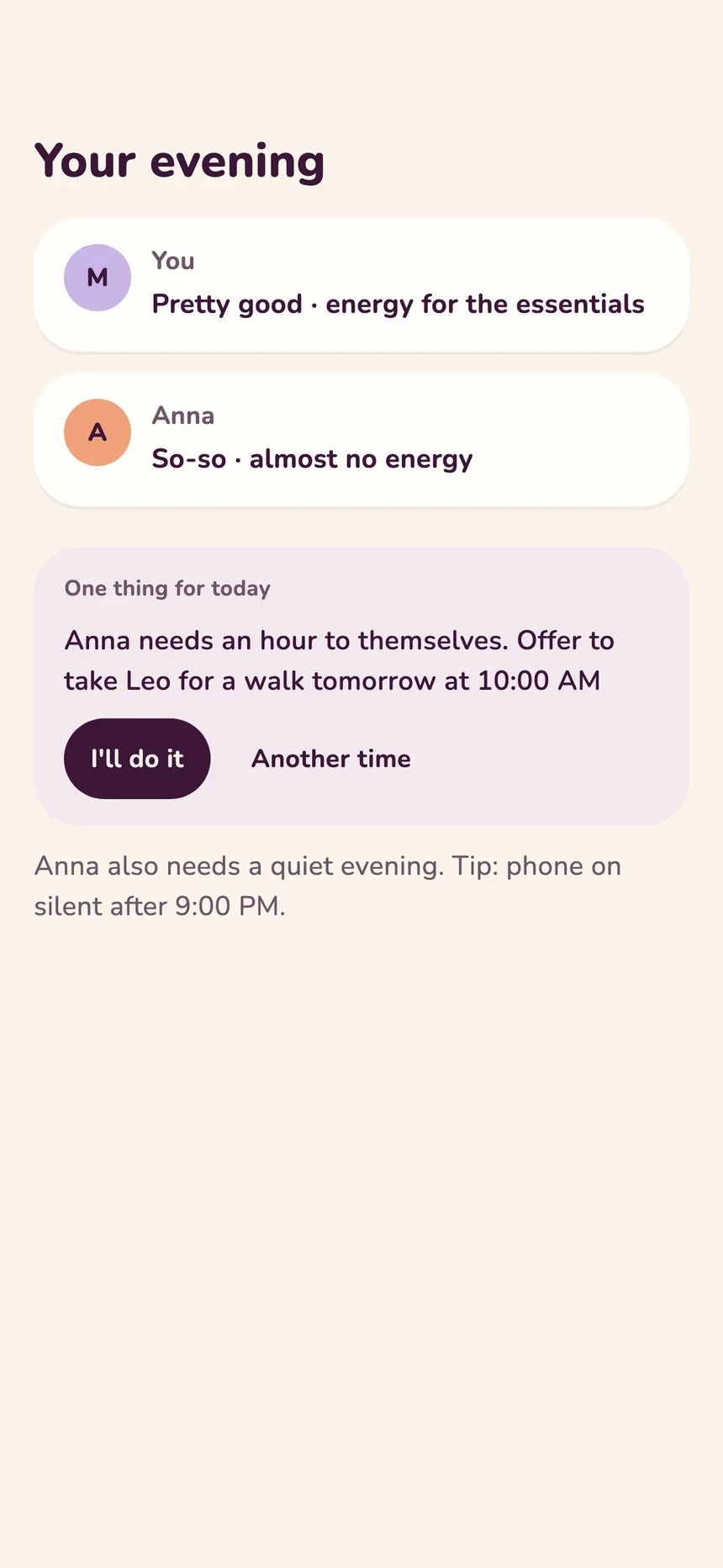
Answers open when both of you have answered. By default, neither of you sees the other's answer until you've both given yours, so nobody adjusts to the other. If your couple prefers, you can switch it so answers are visible right away.
Then the app suggests one thing for today. This is where the check-in becomes useful rather than just nice. Based on what your partner needs, TwoPillows suggests one concrete action. For example:
- "Anna needs an hour to themselves. Offer to take Leo for a walk tomorrow at 10:00 AM."
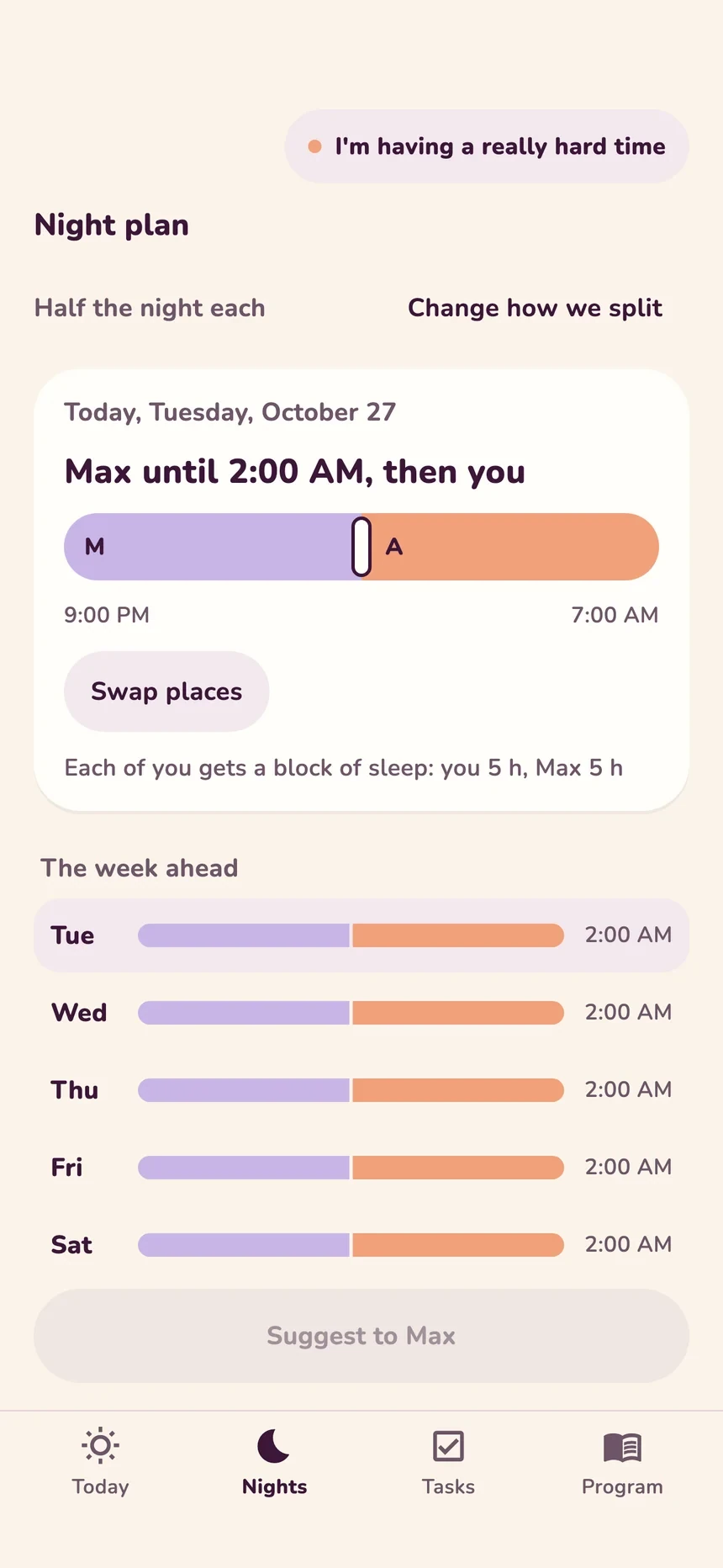
- "Max needs sleep. Take their 2:00–7:00 AM shift tonight." The suggestion comes from your night plan.
- "Max wants to talk. Find 15 minutes tonight, phones away."
- "Today is a low day for Anna. Keep it simple and take one thing off their plate."
You tap "I'll do it" or "Another time". If you take it, it shows up on your Today screen as something you've committed to, at the time you picked.
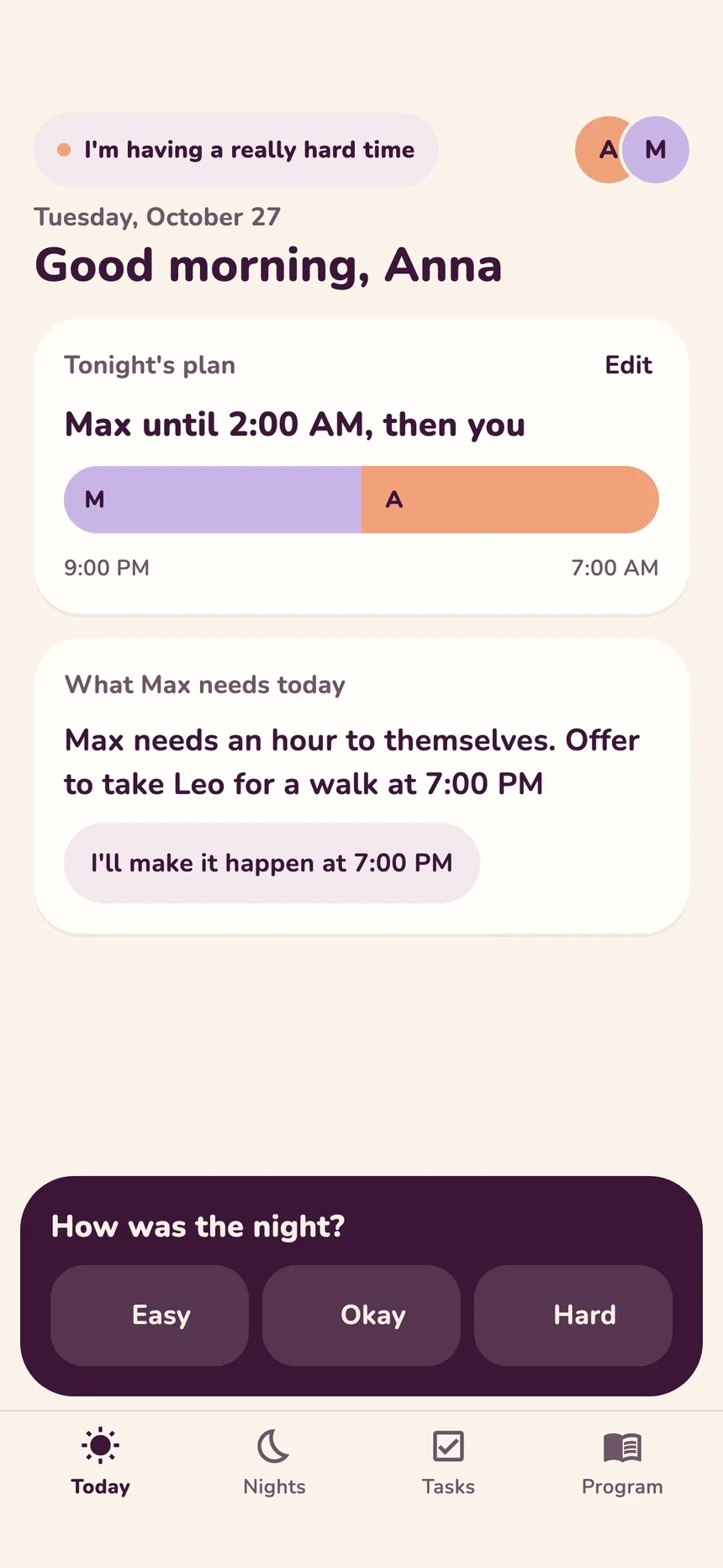
It connects to the rest of your day. The Today screen shows what your partner needs today right next to tonight's night plan. If they asked for a quiet evening, you might see a tip to put your phone on silent after nine. If you missed yesterday's check-in, the app simply says that happens and today's a fresh start. No streaks, no guilt.
Your answers stay between the two of you. Check-in answers are visible only to you and your partner, under the rule you've chosen. Usage analytics are off unless you turn them on.
When the answer keeps being "struggling"
A check-in can show patterns you'd otherwise miss. Feeling low, tearful or anxious for a few days after the birth is very common. But the NHS says that if it lasts longer than two weeks, gets worse, or you're struggling to cope, it may be postnatal depression. It can start any time in the first year, and partners can have it too. If you notice "drained" or "struggling" day after day, for yourself or your partner, talk to your GP, midwife or health visitor. Asking for help early makes a real difference.
TwoPillows also has an "I'm having a really hard time" button at the top of every screen, which shows support lines for your country. It's always free.
Start tonight
You don't need an app to try this. Tonight, ask each other the three questions and pick one need to meet tomorrow. If you'd like a reminder, private answers and a suggestion of what to do, get TwoPillows. The check-in, the night plan and shared tasks are all free, and one subscription covers both of you if you want the full lesson program.
 RomaTalk
 Vistadose
 RomaTalk
 Vistadose
 TwoPillows