
Lypii Apps
Vistadose

How to Keep a GLP-1 Side Effect Diary

What to write in a GLP-1 side effect diary, how weekly patterns show up, which warning signs need a doctor, and how a simple daily check-in makes it easy.

A GLP-1 side effect diary is a short daily note about how you feel on your medication: what showed up, how strong it was, and how many days it came after your dose. After a few weeks it answers questions memory can't, like "Is the nausea getting better?" or "Why is Monday always my worst day?"

This guide covers what to record, how patterns show up across the week, which warning signs mean you should contact a doctor, and how Vistadose keeps the whole thing quick.

Why a GLP-1 side effect diary beats memory

Most side effects of semaglutide, tirzepatide, liraglutide and dulaglutide sit in the stomach and gut: feeling sick, diarrhoea, constipation, heartburn, tiredness. In a pooled analysis of three large semaglutide trials, these effects were mostly mild to moderate and short-lived, and most common around dose increases. So they come and go, and by your next appointment the bad week has blurred into "it was fine, mostly."

A written symptom log gives your doctor dates, strength and timing instead of a vague impression, and shows you whether something is fading or sticking around.

What to record each day

Keep it short. A diary you fill in daily beats a detailed one you abandon after a week.

The essentials:

  • The symptom. Name it plainly: nausea, constipation, heartburn, headache, a sore injection site.
  • How strong it was. Use the same three words every time. Mild: noticeable, but it does not get in the way. Moderate: it gets in the way of some things. Severe: hard to get through your usual day.
  • Day after the dose. If you inject on Sunday, Monday is day 1, Tuesday is day 2, and so on. This one number does most of the work later.
  • Appetite. A score out of 10 is enough.
  • Food and fluids. Roughly how much you drank, and anything unusual (a big fatty meal, alcohol).
  • What helped, if anything. Smaller meals, a walk, an early night. You are collecting facts to discuss, not running experiments.

Worth adding when it applies:

  • A dose change, or a missed or late dose
  • How long a symptom lasted ("nausea from 10 am to about 3 pm")
  • Questions for your doctor

If you also track your shots, a separate GLP-1 injection log keeps dose, time and site in one place, so the diary can stay about how you feel.

A sample diary week

Here is what one week might look like for someone who injects on Sunday morning:

Day Day after dose Side effects Appetite Notes
Sun dose day none 6/10 Dose 8 am, left thigh
Mon 1 nausea, moderate 3/10 Skipped dinner. About 5 glasses of water
Tue 2 nausea, mild 4/10 Better after a light breakfast
Wed 3 constipation, mild 5/10
Thu 4 none 7/10 Felt normal
Fri 5 none 7/10
Sat 6 tired, mild 6/10 Late night

One week tells you little. Four weeks start to tell a story.

How patterns show up across the week

For weekly injections, ask "Which day after the dose do I usually feel sick?" rather than "Which date?" Line up your weeks by day after the dose and look down the columns.

Things people often notice:

  • Nausea after injection clusters early, often on day 1 or 2, fading by midweek.
  • Appetite has a shape: lowest soon after the dose, higher toward the end of the cycle.
  • Changes follow dose increases: a rough week after a step up, then calmer ones.
  • Some things have other causes. A headache only on low-water days points elsewhere.

Three or four cycles are usually enough to tell a real pattern from a one-off bad week. On a daily injection, look at weeks and dose changes instead.

When to contact a doctor

A diary can't tell you whether something is serious. Official patient guidance for these medicines lists warning signs that need help right away, including:

  • Severe stomach pain that does not go away, sometimes spreading to the back, with or without vomiting. The NHS lists this as a possible sign of acute pancreatitis on its semaglutide side effects page.
  • Severe pain in the upper stomach, yellowing of the skin or eyes, fever or pale stools, which can point to gallbladder problems. See the US National Library of Medicine's semaglutide injection information and the NHS tirzepatide page.
  • Passing much less urine, or swelling of the legs, ankles or feet.
  • Signs of dehydration after vomiting or diarrhoea: dark yellow urine, passing urine less often, dizziness that does not go away when you stand up, unusual tiredness. The NHS explains when dehydration needs urgent advice.
  • Signs of a serious allergic reaction: swelling of the throat or tongue, trouble breathing, a raised itchy rash.

If you have any of these, contact your doctor, your urgent advice line or emergency care. For milder side effects that keep bothering you, talk to your doctor or pharmacist. Don't change or skip doses because of what a diary or app shows.

How Vistadose turns the diary into a two-minute habit

Everything above works on paper. Vistadose does it with fewer taps and does the counting for you.

A quick evening check-in

On the Today screen, an Evening check-in asks how your day was (1 to 5), "Any side effects today?", your appetite, and water and protein. Pick side effects from a list (nausea, constipation, diarrhoea, heartburn, fatigue, headache, injection site reaction) or add your own, each rated mild, moderate or severe. Tap None today on good days, or Same as yesterday when nothing changed. "Add details for your doctor" holds what happened and how long it lasted.
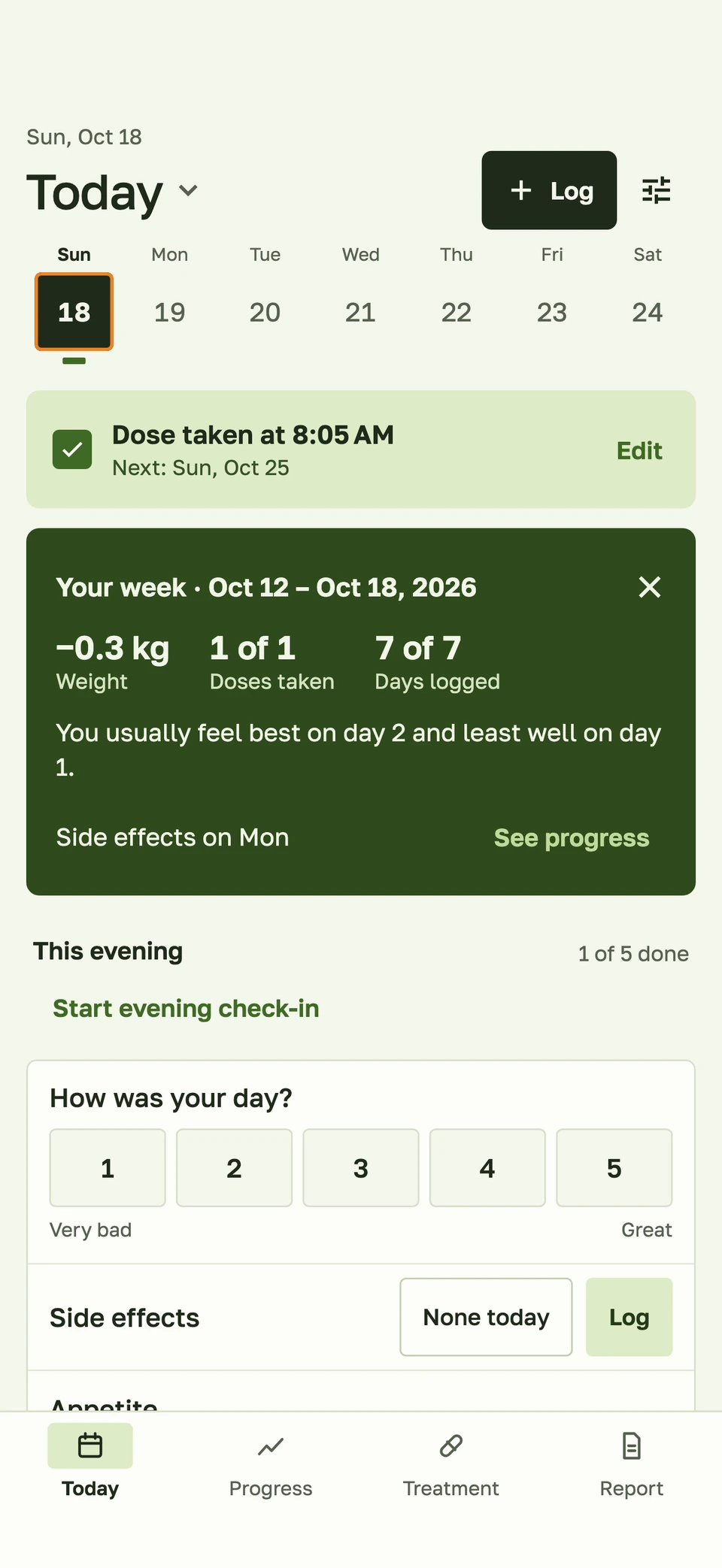
Vistadose Today screen with the week summary and the evening check-in
The Today screen: your week at a glance, then the evening check-in.

Your weekly rhythm

This is the "line your weeks up" step, done for you. On the Progress screen, Your weekly rhythm shows side effects, feeling and appetite by day after the dose, in sentences like "Appetite is usually lowest on day 1 and highest on day 4." It appears after three weeks of doses on a weekly medication. A Side effects card lists each symptom, how many days it appeared and on which days after the dose.
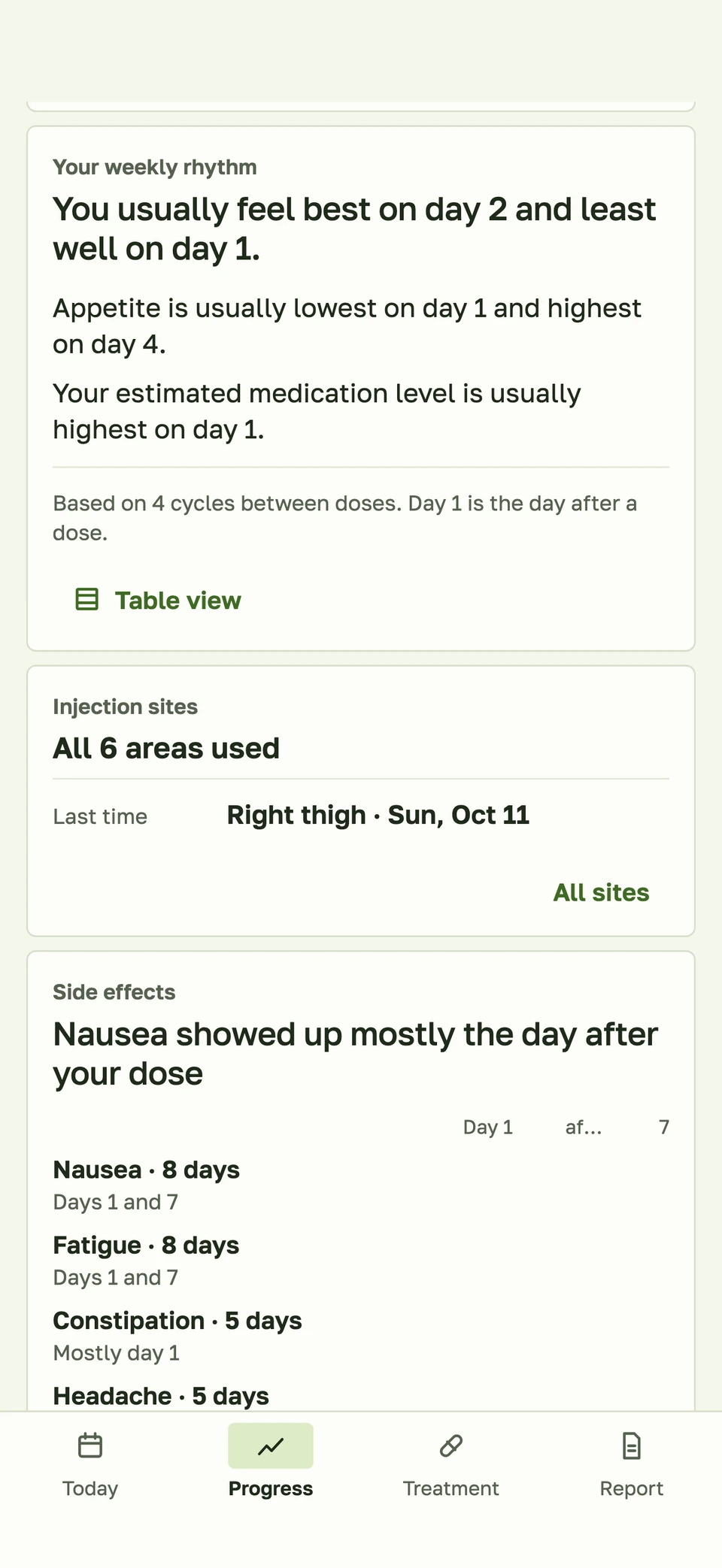
Vistadose weekly rhythm card showing side effects and appetite by day after the dose
Your weekly rhythm: side effects and appetite by day after the dose.

The estimated level chart

For supported medications, Vistadose draws an estimated medication level from your logged doses and published average data, so you can see where your side-effect days fall in the week. It is an estimate, not a measurement, and must not be used to choose a dose. Vistadose never calculates or suggests doses.

A report for your doctor

The Report tab builds a PDF for up to 90 days: side effects with the highest strength reached, appetite, your notes and a "Usual week between doses" summary. Add your questions, then share, print or show it on your phone. It is made on the phone; nothing is uploaded. See also the GLP-1 appointment checklist.

How Vistadose helps

A GLP-1 side effects tracker should take less effort than the side effects. Vistadose needs no account, shows no ads and keeps your entries encrypted on your phone. The check-in, weekly rhythm, doctor report and encrypted backup to a file are free. Plus adds deeper insights (dose comparison, correlations, a monthly review), a report in a second language and an automatic Google Drive copy.

See what Vistadose does or download it free for iPhone and Android.

FAQ

How long should I keep a GLP-1 side effect diary? At least through the first months and every dose change, when side effects are most likely to shift.

Do I need to log days with no side effects? Yes. Without "none" days, you cannot tell a good week from a forgotten one.

Can the app tell me if a symptom is dangerous? No. Vistadose records and summarises what you enter. If you have warning signs like severe stomach pain or signs of dehydration, contact a doctor or urgent care.

Does my diary leave my phone? Not unless you share a report or export it yourself. If you turn on the optional Google Drive copy in Plus, it is stored encrypted.

Vistadose is not a medical device and does not replace advice from your doctor.
Lypii Apps
Vistadose

How to Keep a GLP-1 Side Effect Diary

What to write in a GLP-1 side effect diary, how weekly patterns show up, which warning signs need a doctor, and how a simple daily check-in makes it easy.

A GLP-1 side effect diary is a short daily note about how you feel on your medication: what showed up, how strong it was, and how many days it came after your dose. After a few weeks it answers questions memory can't, like "Is the nausea getting better?" or "Why is Monday always my worst day?"

This guide covers what to record, how patterns show up across the week, which warning signs mean you should contact a doctor, and how Vistadose keeps the whole thing quick.

Why a GLP-1 side effect diary beats memory

Most side effects of semaglutide, tirzepatide, liraglutide and dulaglutide sit in the stomach and gut: feeling sick, diarrhoea, constipation, heartburn, tiredness. In a pooled analysis of three large semaglutide trials, these effects were mostly mild to moderate and short-lived, and most common around dose increases. So they come and go, and by your next appointment the bad week has blurred into "it was fine, mostly."

A written symptom log gives your doctor dates, strength and timing instead of a vague impression, and shows you whether something is fading or sticking around.

What to record each day

Keep it short. A diary you fill in daily beats a detailed one you abandon after a week.

The essentials:

  • The symptom. Name it plainly: nausea, constipation, heartburn, headache, a sore injection site.
  • How strong it was. Use the same three words every time. Mild: noticeable, but it does not get in the way. Moderate: it gets in the way of some things. Severe: hard to get through your usual day.
  • Day after the dose. If you inject on Sunday, Monday is day 1, Tuesday is day 2, and so on. This one number does most of the work later.
  • Appetite. A score out of 10 is enough.
  • Food and fluids. Roughly how much you drank, and anything unusual (a big fatty meal, alcohol).
  • What helped, if anything. Smaller meals, a walk, an early night. You are collecting facts to discuss, not running experiments.

Worth adding when it applies:

  • A dose change, or a missed or late dose
  • How long a symptom lasted ("nausea from 10 am to about 3 pm")
  • Questions for your doctor

If you also track your shots, a separate GLP-1 injection log keeps dose, time and site in one place, so the diary can stay about how you feel.

A sample diary week

Here is what one week might look like for someone who injects on Sunday morning:

Day Day after dose Side effects Appetite Notes
Sun dose day none 6/10 Dose 8 am, left thigh
Mon 1 nausea, moderate 3/10 Skipped dinner. About 5 glasses of water
Tue 2 nausea, mild 4/10 Better after a light breakfast
Wed 3 constipation, mild 5/10
Thu 4 none 7/10 Felt normal
Fri 5 none 7/10
Sat 6 tired, mild 6/10 Late night

One week tells you little. Four weeks start to tell a story.

How patterns show up across the week

For weekly injections, ask "Which day after the dose do I usually feel sick?" rather than "Which date?" Line up your weeks by day after the dose and look down the columns.

Things people often notice:

  • Nausea after injection clusters early, often on day 1 or 2, fading by midweek.
  • Appetite has a shape: lowest soon after the dose, higher toward the end of the cycle.
  • Changes follow dose increases: a rough week after a step up, then calmer ones.
  • Some things have other causes. A headache only on low-water days points elsewhere.

Three or four cycles are usually enough to tell a real pattern from a one-off bad week. On a daily injection, look at weeks and dose changes instead.

When to contact a doctor

A diary can't tell you whether something is serious. Official patient guidance for these medicines lists warning signs that need help right away, including:

  • Severe stomach pain that does not go away, sometimes spreading to the back, with or without vomiting. The NHS lists this as a possible sign of acute pancreatitis on its semaglutide side effects page.
  • Severe pain in the upper stomach, yellowing of the skin or eyes, fever or pale stools, which can point to gallbladder problems. See the US National Library of Medicine's semaglutide injection information and the NHS tirzepatide page.
  • Passing much less urine, or swelling of the legs, ankles or feet.
  • Signs of dehydration after vomiting or diarrhoea: dark yellow urine, passing urine less often, dizziness that does not go away when you stand up, unusual tiredness. The NHS explains when dehydration needs urgent advice.
  • Signs of a serious allergic reaction: swelling of the throat or tongue, trouble breathing, a raised itchy rash.

If you have any of these, contact your doctor, your urgent advice line or emergency care. For milder side effects that keep bothering you, talk to your doctor or pharmacist. Don't change or skip doses because of what a diary or app shows.

How Vistadose turns the diary into a two-minute habit

Everything above works on paper. Vistadose does it with fewer taps and does the counting for you.

A quick evening check-in

On the Today screen, an Evening check-in asks how your day was (1 to 5), "Any side effects today?", your appetite, and water and protein. Pick side effects from a list (nausea, constipation, diarrhoea, heartburn, fatigue, headache, injection site reaction) or add your own, each rated mild, moderate or severe. Tap None today on good days, or Same as yesterday when nothing changed. "Add details for your doctor" holds what happened and how long it lasted.

Vistadose Today screen with the week summary and the evening check-in
The Today screen: your week at a glance, then the evening check-in.

Your weekly rhythm

This is the "line your weeks up" step, done for you. On the Progress screen, Your weekly rhythm shows side effects, feeling and appetite by day after the dose, in sentences like "Appetite is usually lowest on day 1 and highest on day 4." It appears after three weeks of doses on a weekly medication. A Side effects card lists each symptom, how many days it appeared and on which days after the dose.

Vistadose weekly rhythm card showing side effects and appetite by day after the dose
Your weekly rhythm: side effects and appetite by day after the dose.

The estimated level chart

For supported medications, Vistadose draws an estimated medication level from your logged doses and published average data, so you can see where your side-effect days fall in the week. It is an estimate, not a measurement, and must not be used to choose a dose. Vistadose never calculates or suggests doses.

A report for your doctor

The Report tab builds a PDF for up to 90 days: side effects with the highest strength reached, appetite, your notes and a "Usual week between doses" summary. Add your questions, then share, print or show it on your phone. It is made on the phone; nothing is uploaded. See also the GLP-1 appointment checklist.

How Vistadose helps

A GLP-1 side effects tracker should take less effort than the side effects. Vistadose needs no account, shows no ads and keeps your entries encrypted on your phone. The check-in, weekly rhythm, doctor report and encrypted backup to a file are free. Plus adds deeper insights (dose comparison, correlations, a monthly review), a report in a second language and an automatic Google Drive copy.

See what Vistadose does or download it free for iPhone and Android.

FAQ

How long should I keep a GLP-1 side effect diary? At least through the first months and every dose change, when side effects are most likely to shift.

Do I need to log days with no side effects? Yes. Without "none" days, you cannot tell a good week from a forgotten one.

Can the app tell me if a symptom is dangerous? No. Vistadose records and summarises what you enter. If you have warning signs like severe stomach pain or signs of dehydration, contact a doctor or urgent care.

Does my diary leave my phone? Not unless you share a report or export it yourself. If you turn on the optional Google Drive copy in Plus, it is stored encrypted.

Vistadose is not a medical device and does not replace advice from your doctor.

ABOUT THIS APPVistadoseKeep a private record of your GLP-1 doses, injection sites and side effects. See how you feel between doses and bring a PDF report to your next appointment.
SHARE
Lypii AppsContact
Vistadose

How to Keep a GLP-1 Side Effect Diary

What to write in a GLP-1 side effect diary, how weekly patterns show up, which warning signs need a doctor, and how a simple daily check-in makes it easy.

A GLP-1 side effect diary is a short daily note about how you feel on your medication: what showed up, how strong it was, and how many days it came after your dose. After a few weeks it answers questions memory can't, like "Is the nausea getting better?" or "Why is Monday always my worst day?"

This guide covers what to record, how patterns show up across the week, which warning signs mean you should contact a doctor, and how Vistadose keeps the whole thing quick.

Why a GLP-1 side effect diary beats memory

Most side effects of semaglutide, tirzepatide, liraglutide and dulaglutide sit in the stomach and gut: feeling sick, diarrhoea, constipation, heartburn, tiredness. In a pooled analysis of three large semaglutide trials, these effects were mostly mild to moderate and short-lived, and most common around dose increases. So they come and go, and by your next appointment the bad week has blurred into "it was fine, mostly."

A written symptom log gives your doctor dates, strength and timing instead of a vague impression, and shows you whether something is fading or sticking around.

What to record each day

Keep it short. A diary you fill in daily beats a detailed one you abandon after a week.

The essentials:

  • The symptom. Name it plainly: nausea, constipation, heartburn, headache, a sore injection site.
  • How strong it was. Use the same three words every time. Mild: noticeable, but it does not get in the way. Moderate: it gets in the way of some things. Severe: hard to get through your usual day.
  • Day after the dose. If you inject on Sunday, Monday is day 1, Tuesday is day 2, and so on. This one number does most of the work later.
  • Appetite. A score out of 10 is enough.
  • Food and fluids. Roughly how much you drank, and anything unusual (a big fatty meal, alcohol).
  • What helped, if anything. Smaller meals, a walk, an early night. You are collecting facts to discuss, not running experiments.

Worth adding when it applies:

  • A dose change, or a missed or late dose
  • How long a symptom lasted ("nausea from 10 am to about 3 pm")
  • Questions for your doctor

If you also track your shots, a separate GLP-1 injection log keeps dose, time and site in one place, so the diary can stay about how you feel.

A sample diary week

Here is what one week might look like for someone who injects on Sunday morning:

Day Day after dose Side effects Appetite Notes
Sun dose day none 6/10 Dose 8 am, left thigh
Mon 1 nausea, moderate 3/10 Skipped dinner. About 5 glasses of water
Tue 2 nausea, mild 4/10 Better after a light breakfast
Wed 3 constipation, mild 5/10
Thu 4 none 7/10 Felt normal
Fri 5 none 7/10
Sat 6 tired, mild 6/10 Late night

One week tells you little. Four weeks start to tell a story.

How patterns show up across the week

For weekly injections, ask "Which day after the dose do I usually feel sick?" rather than "Which date?" Line up your weeks by day after the dose and look down the columns.

Things people often notice:

  • Nausea after injection clusters early, often on day 1 or 2, fading by midweek.
  • Appetite has a shape: lowest soon after the dose, higher toward the end of the cycle.
  • Changes follow dose increases: a rough week after a step up, then calmer ones.
  • Some things have other causes. A headache only on low-water days points elsewhere.

Three or four cycles are usually enough to tell a real pattern from a one-off bad week. On a daily injection, look at weeks and dose changes instead.

When to contact a doctor

A diary can't tell you whether something is serious. Official patient guidance for these medicines lists warning signs that need help right away, including:

  • Severe stomach pain that does not go away, sometimes spreading to the back, with or without vomiting. The NHS lists this as a possible sign of acute pancreatitis on its semaglutide side effects page.
  • Severe pain in the upper stomach, yellowing of the skin or eyes, fever or pale stools, which can point to gallbladder problems. See the US National Library of Medicine's semaglutide injection information and the NHS tirzepatide page.
  • Passing much less urine, or swelling of the legs, ankles or feet.
  • Signs of dehydration after vomiting or diarrhoea: dark yellow urine, passing urine less often, dizziness that does not go away when you stand up, unusual tiredness. The NHS explains when dehydration needs urgent advice.
  • Signs of a serious allergic reaction: swelling of the throat or tongue, trouble breathing, a raised itchy rash.

If you have any of these, contact your doctor, your urgent advice line or emergency care. For milder side effects that keep bothering you, talk to your doctor or pharmacist. Don't change or skip doses because of what a diary or app shows.

How Vistadose turns the diary into a two-minute habit

Everything above works on paper. Vistadose does it with fewer taps and does the counting for you.

A quick evening check-in

On the Today screen, an Evening check-in asks how your day was (1 to 5), "Any side effects today?", your appetite, and water and protein. Pick side effects from a list (nausea, constipation, diarrhoea, heartburn, fatigue, headache, injection site reaction) or add your own, each rated mild, moderate or severe. Tap None today on good days, or Same as yesterday when nothing changed. "Add details for your doctor" holds what happened and how long it lasted.

Vistadose Today screen with the week summary and the evening check-in
The Today screen: your week at a glance, then the evening check-in.

Your weekly rhythm

This is the "line your weeks up" step, done for you. On the Progress screen, Your weekly rhythm shows side effects, feeling and appetite by day after the dose, in sentences like "Appetite is usually lowest on day 1 and highest on day 4." It appears after three weeks of doses on a weekly medication. A Side effects card lists each symptom, how many days it appeared and on which days after the dose.

Vistadose weekly rhythm card showing side effects and appetite by day after the dose
Your weekly rhythm: side effects and appetite by day after the dose.

The estimated level chart

For supported medications, Vistadose draws an estimated medication level from your logged doses and published average data, so you can see where your side-effect days fall in the week. It is an estimate, not a measurement, and must not be used to choose a dose. Vistadose never calculates or suggests doses.

A report for your doctor

The Report tab builds a PDF for up to 90 days: side effects with the highest strength reached, appetite, your notes and a "Usual week between doses" summary. Add your questions, then share, print or show it on your phone. It is made on the phone; nothing is uploaded. See also the GLP-1 appointment checklist.

How Vistadose helps

A GLP-1 side effects tracker should take less effort than the side effects. Vistadose needs no account, shows no ads and keeps your entries encrypted on your phone. The check-in, weekly rhythm, doctor report and encrypted backup to a file are free. Plus adds deeper insights (dose comparison, correlations, a monthly review), a report in a second language and an automatic Google Drive copy.

See what Vistadose does or download it free for iPhone and Android.

FAQ

How long should I keep a GLP-1 side effect diary? At least through the first months and every dose change, when side effects are most likely to shift.

Do I need to log days with no side effects? Yes. Without "none" days, you cannot tell a good week from a forgotten one.

Can the app tell me if a symptom is dangerous? No. Vistadose records and summarises what you enter. If you have warning signs like severe stomach pain or signs of dehydration, contact a doctor or urgent care.

Does my diary leave my phone? Not unless you share a report or export it yourself. If you turn on the optional Google Drive copy in Plus, it is stored encrypted.

Vistadose is not a medical device and does not replace advice from your doctor.

ABOUT THIS APPVistadoseKeep a private record of your GLP-1 doses, injection sites and side effects. See how you feel between doses and bring a PDF report to your next appointment.
SHARE