
Lypii Apps
TwoPillows

The Mental Load After a Baby: Five Often-Missed Jobs

The mental load after a baby is the noticing, planning and checking nobody sees. Five jobs couples often miss, and how to share them fairly.

Vaccinations next Tuesday. Nappies running low. The baby has outgrown the sleepsuits again. Grandma wants to know if Sunday still works. Someone has to notice all of this before it becomes a problem.

That noticing is the mental load after a baby: the planning, remembering and checking that keeps a family running. It doesn't show up on any to-do list, because it's the work of writing the list in the first place. And because nobody sees it, it's one of the most common reasons new parents end up feeling alone, even when both are working flat out.

This article explains what the mental load is, names five jobs couples most often miss when they divide the work, and shows how to make them visible and shared.

What the mental load actually is

Sociologist Allison Daminger interviewed 35 couples and described this work as cognitive labour. She broke it into four steps:

  1. Anticipating a need ("we'll need the next size soon").
  2. Identifying options ("these ones, or the ones from that shop").
  3. Deciding ("let's get these").
  4. Monitoring ("did they arrive? do they fit?").

The interesting part: in most couples she studied, decisions were shared. But one person did far more of the anticipating and monitoring. Because deciding feels like the important bit, a couple who decides together can feel equal while one partner quietly carries the rest.

With a newborn, the amount of this work explodes. The person carrying it often feels tired in a way that's hard to explain: "I didn't do anything today", yet their head never stopped.

Five jobs that are easy to miss

When couples divide baby care, they usually think of the visible jobs: feeds, nappies, baths, cooking. These five tend to slip through the gaps and land, by default, on whoever notices first.

1. Keeping supplies stocked

Nappies, wipes, nappy cream, formula, bottle teats, the right size of everything. Running out at 11 p.m. is a crisis; noticing three days earlier is invisible. Whoever owns this job tracks what's running low and reorders before it runs out. It's a small job with a big payoff, because nothing creates more last-minute stress.

2. The health calendar

Baby check-ups, vaccinations on schedule, the postnatal check for the parent who gave birth, physio, repeat prescriptions, a thermometer and baby medicines in date with the right doses written down. Each appointment is short. Keeping the whole calendar in your head is not. The owner knows when the next one is due, books it, brings the record and goes, or arranges who goes.

3. Clothes that fit

Babies outgrow clothes in weeks. Someone has to notice the sleepsuits getting tight, sort out what's too small, find the next size and put the outgrown ones away or pass them on. It sounds trivial until you realise how many evenings it quietly takes up.

4. Family and visitors

Answering the grandparents. Deciding who visits when and for how long. Sending photos, thank-you messages for gifts, remembering birthdays now that there's less headspace than ever. This social work is real work, and it often falls along old lines: each partner handling "their" side of the family, or one person handling both.

5. Paperwork with deadlines

Registering the birth, applying for parental leave and benefits on time, adding the baby to health insurance, getting an ID or passport, and putting your name on childcare waiting lists months in advance. These are one-off jobs with real deadlines, and they're often forgotten until they're urgent.

How to share the mental load

Make it visible first. For one day, the partner who carries more of it says out loud every single thing they remember. Both of you are usually surprised. You can't share what you can't see.

Hand over whole areas, not single tasks. "Doctor's appointments are yours" includes noticing they're due, booking, going and following up. "Can you book the next one?" only hands over the doing.

Don't hand it back. If an area is yours, you remember it. Asking "when is it again?" returns the thinking to your partner.

Write things where you both see them. Shared lists, not one person's head.

Thank each other for the invisible. Gratitude researcher Sara Algoe found that when one partner felt thanked by the other, both felt more satisfied with the relationship the next day. Specific thanks works best: not "thanks for everything", but "thanks for booking the jabs, I'd completely forgotten". And it gets harder exactly when you need it most: researchers at UC Berkeley found that people who had slept badly showed less appreciation for their partner.

How TwoPillows makes the invisible visible

TwoPillows was built with the mental load in mind. Three features do most of the work.
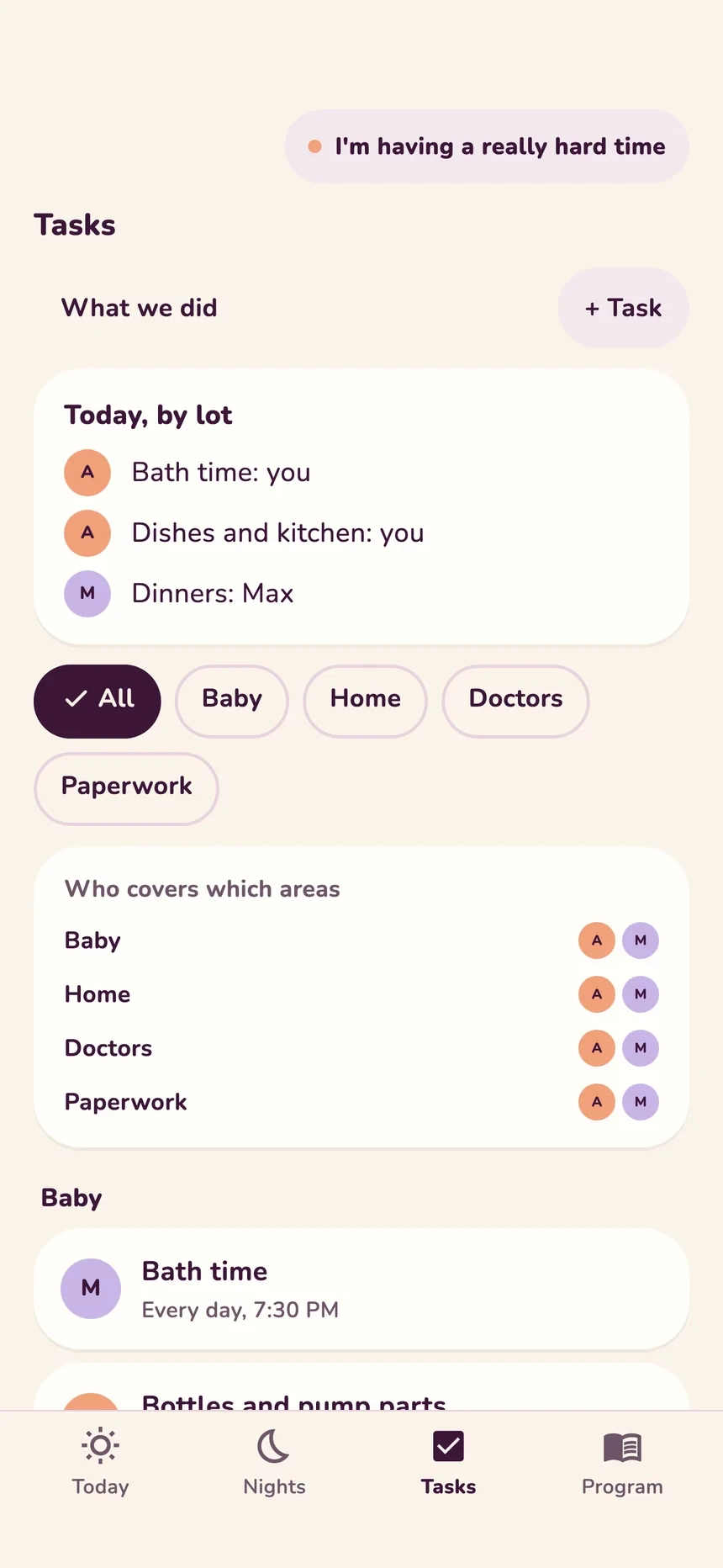
The TwoPillows Tasks tab showing tasks grouped by Baby, Home, Doctors and Paperwork, with a view of who covers which area

Tasks with an owner, including the thinking. In the Tasks tab, you deal out a deck of cards together, and every card has one owner. Ownership is spelled out on the card as three steps: remember, prepare, do. All five jobs above are in the deck: "Nappies and supplies", "Baby check-ups", "Vaccinations on schedule", "Medicine cabinet", "Clothes that fit", "Visitors", "Registering the birth", "Parental leave and benefits", "Childcare" and more. Each comes with a line that describes the whole job, for example "Track nappies, wipes and cream, reorder before they run out." The app also shows who covers which area (baby, home, doctors, paperwork) and gently points out when most of the everyday tasks sit with one person.

One-tap invisible tasks. Most mental-load work never becomes a formal task. You just do it. So TwoPillows lets you log it in one tap: "Booked a doctor", "Ordered groceries", "Answered the grandparents", "Sorted out clothes", "Looked something up for the baby", "Planned the meals", "Paid the bills", or your own words. The Today screen also asks a simple question: what did you do that no one saw?
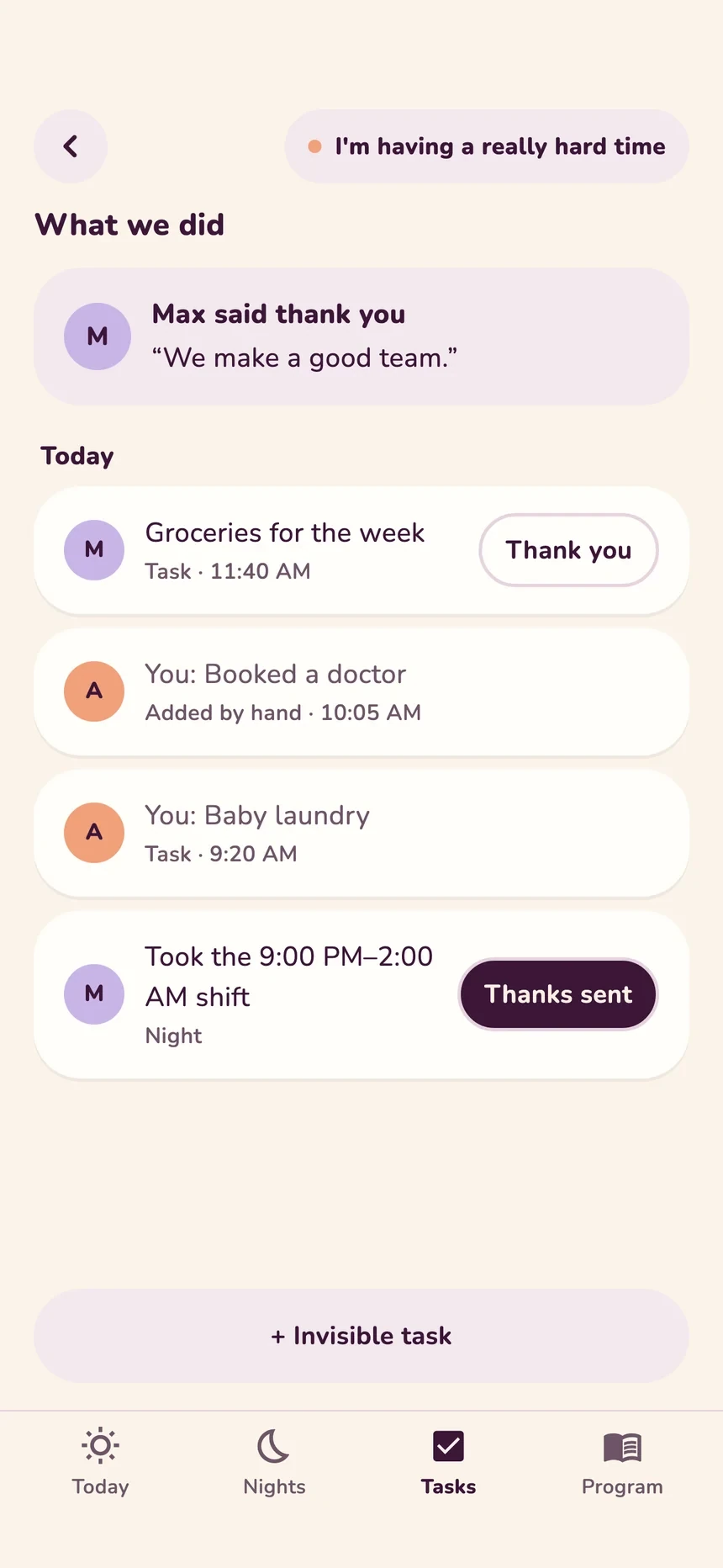
The "What we did" feed in TwoPillows, with tasks, a night shift and an invisible task, and a thank-you from a partner

A shared feed of what you both did. Finished tasks, night shifts and invisible jobs all land in one feed, "What we did". There's no counter and no scoreboard, on purpose. The feed isn't there to prove who did more. It's there so your partner can see the work and say thank you, with their own words or a ready phrase, even when you're on different shifts.

The lesson program has short lessons on this too, including "Who remembers?" and "Thanks for what nobody saw", each with a one-minute version and a detailed one.

When it still feels uneven

Even with a good split, the load shifts. One of you goes back to work, the baby starts solids, nursery begins. Ohio State researchers found that new parents tend to overestimate how much they contribute, so don't argue from impressions. Look at what's actually on each person's list, including the nights, and redeal a few cards. Aim for a load you both see and both agree to, not a perfect fifty-fifty.

Tonight, pick one of the five jobs above that nobody officially owns. Decide together who takes it, all of it. Or get TwoPillows and deal the whole deck in ten minutes. Tasks, the feed and thank-yous are free.

Lypii Apps
TwoPillows

The Mental Load After a Baby: Five Often-Missed Jobs

The mental load after a baby is the noticing, planning and checking nobody sees. Five jobs couples often miss, and how to share them fairly.

Vaccinations next Tuesday. Nappies running low. The baby has outgrown the sleepsuits again. Grandma wants to know if Sunday still works. Someone has to notice all of this before it becomes a problem.

That noticing is the mental load after a baby: the planning, remembering and checking that keeps a family running. It doesn't show up on any to-do list, because it's the work of writing the list in the first place. And because nobody sees it, it's one of the most common reasons new parents end up feeling alone, even when both are working flat out.

This article explains what the mental load is, names five jobs couples most often miss when they divide the work, and shows how to make them visible and shared.

What the mental load actually is

Sociologist Allison Daminger interviewed 35 couples and described this work as cognitive labour. She broke it into four steps:

  1. Anticipating a need ("we'll need the next size soon").
  2. Identifying options ("these ones, or the ones from that shop").
  3. Deciding ("let's get these").
  4. Monitoring ("did they arrive? do they fit?").

The interesting part: in most couples she studied, decisions were shared. But one person did far more of the anticipating and monitoring. Because deciding feels like the important bit, a couple who decides together can feel equal while one partner quietly carries the rest.

With a newborn, the amount of this work explodes. The person carrying it often feels tired in a way that's hard to explain: "I didn't do anything today", yet their head never stopped.

Five jobs that are easy to miss

When couples divide baby care, they usually think of the visible jobs: feeds, nappies, baths, cooking. These five tend to slip through the gaps and land, by default, on whoever notices first.

1. Keeping supplies stocked

Nappies, wipes, nappy cream, formula, bottle teats, the right size of everything. Running out at 11 p.m. is a crisis; noticing three days earlier is invisible. Whoever owns this job tracks what's running low and reorders before it runs out. It's a small job with a big payoff, because nothing creates more last-minute stress.

2. The health calendar

Baby check-ups, vaccinations on schedule, the postnatal check for the parent who gave birth, physio, repeat prescriptions, a thermometer and baby medicines in date with the right doses written down. Each appointment is short. Keeping the whole calendar in your head is not. The owner knows when the next one is due, books it, brings the record and goes, or arranges who goes.

3. Clothes that fit

Babies outgrow clothes in weeks. Someone has to notice the sleepsuits getting tight, sort out what's too small, find the next size and put the outgrown ones away or pass them on. It sounds trivial until you realise how many evenings it quietly takes up.

4. Family and visitors

Answering the grandparents. Deciding who visits when and for how long. Sending photos, thank-you messages for gifts, remembering birthdays now that there's less headspace than ever. This social work is real work, and it often falls along old lines: each partner handling "their" side of the family, or one person handling both.

5. Paperwork with deadlines

Registering the birth, applying for parental leave and benefits on time, adding the baby to health insurance, getting an ID or passport, and putting your name on childcare waiting lists months in advance. These are one-off jobs with real deadlines, and they're often forgotten until they're urgent.

How to share the mental load

Make it visible first. For one day, the partner who carries more of it says out loud every single thing they remember. Both of you are usually surprised. You can't share what you can't see.

Hand over whole areas, not single tasks. "Doctor's appointments are yours" includes noticing they're due, booking, going and following up. "Can you book the next one?" only hands over the doing.

Don't hand it back. If an area is yours, you remember it. Asking "when is it again?" returns the thinking to your partner.

Write things where you both see them. Shared lists, not one person's head.

Thank each other for the invisible. Gratitude researcher Sara Algoe found that when one partner felt thanked by the other, both felt more satisfied with the relationship the next day. Specific thanks works best: not "thanks for everything", but "thanks for booking the jabs, I'd completely forgotten". And it gets harder exactly when you need it most: researchers at UC Berkeley found that people who had slept badly showed less appreciation for their partner.

How TwoPillows makes the invisible visible

TwoPillows was built with the mental load in mind. Three features do most of the work.

The TwoPillows Tasks tab showing tasks grouped by Baby, Home, Doctors and Paperwork, with a view of who covers which area

Tasks with an owner, including the thinking. In the Tasks tab, you deal out a deck of cards together, and every card has one owner. Ownership is spelled out on the card as three steps: remember, prepare, do. All five jobs above are in the deck: "Nappies and supplies", "Baby check-ups", "Vaccinations on schedule", "Medicine cabinet", "Clothes that fit", "Visitors", "Registering the birth", "Parental leave and benefits", "Childcare" and more. Each comes with a line that describes the whole job, for example "Track nappies, wipes and cream, reorder before they run out." The app also shows who covers which area (baby, home, doctors, paperwork) and gently points out when most of the everyday tasks sit with one person.

One-tap invisible tasks. Most mental-load work never becomes a formal task. You just do it. So TwoPillows lets you log it in one tap: "Booked a doctor", "Ordered groceries", "Answered the grandparents", "Sorted out clothes", "Looked something up for the baby", "Planned the meals", "Paid the bills", or your own words. The Today screen also asks a simple question: what did you do that no one saw?

The "What we did" feed in TwoPillows, with tasks, a night shift and an invisible task, and a thank-you from a partner

A shared feed of what you both did. Finished tasks, night shifts and invisible jobs all land in one feed, "What we did". There's no counter and no scoreboard, on purpose. The feed isn't there to prove who did more. It's there so your partner can see the work and say thank you, with their own words or a ready phrase, even when you're on different shifts.

The lesson program has short lessons on this too, including "Who remembers?" and "Thanks for what nobody saw", each with a one-minute version and a detailed one.

When it still feels uneven

Even with a good split, the load shifts. One of you goes back to work, the baby starts solids, nursery begins. Ohio State researchers found that new parents tend to overestimate how much they contribute, so don't argue from impressions. Look at what's actually on each person's list, including the nights, and redeal a few cards. Aim for a load you both see and both agree to, not a perfect fifty-fifty.

Tonight, pick one of the five jobs above that nobody officially owns. Decide together who takes it, all of it. Or get TwoPillows and deal the whole deck in ten minutes. Tasks, the feed and thank-yous are free.

ABOUT THIS APPTwoPillowsDecide who’s up with the baby and who’s taking care of each job. You can start on your own and invite your partner when you’re ready.
SHARE
Lypii AppsContact
TwoPillows

The Mental Load After a Baby: Five Often-Missed Jobs

The mental load after a baby is the noticing, planning and checking nobody sees. Five jobs couples often miss, and how to share them fairly.

Vaccinations next Tuesday. Nappies running low. The baby has outgrown the sleepsuits again. Grandma wants to know if Sunday still works. Someone has to notice all of this before it becomes a problem.

That noticing is the mental load after a baby: the planning, remembering and checking that keeps a family running. It doesn't show up on any to-do list, because it's the work of writing the list in the first place. And because nobody sees it, it's one of the most common reasons new parents end up feeling alone, even when both are working flat out.

This article explains what the mental load is, names five jobs couples most often miss when they divide the work, and shows how to make them visible and shared.

What the mental load actually is

Sociologist Allison Daminger interviewed 35 couples and described this work as cognitive labour. She broke it into four steps:

  1. Anticipating a need ("we'll need the next size soon").
  2. Identifying options ("these ones, or the ones from that shop").
  3. Deciding ("let's get these").
  4. Monitoring ("did they arrive? do they fit?").

The interesting part: in most couples she studied, decisions were shared. But one person did far more of the anticipating and monitoring. Because deciding feels like the important bit, a couple who decides together can feel equal while one partner quietly carries the rest.

With a newborn, the amount of this work explodes. The person carrying it often feels tired in a way that's hard to explain: "I didn't do anything today", yet their head never stopped.

Five jobs that are easy to miss

When couples divide baby care, they usually think of the visible jobs: feeds, nappies, baths, cooking. These five tend to slip through the gaps and land, by default, on whoever notices first.

1. Keeping supplies stocked

Nappies, wipes, nappy cream, formula, bottle teats, the right size of everything. Running out at 11 p.m. is a crisis; noticing three days earlier is invisible. Whoever owns this job tracks what's running low and reorders before it runs out. It's a small job with a big payoff, because nothing creates more last-minute stress.

2. The health calendar

Baby check-ups, vaccinations on schedule, the postnatal check for the parent who gave birth, physio, repeat prescriptions, a thermometer and baby medicines in date with the right doses written down. Each appointment is short. Keeping the whole calendar in your head is not. The owner knows when the next one is due, books it, brings the record and goes, or arranges who goes.

3. Clothes that fit

Babies outgrow clothes in weeks. Someone has to notice the sleepsuits getting tight, sort out what's too small, find the next size and put the outgrown ones away or pass them on. It sounds trivial until you realise how many evenings it quietly takes up.

4. Family and visitors

Answering the grandparents. Deciding who visits when and for how long. Sending photos, thank-you messages for gifts, remembering birthdays now that there's less headspace than ever. This social work is real work, and it often falls along old lines: each partner handling "their" side of the family, or one person handling both.

5. Paperwork with deadlines

Registering the birth, applying for parental leave and benefits on time, adding the baby to health insurance, getting an ID or passport, and putting your name on childcare waiting lists months in advance. These are one-off jobs with real deadlines, and they're often forgotten until they're urgent.

How to share the mental load

Make it visible first. For one day, the partner who carries more of it says out loud every single thing they remember. Both of you are usually surprised. You can't share what you can't see.

Hand over whole areas, not single tasks. "Doctor's appointments are yours" includes noticing they're due, booking, going and following up. "Can you book the next one?" only hands over the doing.

Don't hand it back. If an area is yours, you remember it. Asking "when is it again?" returns the thinking to your partner.

Write things where you both see them. Shared lists, not one person's head.

Thank each other for the invisible. Gratitude researcher Sara Algoe found that when one partner felt thanked by the other, both felt more satisfied with the relationship the next day. Specific thanks works best: not "thanks for everything", but "thanks for booking the jabs, I'd completely forgotten". And it gets harder exactly when you need it most: researchers at UC Berkeley found that people who had slept badly showed less appreciation for their partner.

How TwoPillows makes the invisible visible

TwoPillows was built with the mental load in mind. Three features do most of the work.

The TwoPillows Tasks tab showing tasks grouped by Baby, Home, Doctors and Paperwork, with a view of who covers which area

Tasks with an owner, including the thinking. In the Tasks tab, you deal out a deck of cards together, and every card has one owner. Ownership is spelled out on the card as three steps: remember, prepare, do. All five jobs above are in the deck: "Nappies and supplies", "Baby check-ups", "Vaccinations on schedule", "Medicine cabinet", "Clothes that fit", "Visitors", "Registering the birth", "Parental leave and benefits", "Childcare" and more. Each comes with a line that describes the whole job, for example "Track nappies, wipes and cream, reorder before they run out." The app also shows who covers which area (baby, home, doctors, paperwork) and gently points out when most of the everyday tasks sit with one person.

One-tap invisible tasks. Most mental-load work never becomes a formal task. You just do it. So TwoPillows lets you log it in one tap: "Booked a doctor", "Ordered groceries", "Answered the grandparents", "Sorted out clothes", "Looked something up for the baby", "Planned the meals", "Paid the bills", or your own words. The Today screen also asks a simple question: what did you do that no one saw?

The "What we did" feed in TwoPillows, with tasks, a night shift and an invisible task, and a thank-you from a partner

A shared feed of what you both did. Finished tasks, night shifts and invisible jobs all land in one feed, "What we did". There's no counter and no scoreboard, on purpose. The feed isn't there to prove who did more. It's there so your partner can see the work and say thank you, with their own words or a ready phrase, even when you're on different shifts.

The lesson program has short lessons on this too, including "Who remembers?" and "Thanks for what nobody saw", each with a one-minute version and a detailed one.

When it still feels uneven

Even with a good split, the load shifts. One of you goes back to work, the baby starts solids, nursery begins. Ohio State researchers found that new parents tend to overestimate how much they contribute, so don't argue from impressions. Look at what's actually on each person's list, including the nights, and redeal a few cards. Aim for a load you both see and both agree to, not a perfect fifty-fifty.

Tonight, pick one of the five jobs above that nobody officially owns. Decide together who takes it, all of it. Or get TwoPillows and deal the whole deck in ten minutes. Tasks, the feed and thank-yous are free.

ABOUT THIS APPTwoPillowsDecide who’s up with the baby and who’s taking care of each job. You can start on your own and invite your partner when you’re ready.
SHARE