
Lypii Apps
TwoPillows

Sharing Baby-Care Tasks: Agree on Who Owns Each Job

Sharing baby care tasks works best when each job has one owner who remembers, prepares and does it. A practical way to divide the work as new parents.

Most new parents start with the best intentions. "We'll share everything." "Whoever's free does it." Then the baby arrives, and within a few weeks one of you is quietly keeping track of almost everything, while the other helps whenever asked.

Nobody planned it that way. It just happens, and it's one of the most common sources of tension in the first year. The good news is that it can be prevented with a surprisingly simple shift: stop sharing tasks and start owning them.

This guide explains why "we'll both do it" tends to fail, how ownership works in practice, and how to divide baby-care tasks in about ten minutes.

Why "we'll share it" quietly turns into "one of us does it"

Researchers at Ohio State University followed dual-earner couples from pregnancy into parenthood and asked them to keep detailed time diaries. Before the birth, the partners' total workloads were about even. After it, a gap appeared: the extra work that came with the baby fell much more on one partner. And when the same parents estimated their hours in a survey, both believed they had added more than they actually had. Memory is generous.

Part of the reason is that "sharing" a task usually means sharing the doing, but not the thinking. Someone still has to notice that the nappies are running low, remember that the vaccinations are due, and check that the bottles are clean before bedtime. Sociologist Allison Daminger calls this cognitive labour: anticipating a need, finding options, deciding and checking that it got done. In most couples she studied, one person did far more of the noticing and checking, even when decisions were made together.

When a task belongs to both of you, the noticing usually falls to whoever notices first. Over weeks, that becomes the same person every time.

Ownership: one job, one owner, all three steps

The fix is to give each job one owner, and to make ownership mean all of it:

  1. Remember. The owner knows when it's due without being reminded.
  2. Prepare. The owner makes sure everything needed is there.
  3. Do. The owner does it, or arranges for it to be done.

Take bath time. "You do the bath" means getting the baby wet. "Bath time is yours" means knowing it's due at 7:30, having water, towels and clean clothes ready, and giving the bath. If you're stuck at work, you arrange a swap. Your partner doesn't have to think about it at all.

Ownership doesn't mean the owner does every single bath forever. It means the owner carries the job, including the thinking. That's what actually takes weight off the other person's mind.

How to divide baby-care tasks in ten minutes

Sit down together, ideally before the birth or in a calm moment, and go through the jobs one by one. For each, decide one of three things: I'll take it, you take it, or we don't need this.

A typical list covers four areas:

  • Baby: bath time, bottles and pump parts, night feed set-up, baby laundry, nappies and supplies, clothes that fit, bedtime routine.
  • Home: groceries, dinners, laundry, dishes, cleaning, bins, visitors.
  • Doctors: baby check-ups, vaccinations, recovery after birth, the medicine cabinet, sick days.
  • Paperwork: registering the birth, parental leave and benefits, insurance and IDs, childcare, bills.

Some tips that make the split stick:

Hand over whole areas, not single chores. "Doctor's appointments are yours" is clearer than "can you book the next one?". It includes noticing they're due, booking, going and following up.

Fair doesn't mean fifty-fifty on every list. One of you may be recovering from the birth or feeding at the breast. One may be back at work sooner. Look at the whole picture, including nights.

Let the owner do it their way. Research by Sarah Schoppe-Sullivan at Ohio State found that encouragement from one parent makes the other more involved in childcare, while frequent criticism has the opposite effect. If the nappy is on slightly crooked but it's on, let it be. That's how a job really becomes the other person's.

Don't hand it back. If an area is yours, you remember it. Asking "when is it again?" quietly returns the thinking to your partner.

Look again after a few weeks. The first split is a guess. Real life will show what doesn't fit.

How TwoPillows makes ownership easy

TwoPillows has a Tasks tab built around exactly this idea.
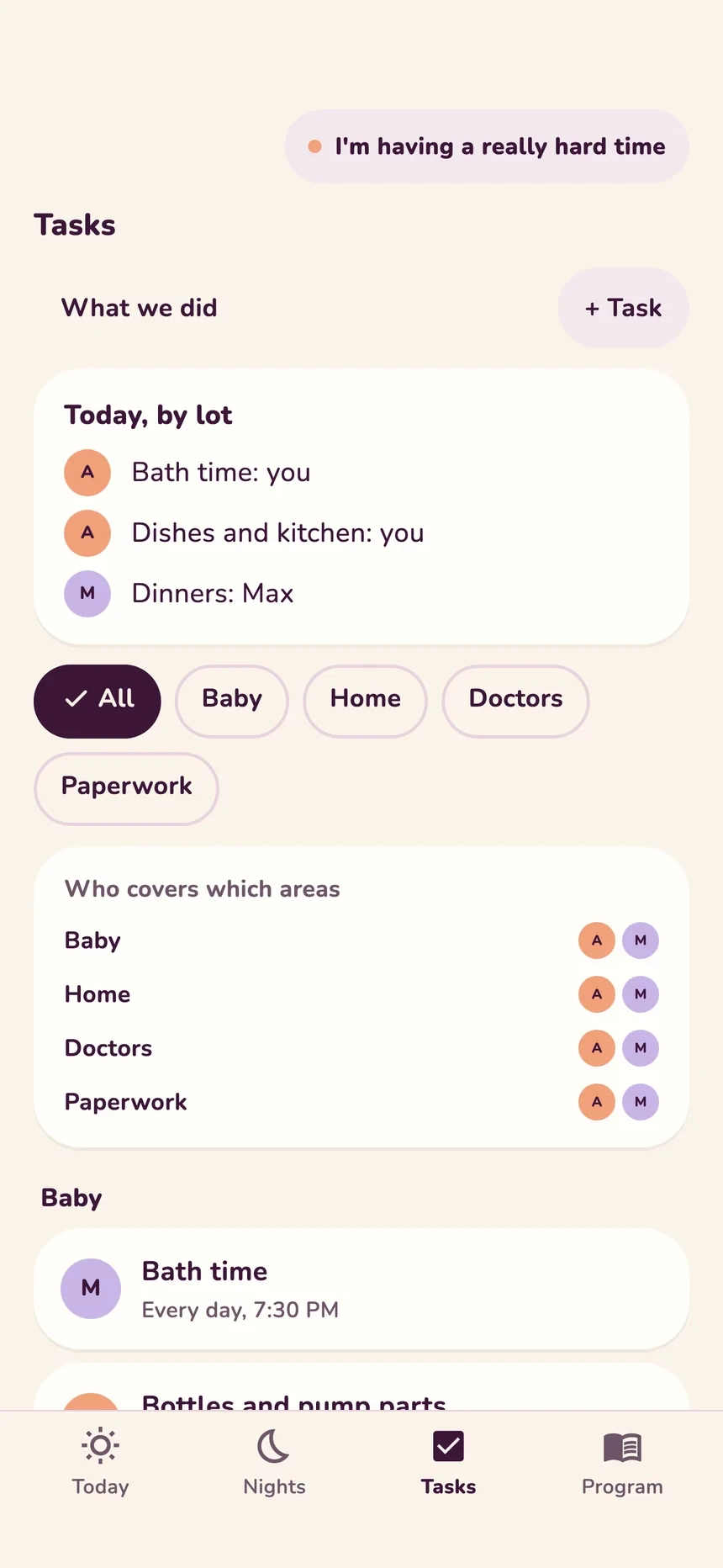
The TwoPillows Tasks tab with tasks grouped by area and a summary of who covers Baby, Home, Doctors and Paperwork

Dealing the cards. The first time you open Tasks, the app suggests dealing them out. You get a deck of about thirty cards covering baby, home, doctors and paperwork. You go through them one at a time, together on one phone, and for each card choose "I'll take it", "Max takes it" (or whatever your partner's name is), or "We don't need this". It takes about ten minutes. You can pause and come back, and if your partner hasn't joined yet you can deal on your own. In that case the cards you give them become suggestions, which they can accept or hand back.

Ownership is written on the card. Every task shows who owns it and what that means: remember, prepare, do. The bath card, for example, says "Know when it's due, have water, towels and clothes ready, give the bath." No more "I thought you were doing it".

A view of the balance. The Tasks tab shows who covers which areas: baby, home, doctors, paperwork. If most of the everyday tasks sit with one of you, the app points it out gently and suggests a look together. It's a nudge, not a score.

Room for real life. Tasks can repeat every day, week or month, or only when needed, and each one can have a note for something worth remembering. If your partner is swamped, you can offer to take one of their tasks over, and they decide whether to hand it over or keep it. When the owner does something differently from you, the app sometimes offers a small tip: let it be all theirs, even if they do it their way.

A bit of play for hard days. On days when nobody wants anything, there's a lottery. Draw up to three of today's tasks and let chance decide who does each, just for today. Nobody's cards change.

Done means seen. When a task is done, it appears in your shared feed of what each of you did, so the work doesn't disappear the moment it's finished. Your partner can say thank you in one tap.

Common sticking points

"It's quicker if I just do it myself." It is, for the first few times. But every time you step in, the job comes back to you, along with the thinking. Give the owner a few weeks to find their own way.

"We disagree about how it should be done." Agree on the few things that really matter, such as safe sleep rules or medicine doses, and let the rest go. Different isn't wrong.

"One of us is home all day, so of course they do more." Maybe, and that can be a fair deal. Just make it a decision you both made, not something that happened by default. And remember that the evening and the night count too.

A team, not a manager and a helper

Couples who see themselves as one parenting team tend to do better. The Family Foundations programme, which teaches expectant couples to support each other as co-parents, found benefits for both the parents and the baby. Sharing the load clearly, with one owner for each job, is one of the most practical ways to work as that team.

Tonight, pick three jobs that cause the most friction in your home and give each one an owner. Or get TwoPillows and deal the whole deck together in ten minutes. Tasks are free, and so is the night plan.

Lypii Apps
TwoPillows

Sharing Baby-Care Tasks: Agree on Who Owns Each Job

Sharing baby care tasks works best when each job has one owner who remembers, prepares and does it. A practical way to divide the work as new parents.

Most new parents start with the best intentions. "We'll share everything." "Whoever's free does it." Then the baby arrives, and within a few weeks one of you is quietly keeping track of almost everything, while the other helps whenever asked.

Nobody planned it that way. It just happens, and it's one of the most common sources of tension in the first year. The good news is that it can be prevented with a surprisingly simple shift: stop sharing tasks and start owning them.

This guide explains why "we'll both do it" tends to fail, how ownership works in practice, and how to divide baby-care tasks in about ten minutes.

Why "we'll share it" quietly turns into "one of us does it"

Researchers at Ohio State University followed dual-earner couples from pregnancy into parenthood and asked them to keep detailed time diaries. Before the birth, the partners' total workloads were about even. After it, a gap appeared: the extra work that came with the baby fell much more on one partner. And when the same parents estimated their hours in a survey, both believed they had added more than they actually had. Memory is generous.

Part of the reason is that "sharing" a task usually means sharing the doing, but not the thinking. Someone still has to notice that the nappies are running low, remember that the vaccinations are due, and check that the bottles are clean before bedtime. Sociologist Allison Daminger calls this cognitive labour: anticipating a need, finding options, deciding and checking that it got done. In most couples she studied, one person did far more of the noticing and checking, even when decisions were made together.

When a task belongs to both of you, the noticing usually falls to whoever notices first. Over weeks, that becomes the same person every time.

Ownership: one job, one owner, all three steps

The fix is to give each job one owner, and to make ownership mean all of it:

  1. Remember. The owner knows when it's due without being reminded.
  2. Prepare. The owner makes sure everything needed is there.
  3. Do. The owner does it, or arranges for it to be done.

Take bath time. "You do the bath" means getting the baby wet. "Bath time is yours" means knowing it's due at 7:30, having water, towels and clean clothes ready, and giving the bath. If you're stuck at work, you arrange a swap. Your partner doesn't have to think about it at all.

Ownership doesn't mean the owner does every single bath forever. It means the owner carries the job, including the thinking. That's what actually takes weight off the other person's mind.

How to divide baby-care tasks in ten minutes

Sit down together, ideally before the birth or in a calm moment, and go through the jobs one by one. For each, decide one of three things: I'll take it, you take it, or we don't need this.

A typical list covers four areas:

  • Baby: bath time, bottles and pump parts, night feed set-up, baby laundry, nappies and supplies, clothes that fit, bedtime routine.
  • Home: groceries, dinners, laundry, dishes, cleaning, bins, visitors.
  • Doctors: baby check-ups, vaccinations, recovery after birth, the medicine cabinet, sick days.
  • Paperwork: registering the birth, parental leave and benefits, insurance and IDs, childcare, bills.

Some tips that make the split stick:

Hand over whole areas, not single chores. "Doctor's appointments are yours" is clearer than "can you book the next one?". It includes noticing they're due, booking, going and following up.

Fair doesn't mean fifty-fifty on every list. One of you may be recovering from the birth or feeding at the breast. One may be back at work sooner. Look at the whole picture, including nights.

Let the owner do it their way. Research by Sarah Schoppe-Sullivan at Ohio State found that encouragement from one parent makes the other more involved in childcare, while frequent criticism has the opposite effect. If the nappy is on slightly crooked but it's on, let it be. That's how a job really becomes the other person's.

Don't hand it back. If an area is yours, you remember it. Asking "when is it again?" quietly returns the thinking to your partner.

Look again after a few weeks. The first split is a guess. Real life will show what doesn't fit.

How TwoPillows makes ownership easy

TwoPillows has a Tasks tab built around exactly this idea.

The TwoPillows Tasks tab with tasks grouped by area and a summary of who covers Baby, Home, Doctors and Paperwork

Dealing the cards. The first time you open Tasks, the app suggests dealing them out. You get a deck of about thirty cards covering baby, home, doctors and paperwork. You go through them one at a time, together on one phone, and for each card choose "I'll take it", "Max takes it" (or whatever your partner's name is), or "We don't need this". It takes about ten minutes. You can pause and come back, and if your partner hasn't joined yet you can deal on your own. In that case the cards you give them become suggestions, which they can accept or hand back.

Ownership is written on the card. Every task shows who owns it and what that means: remember, prepare, do. The bath card, for example, says "Know when it's due, have water, towels and clothes ready, give the bath." No more "I thought you were doing it".

A view of the balance. The Tasks tab shows who covers which areas: baby, home, doctors, paperwork. If most of the everyday tasks sit with one of you, the app points it out gently and suggests a look together. It's a nudge, not a score.

Room for real life. Tasks can repeat every day, week or month, or only when needed, and each one can have a note for something worth remembering. If your partner is swamped, you can offer to take one of their tasks over, and they decide whether to hand it over or keep it. When the owner does something differently from you, the app sometimes offers a small tip: let it be all theirs, even if they do it their way.

A bit of play for hard days. On days when nobody wants anything, there's a lottery. Draw up to three of today's tasks and let chance decide who does each, just for today. Nobody's cards change.

Done means seen. When a task is done, it appears in your shared feed of what each of you did, so the work doesn't disappear the moment it's finished. Your partner can say thank you in one tap.

Common sticking points

"It's quicker if I just do it myself." It is, for the first few times. But every time you step in, the job comes back to you, along with the thinking. Give the owner a few weeks to find their own way.

"We disagree about how it should be done." Agree on the few things that really matter, such as safe sleep rules or medicine doses, and let the rest go. Different isn't wrong.

"One of us is home all day, so of course they do more." Maybe, and that can be a fair deal. Just make it a decision you both made, not something that happened by default. And remember that the evening and the night count too.

A team, not a manager and a helper

Couples who see themselves as one parenting team tend to do better. The Family Foundations programme, which teaches expectant couples to support each other as co-parents, found benefits for both the parents and the baby. Sharing the load clearly, with one owner for each job, is one of the most practical ways to work as that team.

Tonight, pick three jobs that cause the most friction in your home and give each one an owner. Or get TwoPillows and deal the whole deck together in ten minutes. Tasks are free, and so is the night plan.

ABOUT THIS APPTwoPillowsDecide who’s up with the baby and who’s taking care of each job. You can start on your own and invite your partner when you’re ready.
SHARE
Lypii AppsContact
TwoPillows

Sharing Baby-Care Tasks: Agree on Who Owns Each Job

Sharing baby care tasks works best when each job has one owner who remembers, prepares and does it. A practical way to divide the work as new parents.

Most new parents start with the best intentions. "We'll share everything." "Whoever's free does it." Then the baby arrives, and within a few weeks one of you is quietly keeping track of almost everything, while the other helps whenever asked.

Nobody planned it that way. It just happens, and it's one of the most common sources of tension in the first year. The good news is that it can be prevented with a surprisingly simple shift: stop sharing tasks and start owning them.

This guide explains why "we'll both do it" tends to fail, how ownership works in practice, and how to divide baby-care tasks in about ten minutes.

Why "we'll share it" quietly turns into "one of us does it"

Researchers at Ohio State University followed dual-earner couples from pregnancy into parenthood and asked them to keep detailed time diaries. Before the birth, the partners' total workloads were about even. After it, a gap appeared: the extra work that came with the baby fell much more on one partner. And when the same parents estimated their hours in a survey, both believed they had added more than they actually had. Memory is generous.

Part of the reason is that "sharing" a task usually means sharing the doing, but not the thinking. Someone still has to notice that the nappies are running low, remember that the vaccinations are due, and check that the bottles are clean before bedtime. Sociologist Allison Daminger calls this cognitive labour: anticipating a need, finding options, deciding and checking that it got done. In most couples she studied, one person did far more of the noticing and checking, even when decisions were made together.

When a task belongs to both of you, the noticing usually falls to whoever notices first. Over weeks, that becomes the same person every time.

Ownership: one job, one owner, all three steps

The fix is to give each job one owner, and to make ownership mean all of it:

  1. Remember. The owner knows when it's due without being reminded.
  2. Prepare. The owner makes sure everything needed is there.
  3. Do. The owner does it, or arranges for it to be done.

Take bath time. "You do the bath" means getting the baby wet. "Bath time is yours" means knowing it's due at 7:30, having water, towels and clean clothes ready, and giving the bath. If you're stuck at work, you arrange a swap. Your partner doesn't have to think about it at all.

Ownership doesn't mean the owner does every single bath forever. It means the owner carries the job, including the thinking. That's what actually takes weight off the other person's mind.

How to divide baby-care tasks in ten minutes

Sit down together, ideally before the birth or in a calm moment, and go through the jobs one by one. For each, decide one of three things: I'll take it, you take it, or we don't need this.

A typical list covers four areas:

  • Baby: bath time, bottles and pump parts, night feed set-up, baby laundry, nappies and supplies, clothes that fit, bedtime routine.
  • Home: groceries, dinners, laundry, dishes, cleaning, bins, visitors.
  • Doctors: baby check-ups, vaccinations, recovery after birth, the medicine cabinet, sick days.
  • Paperwork: registering the birth, parental leave and benefits, insurance and IDs, childcare, bills.

Some tips that make the split stick:

Hand over whole areas, not single chores. "Doctor's appointments are yours" is clearer than "can you book the next one?". It includes noticing they're due, booking, going and following up.

Fair doesn't mean fifty-fifty on every list. One of you may be recovering from the birth or feeding at the breast. One may be back at work sooner. Look at the whole picture, including nights.

Let the owner do it their way. Research by Sarah Schoppe-Sullivan at Ohio State found that encouragement from one parent makes the other more involved in childcare, while frequent criticism has the opposite effect. If the nappy is on slightly crooked but it's on, let it be. That's how a job really becomes the other person's.

Don't hand it back. If an area is yours, you remember it. Asking "when is it again?" quietly returns the thinking to your partner.

Look again after a few weeks. The first split is a guess. Real life will show what doesn't fit.

How TwoPillows makes ownership easy

TwoPillows has a Tasks tab built around exactly this idea.

The TwoPillows Tasks tab with tasks grouped by area and a summary of who covers Baby, Home, Doctors and Paperwork

Dealing the cards. The first time you open Tasks, the app suggests dealing them out. You get a deck of about thirty cards covering baby, home, doctors and paperwork. You go through them one at a time, together on one phone, and for each card choose "I'll take it", "Max takes it" (or whatever your partner's name is), or "We don't need this". It takes about ten minutes. You can pause and come back, and if your partner hasn't joined yet you can deal on your own. In that case the cards you give them become suggestions, which they can accept or hand back.

Ownership is written on the card. Every task shows who owns it and what that means: remember, prepare, do. The bath card, for example, says "Know when it's due, have water, towels and clothes ready, give the bath." No more "I thought you were doing it".

A view of the balance. The Tasks tab shows who covers which areas: baby, home, doctors, paperwork. If most of the everyday tasks sit with one of you, the app points it out gently and suggests a look together. It's a nudge, not a score.

Room for real life. Tasks can repeat every day, week or month, or only when needed, and each one can have a note for something worth remembering. If your partner is swamped, you can offer to take one of their tasks over, and they decide whether to hand it over or keep it. When the owner does something differently from you, the app sometimes offers a small tip: let it be all theirs, even if they do it their way.

A bit of play for hard days. On days when nobody wants anything, there's a lottery. Draw up to three of today's tasks and let chance decide who does each, just for today. Nobody's cards change.

Done means seen. When a task is done, it appears in your shared feed of what each of you did, so the work doesn't disappear the moment it's finished. Your partner can say thank you in one tap.

Common sticking points

"It's quicker if I just do it myself." It is, for the first few times. But every time you step in, the job comes back to you, along with the thinking. Give the owner a few weeks to find their own way.

"We disagree about how it should be done." Agree on the few things that really matter, such as safe sleep rules or medicine doses, and let the rest go. Different isn't wrong.

"One of us is home all day, so of course they do more." Maybe, and that can be a fair deal. Just make it a decision you both made, not something that happened by default. And remember that the evening and the night count too.

A team, not a manager and a helper

Couples who see themselves as one parenting team tend to do better. The Family Foundations programme, which teaches expectant couples to support each other as co-parents, found benefits for both the parents and the baby. Sharing the load clearly, with one owner for each job, is one of the most practical ways to work as that team.

Tonight, pick three jobs that cause the most friction in your home and give each one an owner. Or get TwoPillows and deal the whole deck together in ten minutes. Tasks are free, and so is the night plan.

ABOUT THIS APPTwoPillowsDecide who’s up with the baby and who’s taking care of each job. You can start on your own and invite your partner when you’re ready.
SHARE