
Lypii Apps
Vistadose

A Weekly GLP-1 Weight Log: What to Record

How to keep a GLP-1 weight log that means something: weigh the same way each time, read weekly averages and note waist, labs, protein and dose changes.

If you take semaglutide, tirzepatide, liraglutide, dulaglutide or another GLP-1 medicine, your doctor will probably ask about your weight at every visit. A GLP-1 weight log makes that question easy to answer. Not with one number from this morning, but with a calm picture of the last few weeks.

This guide covers how to weigh so the numbers are comparable, why a weekly view tells you more than daily readings, and what else is worth writing down next to the scale. It works with a notebook. At the end we show how Vistadose handles each part.

One thing first. Weight is one data point among many. It says nothing about your worth, and it is not the only sign of how treatment is going. Keep the log as information to discuss with your doctor, not as a scorecard.

How to weigh so the numbers mean something

Your body weight moves through the day. Food, drink, salt, a bowel movement, a hard workout or a late meal can shift the scale by a kilo or more. You can't remove that noise, but you can stop adding to it.

  • Same time. Most people pick the morning, after using the toilet and before eating or drinking.
  • Same scale. Two scales rarely agree. Use one, on a hard, flat floor, in the same spot.
  • Same clothes. Ideally none, or the same light layer each time.
  • Same conditions. If you weigh on dose day, keep doing it on dose day. If you skip a morning, just skip it. Don't weigh again in the evening to "make up" for it.

Write the number down straight away. If something unusual happened (a salty dinner, a stomach bug, travel), add a short note.

Why a weekly weigh-in view beats daily swings

Daily numbers zigzag. A reading that is up 0.8 kg on Tuesday is usually water, not body fat, and it can sour your day for no reason.

A weekly view fixes this. You have two options:

  1. Weigh once a week on the same day, under the same conditions. Simple and low effort.
  2. Weigh more often and look at the weekly average. More data points, but you judge the trend by the average, never by a single day.

Either way, compare week with week. A weekly weigh-in makes stalls and changes easier to see, and it gives your doctor something steadier to look at. Long flat stretches are common during treatment, so a few weeks at the same weight is worth noting, not worrying about.

What else to record next to your weight

The scale can't tell you everything. These extra notes make your GLP-1 weight log far more useful at an appointment.

Waist and other body measurements

A tape measure picks up changes the scale can miss. The US National Heart, Lung, and Blood Institute explains how to measure your waist correctly: stand, place the tape just above your hip bones, and read it after you breathe out. The NHS also uses waist size compared with your height as a simple health check. Measure every two to four weeks, at the same time of day, in the same place on your body. A body measurements log can also hold blood pressure or glucose if your doctor wants those.

Lab results your doctor asks for

If you get blood tests, note the date and the values you were given, such as HbA1c or cholesterol. A short dated list saves you hunting through old letters before a visit.

Protein, fiber and water

GLP-1 medicines often reduce appetite, and smaller meals can mean less protein, fiber and fluid. A joint advisory from four US obesity and nutrition societies lists adequate protein and strength training to help preserve lean mass among its priorities during treatment. You don't need to count every calorie. A rough daily total of protein, plus a note on fiber and how many glasses of water you had, already shows patterns. Ask your doctor or a dietitian what amounts suit you.

Appetite and side effects

Rate your appetite on a simple 0 to 10 scale once a day. Note nausea, constipation or tiredness when they happen. Many people see a pattern across the week after a dose, which helps explain why eating looks different on certain days. Our side effect diary guide covers this in more detail.

Dose changes

Write down the date of every change to the doses your doctor prescribed, plus any missed or late doses. Without these, it's hard to read the weight trend. With them, you and your doctor can see what happened at each step. A separate GLP-1 injection log is the easiest way to keep these dates.

A sample week in a GLP-1 weight log

Here is what one week could look like on paper. The numbers are made up.

Day Weight Notes
Mon (dose day) 88.4 kg Dose taken 8:00. Appetite 6/10. Protein about 70 g, 6 glasses water.
Tue 88.1 kg Mild nausea after lunch. Appetite 3/10. Protein about 45 g.
Wed 88.6 kg Salty takeaway last night. Appetite 4/10.
Thu 88.0 kg Felt fine. Walked 40 min. Protein about 65 g.
Fri not weighed Away from home.
Sat 87.9 kg Waist 98 cm (monthly check).
Sun 88.0 kg Appetite 6/10. 8 glasses water.

Weekly average: 88.2 kg, compared with 88.6 kg the week before. Worth mentioning to the doctor: nausea on Tuesday, lower protein on days 2 and 3.

Notice that Wednesday looks like a jump. The note explains it, and the average barely moves. That is the whole point of a weekly view.

How Vistadose helps

Vistadose is a GLP-1 medication companion, not a diet app. Weight is one part of it, next to doses, side effects and your doctor report.

Weight and measurements. Log your weight in a couple of taps. You can also track body measurements (waist, blood pressure, glucose) and lab results such as HbA1c and cholesterol, with the date of the lab report.

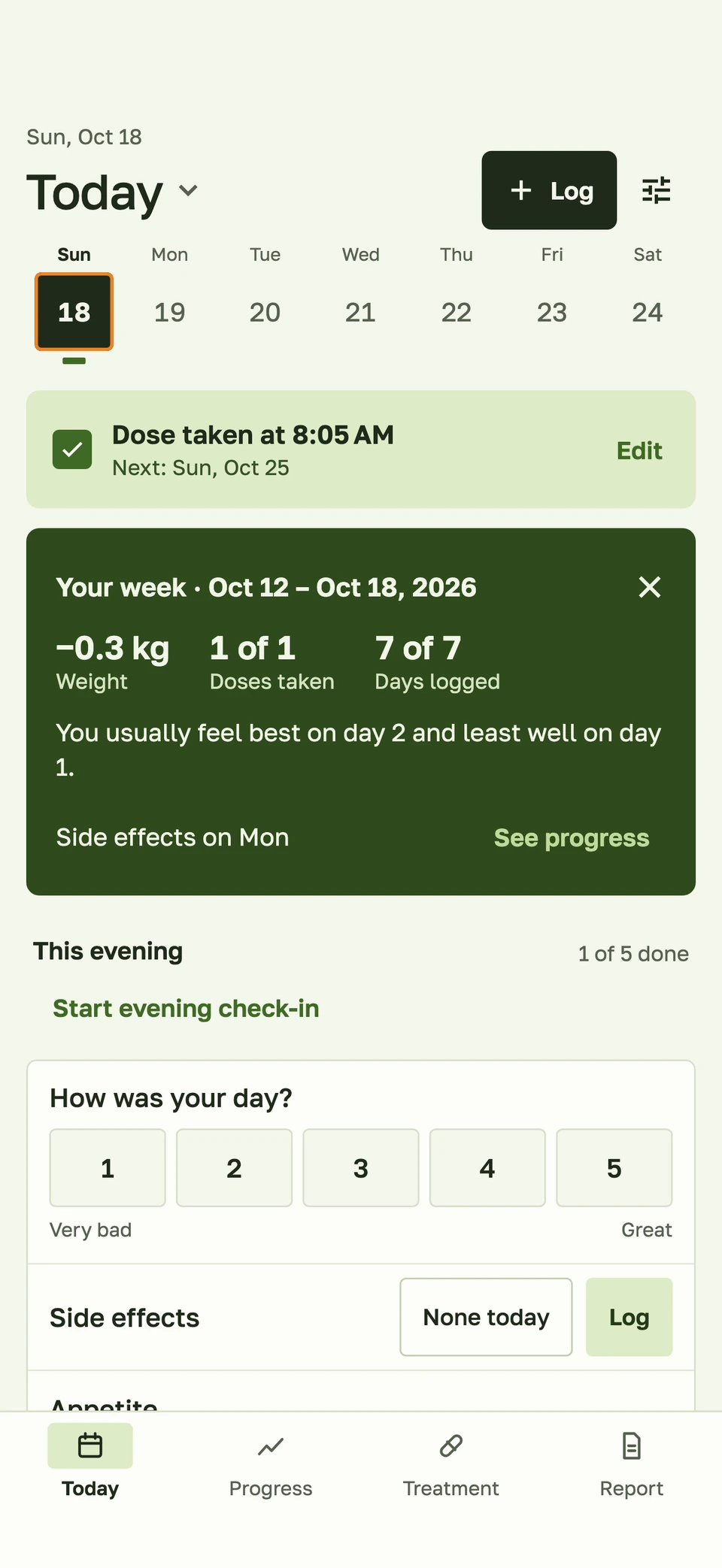
Weekly view. The Progress screen can show your weight by week. Each dot is your average for that week, so daily ups and downs don't hide the trend. Dose changes appear on the chart, and if your weight has stayed about the same for a while, the app says so plainly and notes that plateaus are common. A short "Your week" summary shows weight change, doses taken, days logged and side effect days. You can also set a weigh-in reminder.

Apple Health and Health Connect. If you use a smart scale, you can connect Apple Health (iPhone) or Health Connect (Android). Vistadose then reads your weight, and your height if your profile has none. It only reads, on your phone. Nothing is written back.

Protein, fiber and water. Simple daily counters for water and protein, with an optional daily protein goal. The food log adds fiber, and a weekly view shows your protein and fiber averages.
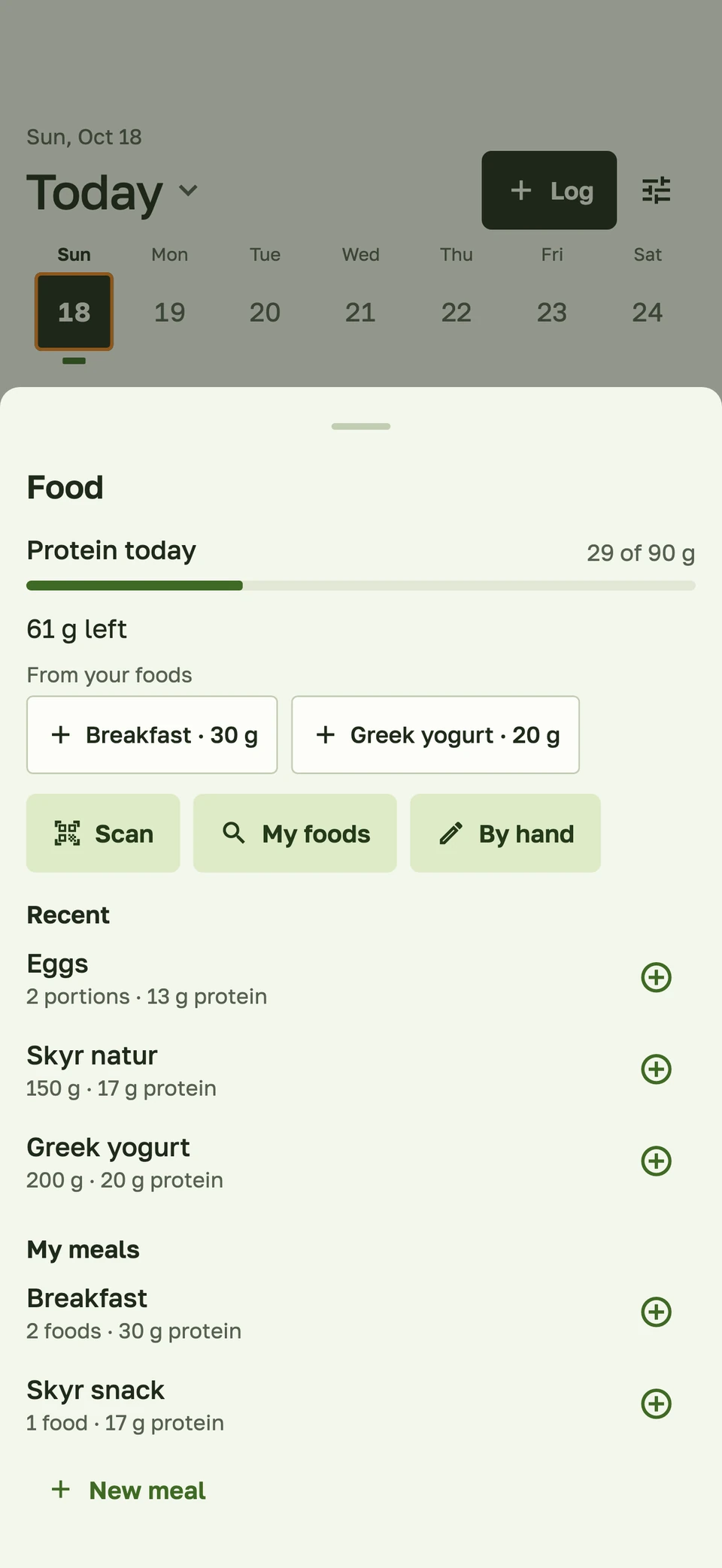
Food sheet in Vistadose showing protein today against a daily goal, with recent foods and saved meals
Protein today against your own daily goal, with recent foods one tap away.

Progress photos. A photo now and then shows changes the scale can miss. The free version keeps up to 5 photos. Photos are encrypted on the phone and never show in widgets or notifications.

Vistadose Plus. Plus adds unlimited photos with side-by-side comparison, deeper insights and a comparison of your weight curve with published clinical trial averages for semaglutide, tirzepatide, liraglutide and orforglipron at the doses studied. Read it as context, not a target. Trial averages come from groups of people, and individual results differ.
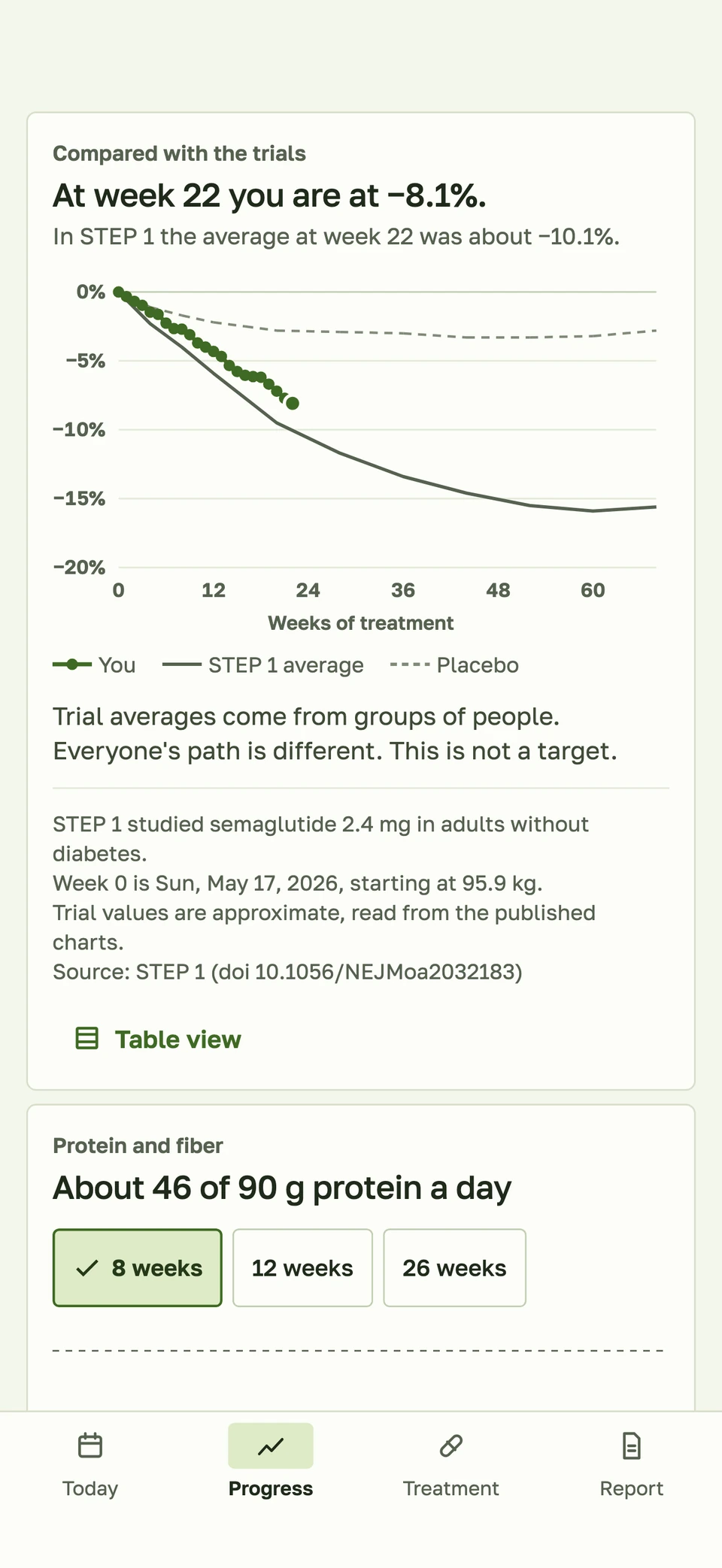
Vistadose Progress screen comparing a weekly weight curve with a published trial average and placebo
Plus: your weekly weight change next to a published trial average. Context, not a target.

Privacy. No account, no ads. Your entries are kept in an encrypted database on your phone. Weight is never shown on the lock screen.

Before your next visit, the doctor report pulls this together. Our appointment checklist explains what to bring.

Learn more at apps.lypii.nl/vistadose or download Vistadose for iPhone or Android.

FAQ

How often should I weigh myself on a GLP-1 medicine? Once a week is enough for most people. If you weigh more often, judge the trend by the weekly average, not by single days. Ask your doctor if they prefer something else.

Why did my weight go up even though I took my dose? Day-to-day changes are mostly water, food and salt. Look at the weekly average over several weeks. The US National Institute of Diabetes and Digestive and Kidney Diseases notes that results vary by medication and by person.

Should I track my waist as well as my weight? It helps. Waist size can change when the scale doesn't, and it takes a minute every few weeks.

Does Vistadose share my weight with Apple Health or Health Connect? No. If you connect them, Vistadose only reads weight and height. It never writes anything back.

Vistadose is not a medical device and does not replace advice from your doctor.
Lypii Apps
Vistadose

A Weekly GLP-1 Weight Log: What to Record

How to keep a GLP-1 weight log that means something: weigh the same way each time, read weekly averages and note waist, labs, protein and dose changes.

If you take semaglutide, tirzepatide, liraglutide, dulaglutide or another GLP-1 medicine, your doctor will probably ask about your weight at every visit. A GLP-1 weight log makes that question easy to answer. Not with one number from this morning, but with a calm picture of the last few weeks.

This guide covers how to weigh so the numbers are comparable, why a weekly view tells you more than daily readings, and what else is worth writing down next to the scale. It works with a notebook. At the end we show how Vistadose handles each part.

One thing first. Weight is one data point among many. It says nothing about your worth, and it is not the only sign of how treatment is going. Keep the log as information to discuss with your doctor, not as a scorecard.

How to weigh so the numbers mean something

Your body weight moves through the day. Food, drink, salt, a bowel movement, a hard workout or a late meal can shift the scale by a kilo or more. You can't remove that noise, but you can stop adding to it.

  • Same time. Most people pick the morning, after using the toilet and before eating or drinking.
  • Same scale. Two scales rarely agree. Use one, on a hard, flat floor, in the same spot.
  • Same clothes. Ideally none, or the same light layer each time.
  • Same conditions. If you weigh on dose day, keep doing it on dose day. If you skip a morning, just skip it. Don't weigh again in the evening to "make up" for it.

Write the number down straight away. If something unusual happened (a salty dinner, a stomach bug, travel), add a short note.

Why a weekly weigh-in view beats daily swings

Daily numbers zigzag. A reading that is up 0.8 kg on Tuesday is usually water, not body fat, and it can sour your day for no reason.

A weekly view fixes this. You have two options:

  1. Weigh once a week on the same day, under the same conditions. Simple and low effort.
  2. Weigh more often and look at the weekly average. More data points, but you judge the trend by the average, never by a single day.

Either way, compare week with week. A weekly weigh-in makes stalls and changes easier to see, and it gives your doctor something steadier to look at. Long flat stretches are common during treatment, so a few weeks at the same weight is worth noting, not worrying about.

What else to record next to your weight

The scale can't tell you everything. These extra notes make your GLP-1 weight log far more useful at an appointment.

Waist and other body measurements

A tape measure picks up changes the scale can miss. The US National Heart, Lung, and Blood Institute explains how to measure your waist correctly: stand, place the tape just above your hip bones, and read it after you breathe out. The NHS also uses waist size compared with your height as a simple health check. Measure every two to four weeks, at the same time of day, in the same place on your body. A body measurements log can also hold blood pressure or glucose if your doctor wants those.

Lab results your doctor asks for

If you get blood tests, note the date and the values you were given, such as HbA1c or cholesterol. A short dated list saves you hunting through old letters before a visit.

Protein, fiber and water

GLP-1 medicines often reduce appetite, and smaller meals can mean less protein, fiber and fluid. A joint advisory from four US obesity and nutrition societies lists adequate protein and strength training to help preserve lean mass among its priorities during treatment. You don't need to count every calorie. A rough daily total of protein, plus a note on fiber and how many glasses of water you had, already shows patterns. Ask your doctor or a dietitian what amounts suit you.

Appetite and side effects

Rate your appetite on a simple 0 to 10 scale once a day. Note nausea, constipation or tiredness when they happen. Many people see a pattern across the week after a dose, which helps explain why eating looks different on certain days. Our side effect diary guide covers this in more detail.

Dose changes

Write down the date of every change to the doses your doctor prescribed, plus any missed or late doses. Without these, it's hard to read the weight trend. With them, you and your doctor can see what happened at each step. A separate GLP-1 injection log is the easiest way to keep these dates.

A sample week in a GLP-1 weight log

Here is what one week could look like on paper. The numbers are made up.

Day Weight Notes
Mon (dose day) 88.4 kg Dose taken 8:00. Appetite 6/10. Protein about 70 g, 6 glasses water.
Tue 88.1 kg Mild nausea after lunch. Appetite 3/10. Protein about 45 g.
Wed 88.6 kg Salty takeaway last night. Appetite 4/10.
Thu 88.0 kg Felt fine. Walked 40 min. Protein about 65 g.
Fri not weighed Away from home.
Sat 87.9 kg Waist 98 cm (monthly check).
Sun 88.0 kg Appetite 6/10. 8 glasses water.

Weekly average: 88.2 kg, compared with 88.6 kg the week before. Worth mentioning to the doctor: nausea on Tuesday, lower protein on days 2 and 3.

Notice that Wednesday looks like a jump. The note explains it, and the average barely moves. That is the whole point of a weekly view.

How Vistadose helps

Vistadose is a GLP-1 medication companion, not a diet app. Weight is one part of it, next to doses, side effects and your doctor report.

Weight and measurements. Log your weight in a couple of taps. You can also track body measurements (waist, blood pressure, glucose) and lab results such as HbA1c and cholesterol, with the date of the lab report.

Weekly view. The Progress screen can show your weight by week. Each dot is your average for that week, so daily ups and downs don't hide the trend. Dose changes appear on the chart, and if your weight has stayed about the same for a while, the app says so plainly and notes that plateaus are common. A short "Your week" summary shows weight change, doses taken, days logged and side effect days. You can also set a weigh-in reminder.

Apple Health and Health Connect. If you use a smart scale, you can connect Apple Health (iPhone) or Health Connect (Android). Vistadose then reads your weight, and your height if your profile has none. It only reads, on your phone. Nothing is written back.

Protein, fiber and water. Simple daily counters for water and protein, with an optional daily protein goal. The food log adds fiber, and a weekly view shows your protein and fiber averages.

Food sheet in Vistadose showing protein today against a daily goal, with recent foods and saved meals
Protein today against your own daily goal, with recent foods one tap away.

Progress photos. A photo now and then shows changes the scale can miss. The free version keeps up to 5 photos. Photos are encrypted on the phone and never show in widgets or notifications.

Vistadose Plus. Plus adds unlimited photos with side-by-side comparison, deeper insights and a comparison of your weight curve with published clinical trial averages for semaglutide, tirzepatide, liraglutide and orforglipron at the doses studied. Read it as context, not a target. Trial averages come from groups of people, and individual results differ.

Vistadose Progress screen comparing a weekly weight curve with a published trial average and placebo
Plus: your weekly weight change next to a published trial average. Context, not a target.

Privacy. No account, no ads. Your entries are kept in an encrypted database on your phone. Weight is never shown on the lock screen.

Before your next visit, the doctor report pulls this together. Our appointment checklist explains what to bring.

Learn more at apps.lypii.nl/vistadose or download Vistadose for iPhone or Android.

FAQ

How often should I weigh myself on a GLP-1 medicine? Once a week is enough for most people. If you weigh more often, judge the trend by the weekly average, not by single days. Ask your doctor if they prefer something else.

Why did my weight go up even though I took my dose? Day-to-day changes are mostly water, food and salt. Look at the weekly average over several weeks. The US National Institute of Diabetes and Digestive and Kidney Diseases notes that results vary by medication and by person.

Should I track my waist as well as my weight? It helps. Waist size can change when the scale doesn't, and it takes a minute every few weeks.

Does Vistadose share my weight with Apple Health or Health Connect? No. If you connect them, Vistadose only reads weight and height. It never writes anything back.

Vistadose is not a medical device and does not replace advice from your doctor.

ABOUT THIS APPVistadoseKeep a private record of your GLP-1 doses, injection sites and side effects. See how you feel between doses and bring a PDF report to your next appointment.
SHARE
Lypii AppsContact
Vistadose

A Weekly GLP-1 Weight Log: What to Record

How to keep a GLP-1 weight log that means something: weigh the same way each time, read weekly averages and note waist, labs, protein and dose changes.

If you take semaglutide, tirzepatide, liraglutide, dulaglutide or another GLP-1 medicine, your doctor will probably ask about your weight at every visit. A GLP-1 weight log makes that question easy to answer. Not with one number from this morning, but with a calm picture of the last few weeks.

This guide covers how to weigh so the numbers are comparable, why a weekly view tells you more than daily readings, and what else is worth writing down next to the scale. It works with a notebook. At the end we show how Vistadose handles each part.

One thing first. Weight is one data point among many. It says nothing about your worth, and it is not the only sign of how treatment is going. Keep the log as information to discuss with your doctor, not as a scorecard.

How to weigh so the numbers mean something

Your body weight moves through the day. Food, drink, salt, a bowel movement, a hard workout or a late meal can shift the scale by a kilo or more. You can't remove that noise, but you can stop adding to it.

  • Same time. Most people pick the morning, after using the toilet and before eating or drinking.
  • Same scale. Two scales rarely agree. Use one, on a hard, flat floor, in the same spot.
  • Same clothes. Ideally none, or the same light layer each time.
  • Same conditions. If you weigh on dose day, keep doing it on dose day. If you skip a morning, just skip it. Don't weigh again in the evening to "make up" for it.

Write the number down straight away. If something unusual happened (a salty dinner, a stomach bug, travel), add a short note.

Why a weekly weigh-in view beats daily swings

Daily numbers zigzag. A reading that is up 0.8 kg on Tuesday is usually water, not body fat, and it can sour your day for no reason.

A weekly view fixes this. You have two options:

  1. Weigh once a week on the same day, under the same conditions. Simple and low effort.
  2. Weigh more often and look at the weekly average. More data points, but you judge the trend by the average, never by a single day.

Either way, compare week with week. A weekly weigh-in makes stalls and changes easier to see, and it gives your doctor something steadier to look at. Long flat stretches are common during treatment, so a few weeks at the same weight is worth noting, not worrying about.

What else to record next to your weight

The scale can't tell you everything. These extra notes make your GLP-1 weight log far more useful at an appointment.

Waist and other body measurements

A tape measure picks up changes the scale can miss. The US National Heart, Lung, and Blood Institute explains how to measure your waist correctly: stand, place the tape just above your hip bones, and read it after you breathe out. The NHS also uses waist size compared with your height as a simple health check. Measure every two to four weeks, at the same time of day, in the same place on your body. A body measurements log can also hold blood pressure or glucose if your doctor wants those.

Lab results your doctor asks for

If you get blood tests, note the date and the values you were given, such as HbA1c or cholesterol. A short dated list saves you hunting through old letters before a visit.

Protein, fiber and water

GLP-1 medicines often reduce appetite, and smaller meals can mean less protein, fiber and fluid. A joint advisory from four US obesity and nutrition societies lists adequate protein and strength training to help preserve lean mass among its priorities during treatment. You don't need to count every calorie. A rough daily total of protein, plus a note on fiber and how many glasses of water you had, already shows patterns. Ask your doctor or a dietitian what amounts suit you.

Appetite and side effects

Rate your appetite on a simple 0 to 10 scale once a day. Note nausea, constipation or tiredness when they happen. Many people see a pattern across the week after a dose, which helps explain why eating looks different on certain days. Our side effect diary guide covers this in more detail.

Dose changes

Write down the date of every change to the doses your doctor prescribed, plus any missed or late doses. Without these, it's hard to read the weight trend. With them, you and your doctor can see what happened at each step. A separate GLP-1 injection log is the easiest way to keep these dates.

A sample week in a GLP-1 weight log

Here is what one week could look like on paper. The numbers are made up.

Day Weight Notes
Mon (dose day) 88.4 kg Dose taken 8:00. Appetite 6/10. Protein about 70 g, 6 glasses water.
Tue 88.1 kg Mild nausea after lunch. Appetite 3/10. Protein about 45 g.
Wed 88.6 kg Salty takeaway last night. Appetite 4/10.
Thu 88.0 kg Felt fine. Walked 40 min. Protein about 65 g.
Fri not weighed Away from home.
Sat 87.9 kg Waist 98 cm (monthly check).
Sun 88.0 kg Appetite 6/10. 8 glasses water.

Weekly average: 88.2 kg, compared with 88.6 kg the week before. Worth mentioning to the doctor: nausea on Tuesday, lower protein on days 2 and 3.

Notice that Wednesday looks like a jump. The note explains it, and the average barely moves. That is the whole point of a weekly view.

How Vistadose helps

Vistadose is a GLP-1 medication companion, not a diet app. Weight is one part of it, next to doses, side effects and your doctor report.

Weight and measurements. Log your weight in a couple of taps. You can also track body measurements (waist, blood pressure, glucose) and lab results such as HbA1c and cholesterol, with the date of the lab report.

Weekly view. The Progress screen can show your weight by week. Each dot is your average for that week, so daily ups and downs don't hide the trend. Dose changes appear on the chart, and if your weight has stayed about the same for a while, the app says so plainly and notes that plateaus are common. A short "Your week" summary shows weight change, doses taken, days logged and side effect days. You can also set a weigh-in reminder.

Apple Health and Health Connect. If you use a smart scale, you can connect Apple Health (iPhone) or Health Connect (Android). Vistadose then reads your weight, and your height if your profile has none. It only reads, on your phone. Nothing is written back.

Protein, fiber and water. Simple daily counters for water and protein, with an optional daily protein goal. The food log adds fiber, and a weekly view shows your protein and fiber averages.

Food sheet in Vistadose showing protein today against a daily goal, with recent foods and saved meals
Protein today against your own daily goal, with recent foods one tap away.

Progress photos. A photo now and then shows changes the scale can miss. The free version keeps up to 5 photos. Photos are encrypted on the phone and never show in widgets or notifications.

Vistadose Plus. Plus adds unlimited photos with side-by-side comparison, deeper insights and a comparison of your weight curve with published clinical trial averages for semaglutide, tirzepatide, liraglutide and orforglipron at the doses studied. Read it as context, not a target. Trial averages come from groups of people, and individual results differ.

Vistadose Progress screen comparing a weekly weight curve with a published trial average and placebo
Plus: your weekly weight change next to a published trial average. Context, not a target.

Privacy. No account, no ads. Your entries are kept in an encrypted database on your phone. Weight is never shown on the lock screen.

Before your next visit, the doctor report pulls this together. Our appointment checklist explains what to bring.

Learn more at apps.lypii.nl/vistadose or download Vistadose for iPhone or Android.

FAQ

How often should I weigh myself on a GLP-1 medicine? Once a week is enough for most people. If you weigh more often, judge the trend by the weekly average, not by single days. Ask your doctor if they prefer something else.

Why did my weight go up even though I took my dose? Day-to-day changes are mostly water, food and salt. Look at the weekly average over several weeks. The US National Institute of Diabetes and Digestive and Kidney Diseases notes that results vary by medication and by person.

Should I track my waist as well as my weight? It helps. Waist size can change when the scale doesn't, and it takes a minute every few weeks.

Does Vistadose share my weight with Apple Health or Health Connect? No. If you connect them, Vistadose only reads weight and height. It never writes anything back.

Vistadose is not a medical device and does not replace advice from your doctor.

ABOUT THIS APPVistadoseKeep a private record of your GLP-1 doses, injection sites and side effects. See how you feel between doses and bring a PDF report to your next appointment.
SHARE